This week’s message (Friday 02 July 2021)

Salve!

This week’s message begins with the Latin word for ‘hello’, because we’ve some news about a change to our curriculum next year…

From September, children in Key Stage 2 (Years 3-6) will learn Latin as the Foreign Language part of the National Curriculum. This might come as a bit of a surprise to some of you, with many wondering why switch to an ancient language. Here, we present three reasons, but there are plenty of others.

Learning some Latin will support learning other languages in the future. About 80% of words in Romance languages such as French, Spanish and Italian come from Latin. The Latin for ‘bread‘ is ‘panem‘. Learning this means your child should more easily recognise and remember the word for bread in French (pain), Spanish (pan) or Italian (pane).

Linked to this is what your child will learn when they move to secondary school. In Year 7, your child might learn French, or Spanish, or German… in most cases, there won’t be much choice, and different secondary schools offer different languages for Year 7 students. Latin provides a really useful basis to learn other languages. (And most secondary schools start from scratch anyway, so Latin will be a good grounding.)

A third reason is that learning some Latin will help to enhance your child’s understanding in English, too. About two thirds of English words are derived from Latin, so your child will be more confident when they come across a new word in English if they can recognise parts of it. Here’s an example. The Latin word for ‘father’ is ‘pater‘, which gives us lots of English words, such as paternal, patronise and patriarchy. ‘Mother’ is ‘mater‘ – what words derive from ‘mater‘?

We’ve spoken to a few parents about this already, and the reaction has been really positive. If you’d like to find out more, we’re hosting a live Zoom discussion next week: 6pm on Thursday 08 July (we’ve deliberately avoided Wednesday in anticipation of some important event that night – it’s coming home…!). If you’d like to attend, please contact [email protected]

Finally this week, a big thank you to all of you who completed this year’s annual survey. We’ll spend some time over the next few weeks looking at the results, and we’ll update you later in the year.

Quia nunc vale!

25 June 2021

This week’s spelling are words ending in the ‘est’ suffix.


fast – fastest

happy – happiest

long – longest

short – shortest

silly – silliest

muddy – muddiest

tall – tallest

tasty – tastiest

Remember, when the word ends in a ‘y’, drop the ‘y’, add an ‘i’ and add ‘est’.

This week’s message (Friday 25 June 2021)

This week’s message has three new messages and a reminder…

Holidays

The 2021-22 school year has been officially shortened by one day to take into account the extra bank holiday for the Queen’s Platinum Jubilee.

The 2021-22 school year is 194 days. Leeds has decided that schools will break up for summer on Tuesday 26 July 2022 instead of Wednesday 27 July. This ensures that pupils and staff all benefit from the extra public holiday, even though it falls during the May half term break.

We had a training day booked on this day that we’ve moved. The holidays and training days for next year are all in our school calendar.

Please remember…

…to spend just a few minutes completing this year’s annual survey. The survey’s open until Wednesday 30 June so you’ve still got a few days. Thank you to all the parents / carers who have responded so far.

Staying safe online: FIFA 21

The European Football Championships are well underway. Your child might be reaching for the online game FIFA 21 to virtually recreate the sort of shots, passes and saves they’ve watched their real-life heroes pull off on TV. In the popularity league table, FIFA is the Real Madrid of football games – some seasons are better than others, but it’s never away from the summit for long.

FIFA doesn’t include inappropriate content or violence (apart from the odd reckless sliding tackle!). However, do be aware of risks such as in-game purchases, over-competitiveness and the possibility of becoming addicted. Read more about FIFA 21.

Finally, a short message that we emailed earlier in the week…

Stay safe

The number of pupils absent because of a potential contact with Covid-19 in school has quadrupled in just one week. In our own schools, and in lots of schools around us, there’s been a notable rise in Covid cases – more now than ever before.

Please keep your child at home if:

  • they’ve any of the recognised Covid symptoms
  • they just don’t feel quite right (a headache, feeling sick, particularly tired…)

And an update to this, following an email to schools from Leeds City Council…

As you are no doubt aware, the Delta variant of Covid-19 is now the most prevalent form of the virus in Leeds. The Zoe Covid Symptom Study, the largest ongoing global study of Covid-19, has highlighted that a headache, sore throat and runny nose are now the most common symptoms of the Delta variant, instead of a cough and loss of smell, although fever is still common.

Enjoy your weekend, whatever you and those around you get up to.

Super skills and stamina – you must check this out…

We know our children are talented in school – amazing artists, marvellous mathematicians, superb scientists. We like to hear about the talents and triumphs out of school, too.

Edris in Year 5 has stunned staff today with her climbing skills. This short clip is so impressive in terms of grip and determination. Check out how high she climbs in this clip – you might get dizzy, it’s so high!

For the past 18 months, Edris has been training four hours each week as part of the Leeds Climbing Academy, a selective squad funded by Sport England to develop UK competitive climbers at grass roots.

Well done, Edris!

18 June 2021

In lessons, the children have been learning another key spelling rule: drop the e for ing.  All of the words in the list are verbs.

Before the suffix ing is added to the verb, the e needs to be removed.


  • to have                     having
  • to hike                      hiking
  • to write                    writing
  • to use                        using
  • to make                   making
  • to like                       liking
  • to give                      giving
  • to excite                  exciting


This week’s message (Friday 18 June 2021)

So, unsurprisingly, lockdown restrictions won’t be lifted on 21 June. This week’s message is mainly about the current topic learning in Years 1 to 6 – Design and Technology is the main driver. We start with a Covid-related point and end with a quick reminder about something else!

Monday’s announcement from the Prime Minister

The Prime Minister announced on Monday that current restrictions remain in place. Schools have been advised by the Department for Education to keep current protective measures in place until there is a further announcement on Step 4 of the roadmap. These measures in education settings will remain in place to help reduce transmission of the virus. Subsequent guidance does allow a little bit of flexibility. We’re waiting for more guidance from Leeds Health and Safety advisors to see if any end-of-year events such as Sports Day can happen in some way, although in their typical form that won’t happen.

The rest of this message comes from Mr Wilks, who works at Moortown Primary but is our curriculum leader across all three Sphere Federation schools for Science and Foundation subjects…

Our current topic is all about Design and Technology

Design and Technology is the driving subject for this half-term and it’s a great topic to finish the year! The focus for all classes this year is construction (next year, it’s textiles) so children will be busy designing and making structures, prototypes and products.

A key aspect of the Design and Technology curriculum is the understanding that products don’t just get made. Instead, they go through a design process that includes three key elements: evaluate, design and make. Think of this process as a cycle. For example, Sphere Motors want to create a new family car. Before the car is made, they need to evaluate existing products and talk to customers so that they’re clear about what the new car needs to have. They will then design the car and evaluate those designs. They may make a prototype of the car to help them evaluate the designs. Next, they’ll decide on a final design that will go into production and get made. This finished product will be evaluated and the whole process starts again.

Years 1 and 2 children will be designing, making and evaluating different structures and in doing so, learning about how structures can be strengthened and made more stable. They’ll evaluate real life structures like bridges and towers which will inform their designs.

Years 3,4 children will be creating a prototype of a go-kart using a construction system called TechCard. They’ll evaluate existing products before designing, building, testing and evaluating their own. We will even try to incorporate electric circuits into our designs to power the go-karts.

Years 5,6 children have been set a tricky task of creating a vehicle that can transport an egg (specific tests will be determined by the children) without it breaking. They’ll be using a range of tools (including saws, hammers, drills) to make their product.

In addition to this, children will learn a little about key inventions and designers through history.

Read our Curriculum Statement. On page 17, you’ll find the age-related expectations for the topic. The vocabulary that your child will learn is here:

Years 1 and 2

  • design: a plan or drawing showing what something will look like before it is made
  • design criteria: the things a product must have to be successful
  • design brief: a description of what a new product should do
  • base: the bottom part of an object; the part on which something rests
  • to evaluate: to decide, after careful consideration, how good or bad something is
  • structure: a combination of materials and/or parts to create a 3d shape
  • stable: something that is unlikely to fall down or collapse
  • freestanding: something that stands up by itself
  • to plan: to think about and decide how you’re going to do something

Years 3 and 4

  • product: something that is designed and made to be sold
  • function: the purpose of something
  • design process: the series of steps that need to happen for a product to go from an idea to a finished product
  • design criteria: the precise features a product must have in order to be successful
  • prototype: an early sample or model of a product used to evaluate a design
  • component: a part that combines with other parts to make something eg a machine or a piece of equipment
  • annotated sketch: a detailed sketch labelled with notes (eg dimensions, materials)
  • exploded diagram: a drawing that shows the individual components or parts of a product and how they fit together
  • mechanism: a number of parts or components working together, usually as part of a machine

Years 5 and 6

  • design process: the series of steps that need to happen for a product to go from an idea to a finished product
  • design criteria: the precise features a product must have in order to be successful
  • cross-sectional diagram: a drawing which ‘slices through’ an object to see some of the features inside
  • computer-aided design (CAD): a way of drawing on a computer to visualise designs and simulating them to see how they work
  • innovative: an adjective to describe a new or original idea about how something can be done
  • sustainable material: obtained from renewable sources and do not damage the environment when produced
  • dimensions: measurement of something in a particular direction, eg height, length, width
  • aesthetic: something about the appearance
  • to reinforce: to strengthen or support

Survey

Don’t forget to spend just a few minutes completing this year’s annual survey. We’re always keen to hear your views. Although we can’t guarantee that we can act on every point raised, we do closely consider all the survey results.

The survey’s open until Wednesday 30 June.


Last week’s message ended with talk of ice-cream and sunny weather over the weekend. This weekend looks like being a bit different to that – have a good one, all the same.

11 June 2021

For this week’s spellings, we were looking at spelling the /o/ phoneme with an ‘a’ after a ‘w’.

We were also looking at spelling the /ir/ phoneme with an ‘or’ after a ‘w’.

watch

wasp

swamp

wallet

worm

worth

word

world

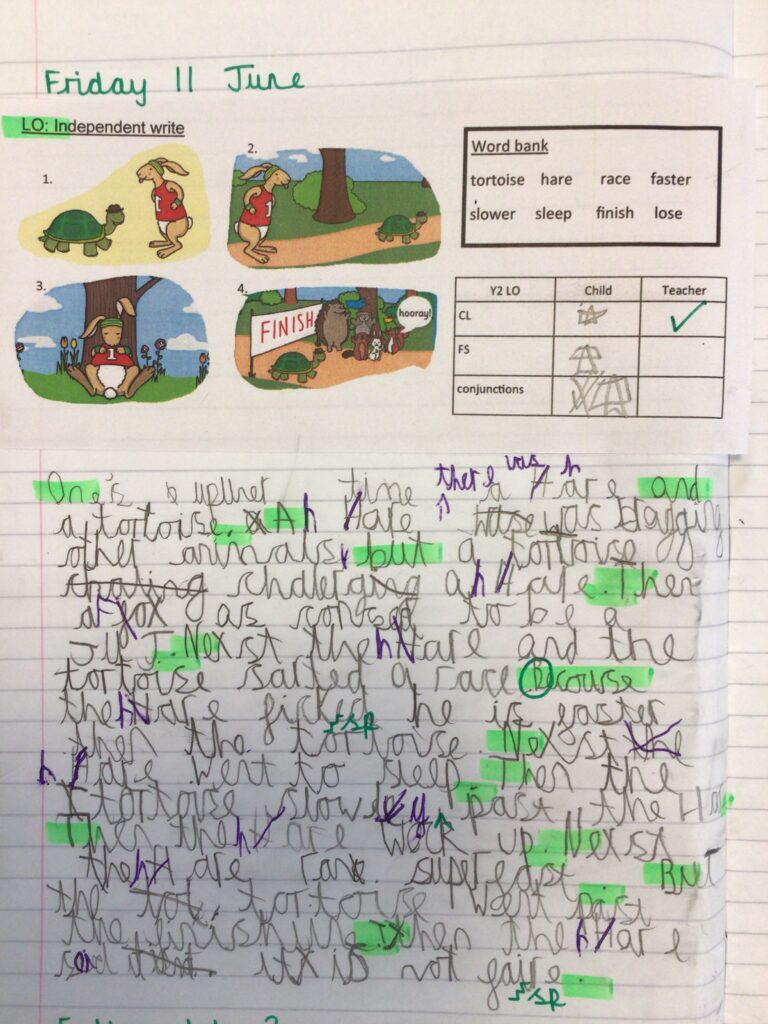
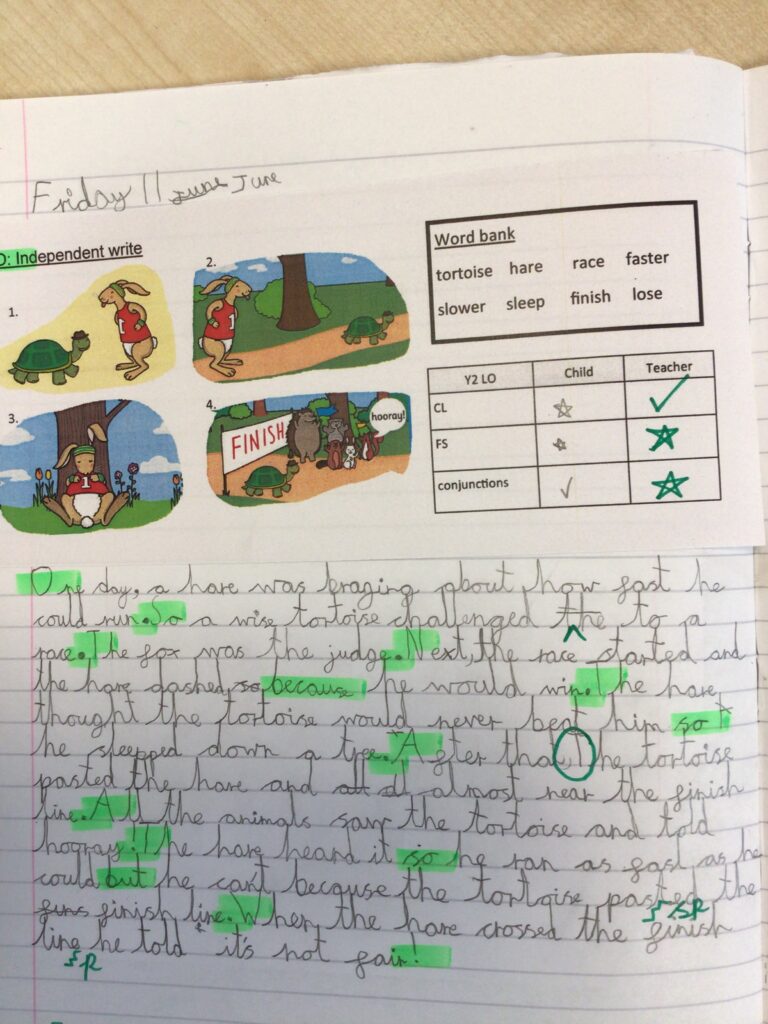
The Tortoise and the Hare

Last week, the children were focusing on Aesop’s fables. We read a few of them throughout the week. The one we focused on the most was, The Tortoise and the Hare. Once the children had listened and read the story, they worked as group to sequence it using pictures and captions.

Then, the children moved on to creating their own story map. Here are a few examples of their brilliant work.

Finally, the children retold the story in their own words. Take a look at some of the amazing examples.

This week’s message (Friday 11 June 2021)

What a difference the sunshine makes! It was such a pleasure to enjoy a happy and healthy half-term break with the end to what started to seem like interminable rain.

Surveys

Every year, we invite you to let us know how we’re doing via the annual survey of parents /carers. This year’s survey is now open.

The first part of the survey is about some of the changes we’ve made due to Covid – we’re especially interested to hear your views about homework. The second part is more general and includes statements which you might be familiar with from previous surveys.

It should only take about 5-10 minutes to complete. Lots of the questions need only a tick answer. Most responses are optional so you can miss out a question if you’ve no particular opinions. There are only a few (marked with a red asterisk*) where a response is needed.

We’re always keen to hear your views. We do closely consider all the survey results, although we can’t guarantee that we can act on every point raised (this year, because of Covid, that’s been especially difficult).

The survey helps us to gain a broad overview of how we’re doing. For more specific questions, comments and concerns, it’s always best to speak with your child’s class teacher or Mrs Weekes. The survey isn’t the right forum to raise a very specific point.

The survey’s open until Wednesday 30 June, so you’ve plenty of time to leave your views.

Amazing attendance

For the first five half-terms, our overall attendance figure is 97.6% – that’s a fantastic figure. Thank you for helping your child to attend school as much as they can.

With attendance over 98%, well done especially to Reception, Year 1 and Year 2!

Our new parent governor

In case you missed our earlier message, our new parent governor is Mr Andy Sammons (Candidate 2), whose child attends Scholes (Elmet) Primary.
The election closed on Friday just before the half-term holiday with 89 votes cast overall.

Thank you to both candidates for standing in the parent governor elections.

End of year events

There’s a lot of uncertainty about 21 June – the final date in the government’s roadmap out of lockdown. This makes it hard to plan for events and activities such as Sports Day, Y5,6 productions and Leavers’ Assembly. These are all still pencilled in, but we’ll have to wait and see whether they can go ahead as normal or whether they need to be adapted (like having a Sports Day but without spectators) or even cancelled.

Enjoy the weekend. Mrs Weekes and I might both indulge in an ice-cream… one of us rates strawberry as a top choice; the other one always opts for the most unusual flavour on a menu (basil being a recent taste triumph). Can you work out who’s more traditional and who’s more adventurous (at least in terms of ice-cream)?!