Autumn 2: Week 7

I think I speak for everyone when I say how proud we are of our wonderful reception class for their fabulous singing during the nativity performance. They did such a fantastic.

Alongside our performance this week, we have made Christmas hats, completed jiqsaws, built models and danced at our Christmas party.

Thank you for all the wonderful gifts you have given.

Enjoy your Christmas break and we look forward to seeing you all back in the new year.


Reception Team


Our weekly message: Friday 13 December

Next week’s the last week before we break up for Christmas. It’s a busy week, so please check our school calendar. We’ve noticed a few children appear more tired than usual so make sure your child gets plenty of sleep so they can enjoy the last week.

At Moortown Primary, we’ve a schedule of visits for each class in school. This week, it was the turn of the Y5 and Y6 children to go on a visit – they went to the Leeds Discovery Centre and the Royal Armouries:

  • ‘The workshops were great and we saw some real artefacts that were about Ancient Egypt.’
  • ‘We even held a piece of rock that was used in one of the Egyptian pyramids.’
  • ‘When we went into the Armouries, we saw lots of things to do with war and this will be a topic later in the year so that was really interesting.’
  • ‘There was a bit of time where we could go in the store room and we saw a real ‘mummy’ – not sure if it was real but it looked it!’

Keep reading!

Even during all the excitement in the run up to the Christmas holidays, we continue to teach Phonics lessons and maintain as many reading practice sessions as we can in Early Years and Key Stage 1. You can help at home by reading to or with your child during the Christmas holidays. It’s a wonderful way for children to relax, explore their imagination and continue learning. Stories about winter adventures, festive traditions, or magical journeys can spark creativity and deepen their love for books. Reading also strengthens vocabulary, comprehension, and critical thinking, keeping young minds active while school is out. It’s a great opportunity to bond over shared stories or bedtime tales. Encourage your child to pick a book they’ll love – whether it’s about reindeer, snowmen, or elves – and make reading a cosy, fun holiday tradition this Christmas!

Staying healthy in the winter months

The UK Health Security Agency has published advice on how to reduce the spread of winter illnesses.

Please remember to follow NHS guidance to know when a child is too ill for school. Pupils should not miss school ‘just in case’ – they can normally attend school with a cough or cold, but not with a fever or diarrhoea and vomiting.

Talk to your child about staying safe online

Most of us tend to think of our online and offline lives as separate, but children today are growing up with technology and the internet as a natural part of their lives. To them there isn’t a separation. It’s all just life. The internet is now part of the real world.

Talking to your child about what they do online is just as important as asking where they are going when they go out with their friends. It can be difficult starting the conversation with your child about their online activities. Technology keeps changing and you might find it overwhelming trying to keep up with it all, but you don’t need to. You just need to take an interest in what apps and games your child is using. That’s the best place to start. Your child might not want to share anything with you at first, but keep trying.

Having honest and open conversations with your child and speaking to them regularly about what they’re doing online could be crucial in giving your child the confidence to tell you if they’ve seen something that makes them feel uncomfortable or may highlight someone who is wanting to cause harm.

Further guidance is available on the LSCP website as well as information on how to set up parental control on all the devices that your child uses.


We’ll end on a highlight of Mrs Weekes’ week…

‘Having my Christmas lunch with Year 5. I found out what they were up to over the Christmas holidays, which family they were meeting up with, and chatting about what other families do if they don’t celebrate Christmas. It was a lovely conversation and a lovely way to spend my lunchtime!’

Autumn 2: Week6

This week, we have been completing challenges, writing postcards to Santa and practising our nativity.

The children enjoyed completing the different challenges in the classroom and sharing them with others. They have been developing their fine motor skills by cutting shapes; developing their writing skills by writing letters to Santa; sequencing stories in the reading area and making pictures with our 2d shapes.

On Thursday, the children enjoyed their Christmas dinner.

Help at home: by identifying 2d shapes in the local environment.

Remember: our nativity is on Tuesday and Wednesday of next week.

This week and next are review weeks for phonics so there will be no phonic sheet sent home.

I am however sending home a wow sheet. This is for you to complete at home if there is anything wow that happens and you would like to share. I will send one home every half term. If you would like any in addition to this please let me know.

We are making a book of our families. Please can you email or send in a picture of your family.

Our weekly message: Friday 06 December

We loved getting some feedback from Scott hall Leisure Centre this week: ‘I just wanted to take the time to compliment both your pupils and the teachers… on their conduct each and every week whilst in the reception area/changing rooms and, of course, during their lesson. They are a credit to your school.’

Christmas

Stuck for a gift idea? Check out the National Book Tokens website: book recommendations (for adults and children), activities, and a chance to win a £100 book token!

It’s a busy time of the year but have a look at this Leeds guide for free and low-cost things to do this winter – from opportunities to meet Santa to a chance to enjoy a festive mystery matinee.

It’s the countdown to Christmas, but there’s still lots of learning to prioritise, too. Keeping daily routines helps your child to manage such an exciting time. Please remember to stick with our Uniform Policy.

Measles

Did you know measles is on the rise in this area? Measles is highly infectious. It can lead to serious complications including fits, damage to the brain, or even worse. Unvaccinated children are most at risk of severe complications from measles. Check out this information from Leeds LA, covering symptoms and how best to protect you and your family.

Science

This rest of this week’s message comes from Mr Wilks, our Science and Foundation subjects leader. The message is about what your child’s currently learning in their Science lessons…

Year 1

Pupils are currently learning about different materials. They’re identifying objects made out of different materials and describing them using appropriate adjectives (eg soft, hard, rough, smooth). They’re working scientifically, for example, to investigate whether different materials float or sink.

Next term, they’ll learn about different types of animals. They’ll work scientifically by identifying and grouping animals. They’ll also learn about carnivores, herbivores and omnivores.

Year 2

Pupils are also learning about materials. They’re exploring a range of different materials and their uses. They’re explaining why a certain material is or isn’t appropriate for a particular use. They’re working scientifically by, for example, investigating whether different materials are waterproof or not.

Next half-term, they’ll be biologists as they’re learning about plants. They’ll explore the types of plants that grow in the school grounds. They’ll also learn about different parts of plants. They’ll work scientifically by conducting an enquiry into whether plants grow healthier in the light or in the dark.

Year 3

Pupils are learning about rocks. They’re describing rocks according to observable characteristics. For example, does the rock have layers? Does it have visible crystals? Is it rough or smooth? Hard or soft? They’re working scientifically by grouping rocks according to these characteristics.

Following this, they’ll learn about soils and then fossils. They’ll learn about the fossilisation process and a female scientist: Mary Anning.

Year 4

Pupils are currently learning about the different states of matter (solids, liquids and gases). They’re classifying things as solids, liquids and gases. Some of these are tricky, for example, sand behaves like a liquid (it pours and takes the shape of its container) but it’s a solid. Pupils are working scientifically by carrying out an enquiry about how the temperature of water affects the time it takes for ice to melt. As part of this unit, they’re also learning about the water cycle.

Next half-term, pupils will be learning about sound. They’ll learn about how sound travels. They’ll work scientifically by conducting an enquiry into how the distance from a sound source affects the volume of a sound.

Year 5

Pupils are currently learning about Earth and space. They’re learning about the planets in our solar system and their movement. As part of this unit they’re also learning about how our understanding of the solar system has developed over time from a geocentric view that the Earth was at the centre of the solar system to a heliocentric view.

Next half-term, pupils will learn about the properties of materials. This revisits and builds on earlier learning about conductors and insulators. They’ll work scientifically by investigating and evaluating an insulating heat experiment.

Year 6

Pupils are learning about electricity this half-term. They’re drawing circuit diagrams using symbols to represent the different components. They’re working scientifically by investigating the effect on different components when the current in a circuit is changed.

After half-term, they’ll move on to learn about light. In this unit, they’ll learn about how light travels in straight lines, how shadows are formed, and they’ll work scientifically by investigating how the size of a shadow changes when the distance from a light source changes.

Help at home

Talk to your child about their learning in class. Check out the Class News pages as they may have some posts about Science learning. Your child may want to recreate an experiment they’ve done at school or have a different question they’d like to investigate. Or, you can look up fun, practical science experiments you can do at home with everyday objects.

Get outside and take notice of the natural world. A large proportion of the primary science curriculum is devoted to biology so here are a few ideas which will support this:

  • Talk about plants and animals that you see at different times of the year. Now is a great time to spot deciduous and evergreen trees.
  • In December/January look out for winter flowering plants like snowdrops, pansies or camellias.
  • Try taking a photo every week from of a green space in your locality. Take it from the same position so that over the weeks and months you can see how the landscape changes.
  • Go on a nature walk. Make a list of ten things to try to find on your walk and see how many you can tick off. It’s been three years and I still haven’t been able to tick woodpecker on my list!

Autumn 2: Week5

During this week, we have been practising our Christmas songs for the nativity. You may have even heard the children singing them at home. They are enjoying learning the songs and creating actions for them.

Our poem of the week this week is Wise Old Owl. Please encourage your child to share this with you and discuss the key vocabulary.

We are encouraging the children to begin sentence writing during our writing sessions and in the areas. We ask them to think of a sentence, count it, try and write it and then check it. We are not expecting these to be accurate but we are trying to develop a love of writing and modelling the thought process.


Math

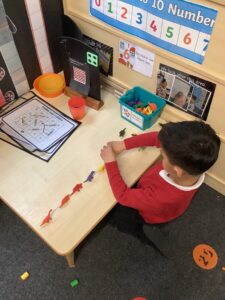
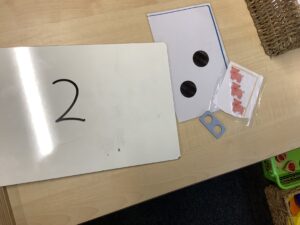
We have been working on numeral recognition this week. The children have been finding numbers and then selecting the correct amount of objects to match the number. Alongside this, we’re supporting the children with their accuracy with counting and recognising that the number they finish on is the amount they have – the stopping number.

Help at home: by pointing out numbers in the environment

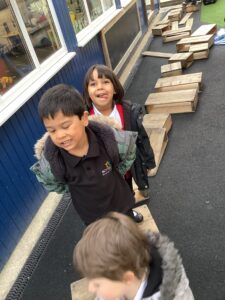
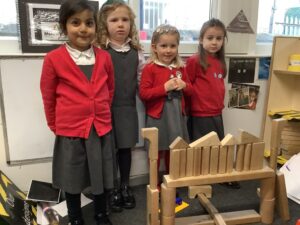
We have been having lots of fun both inside and outside this week. The children have been working as a team to erect different buildings.


Our weekly message: Friday 29 November

This week, our Living and Learning statement has been ‘I can talk about my feelings’…

When you’re reading aloud with your child, or talking about what they’ve been reading independently, or even chatting about something you’ve both watched together, invest some time talking about the feelings of the characters. The more comfortable your child is at this, the more able they’ll be at managing their feelings. (And a good message is that all feelings are okay, but the behaviours they lead to may not be okay – it’s okay to feel angry, for example, but not okay to act in ways that hurt others.)

Terrific times tables

Every year, children in Year 4 take part in the national Multiplication Tables Check. The national data was released this week. The average score across the country was 20.6 out of 25.

At Moortown Primary, our average score was 23.6 – much higher than national. Not only that, whilst 34% achieved full marks (25/25) nationally, 73% of our children achieved this perfect score.

Well done to the children (our current Year 5 children). Thank you for making sure your child learns their times tables. Check out our information and advice about supporting your child with this.

Learning to read, reading to learn

The shift from learning to read to reading to learn is a crucial milestone in a child’s educational journey.

In the Early Years and Key Stage 1, children focus on learning how phonics works and decoding words (that’s ‘sounding out’ the letters into sounds – phonemes).

As they move towards the end of Year 2, children use reading as a tool to explore and acquire knowledge across subjects like science, history, and geography. This can help develop thinking, comprehension, and the ability to use information they have read.

Mastering this skill empowers learners to independently research, solve problems, and engage in lifelong learning. Encouraging reading a wide range of texts and promoting curiosity ensures children are prepared to thrive in an information-rich world.

Help at home: make sure your child reads at home every day, and encourage them to be enthusiastic readers by talking about what their reading, whatever that is – comics, stories, factual books…

Have a happy and healthy weekend.

Autumn 2: Week5

Our book of the week this week is How to Catch a Star by Oliver Jeffers. The children have enjoyed writing about the different ways they could catch a star. We have been looking at different constellations and recreating them on the playground.

We have been discussing our word of the week-reflection. The children used this word when describing what they needed to do during one of our classroom challenges.

Help at home: by practising the phonemes and letter formation that is on the Friday home learning sheet.

Math

We have been continuing our work on part wholes. The children have been partitioning numbers and using the sentence stems ….. is a part…… is a part …. is a whole.

RE

We enjoyed discussing different places of worship on Monday and then the children recreated some of these using the classroom equipment.

Remember: to bring your child’s reading record book and library book on a Thursday.