This week’s message (Friday 26 January 2024)

This week, we’ve messages about measles, free school meals and a couple of forthcoming events in school. Before that, a thank you…

Watch us while we work

For parents and carers of children in Years 1 -6, this afternoon we’ve had another Watch Us While We Work session – the second of the year. Thank you if you were able to come to school to find out ways to support your child at home.

Based on parent feedback, we’ve a new feedback form for planned-in visits like this – things like Watch Us While We Work, Topic review sessions and Reception Stay and Learns.

We’d love to hear your views.

Measles

This comes from the Department for Education (DfE):

There have been recent localised outbreaks of measles centred around the West Midlands. There is a risk of further outbreaks in other areas unless urgent action is taken to increase Measles, Mumps and Rubella (MMR) vaccination take up in areas with low MMR vaccine rates.

Measles spreads very easily among those who are unvaccinated, especially in nurseries and schools. The best protection against measles for children and adults is to get both doses of the MMR vaccine. It is never too late to have these vaccinations.

Read the NHS advice for parents and carers.

Read the DfE has published an Education Hub blog with guidance on measles and the MMR vaccine for parents.

Free School Meals

Circumstances can change for anyone, as the enormous impact from the pandemic continues to prove. Some families can suddenly find themselves trying to cope with a new financial strain and pressure, perhaps as a result of a stressful new situation: separation, loss of a job, decreased working
hours, illness etc. If your household income is low or has recently decreased, your child may well qualify for Free School Meals.

Find out whether you’re eligible.

In addition to securing free school meals, your child would also become eligible for pupil premium funding. This provides us with extra money that we use to support children.

Finally this week, a couple of events coming up…

Wear Red Day

Our school charity this year is Children’s Heart Surgery Fund.

Wear Red Day is an annual fund-raising event to support the Leeds Congenital Heart Unit, its patients and their families.

We know our children wear red as part of their regular uniform every day. Today is still a uniform day, but we invite children to come to school wearing a bit more red than usual – red socks, red hat, red shorts…

This is an optional event. We welcome any donations, all of which will go towards our charity.

Safer Internet Day

This is on Tuesday 06 February. We’ll be making the day in school, but you might want to check out some resources to use at home.

Have a great weekend!

James and the Giant Peach

Last week, we were reading at an extract from James and the Giant Peach by Roald Dahl.

We practised the skill of inference through ‘hot-seating’.

Hot-seating is where one child becomes a character and then the rest of the class asks the person questions about their behaviour, background, motivations or feelings.

The child then has to answer the questions in character!

Help at home by hot-seating with your child when reading their guided reading book!

We are historians!

This half term in topic, we are historians.

In history, we are learning about the Romans and Anglo-Saxons.

This is our vocabulary for this topic:

chronology arrangement of events or dates in time order
empire a large group of countries or states ruled by an emperor
invasion when a country or region is invaded by an armed force
tax a payment you must make to a ruler or government
to resist to stand up to or fight back against something
innovation an improvement or replacement for something
bias a viewpoint that may be based more on opinion than fact
kingdom an area of land ruled by a monarch (a king or queen)

Before we learn about how the Romans came to invade Britain and how the Anglo-Saxons lived after the Romans had left, we needed to learn about what the timeline of British history looks like.

A timeline shows us the chronological order of events.

We have learnt that before the Romans invaded, Britain was living in the Iron Age. The people who lived at this time were called Celts.

The Celts:

  • lived in tribes
  • were farmers
  • lived in wooden, thatched huts
  • had no rulers but did have chiefs
  • made tools and weapons out of bronze and iron

After the Romans invaded, who had power in Britain changed. During the Iron Age, there were lots of tribes each with their own chief. However, in Roman Britain, there was one emperor who was in charge of the whole Roman Empire.

Help at home by asking how power changed from Iron Age Britain to Roman Britain.

This week’s message (Friday 19 January 2024)

Early in each half-term, our weekly message centres around the current KS1 and KS2 topic. The message comes from Mr Wilks, who leads on foundation subjects (see page 7 for what foundation subjects are).

What is this half-term’s topic?

This half-term, we’re historians and will be developing our understanding of Britain’s past and the wider world.

I love history. It’s one of my favourite subjects to teach. There are so many amazing stories and characters from the past and although the people and events we study can be separated from our own lives by thousands of years, there are lots of relevant connections we can make with the world today. Children will use enquiry skills to answer questions about the past that require opinions. They’ll be ‘time detectives’, using sources of evidence to help them answer these questions.

Each phase has age-related specific knowledge, skills and vocabulary that they’ll learn, use and apply across the topic. See pages 22, 23 and 24.

Years 1 and 2

In this topic, children will learn about how shopping has changed over time. They’ll develop chronological understanding by sequencing events in their own lives before learning about how shopping was different during their parents’ and grandparents’ and great grandparents’ childhoods. They’ll look at similar products from different times and try to sequence them chronologically using logical reasoning. They’ll use photographs and other sources of evidence to identify changes and similarities on the high street over time. They’ll learn about the history of a local shop, Marks and Spencer, and how it has changed over time.

The key historical concept which we’ll explore in this topic is trade. Trade is the exchange of goods and services, initially for other goods and services, and then for money.

Years 3 and 4

Children will learn about the Roman Empire and its invasion of Britain. They will examine how life changed for the people living in Britain at the time of the invasion. They will learn about the Celtic warrior, Boudicca, and how she resisted the Romans. Children will also consider what we know about Boudicca, how we know it, and whether we can trust it.

They’ll learn about the amazing inventions and advances that the Romans brought to Britain. Finally, they’ll find out why the Romans left Britain and who the Anglo-Saxons were.

There are two key historical concepts which we’ll explore in this topic: empire and invasion. An empire is a large group of countries or states ruled by an emperor or empress. An invasion is when a country or region is invaded by an armed force. 

Years 5 and 6

In this topic, children will learn about Viking Britain and an Early Islamic Civilisation centred around the city of Baghdad around 800AD.

During this period of time, Baghdad was the largest city in the world and was the centre of the world’s trade routes. Trade between Vikings and Baghdad happened and provides a real link between these two societies.

Through studying the Vikings, children will again learn about how people invaded and settled in Britain. Invasion is also relevant as it brought an end to the Islamic Golden Age.

The Islamic Golden Age was a period of great innovation. Learning and knowledge was key to their success. They built the world’s first hospitals, universities and observatories, as well as studied writing from scholars around the world. The contrast with Viking Britain during the Dark Ages is stark!

There are three key historical concepts which we’ll explore in this topic: trade, invasion and innovation. Trade is the exchange of goods and services, initially for other goods and services, and then for money. An innovation is an improvement or replacement for something. An invasion is when a country or region is invaded by an armed force.

Help at home

Talk to your child about what they’ve been learning in class. The class news page of the school website is a good place to go to find out more about what the children are doing.

Find some books from the library which match what the children are learning. This will be quite easy for children in Key Stage 2 as there will be plenty of books about Roman Britain and Viking Britain. You should also be able to find some about the Islamic Golden Age. For children in KS1, you may find it more difficult to find books about shopping over time. However, any book that looks at how an aspect of life has changed over time will be good. For example, you may find KS1 history books about toys and games, houses, transport, holidays. These will all help your child to sequence chronologically and explore similarities and differences.

Watch television shows about history. Horrible Histories is great – regardless of your age!

This week’s message (Friday 12 January 2024)

Welcome to our first message of 2024! It seems a little late to wish you a happy new year, but we’ll do it all the same: best wishes for a happy and healthy 2024. This week’s message has quite a few things, but we’ve tried to keep them fairly short…

Dates for your diary

This Spring term is a short one – just five weeks in Spring 1 and just a day short of six weeks in Spring 2. As always, please check our school calendar to know what’s coming up (amongst other things, a Watch Us While We Work session in Years 1-6 and Stay and Learn sessions in Reception, plus parent-teacher meetings).

Did your child get an electronic device for Christmas?

…If so, then do make sure parental controls are all in place. Here’s a handy guide from the NSPCC.

Attendance matters

Our whole-school attendance for the Autumn term was 96.9%. How does your child’s class compare with that figure?

  • Reception – 94.9% – that’s an amazing increase since Autumn 1 (91.5%)!
  • Year 1 – 96.7%
  • Year 2 – 97.6%
  • Year 3 – 97.9% – well done!
  • Year 4 – 97.9% – well done, too!
  • Year 5 – 96.9%
  • Year 6 – 96.1%

We know that winter is one of the peak times for adults and children to come down with mild illnesses such as colds, coughs and sore throats.

Your child should stay at home from school if they’ve a high temperature (fever) and are unwell, and wait until it has passed before going back.

If they’ve just got a runny nose, sore throat or slight cough – without a high temperature – your child should still attend school. Children should stay at home if they’ve a high temperature (fever) or if they have diarrhoea and/or vomiting – this helps stop the spread of stomach bugs.

If in doubt, check the NHS site: Is my child too ill for school?

Read this BBC article for five top tips to help.

The national attendance rate for Autumn was 93.2%. We’re proud that our figure is quite a bit higher here at Moortown Primary. Thank you for knowing that attendance counts.

DT: Cooking and nutrition

We sent this message earlier in the week, but in case you missed it…

Our updated long-term plans for Cooking and Nutrition were introduced at the beginning of this school year. Last term, your child took part in a practical lesson where they did some cooking in school and were able to eat what they had made. Hopefully, they’ll have come home and told you all about it!

So we can continue to offer this to all children in Years 1 to 6, we’re asking you for a small voluntary contribution towards the cost of ingredients. This will help to cover the costs for the full year – that’s three recipes. We suggest a contribution between £3 to £6, although we really appreciate anything you can offer. Payment for this can be made online on the School Gateway app.

By the way, please remember to tell us if your child has an allergy so that we can adapt the recipes we’ve planned.

The Big Ambition survey

We’ve mentioned this before, too, but we’ve been asked to communicate a final reminder which comes from Dame Rachel De Souza, the Children’s Commissioner for England…

I have been overwhelmed by the response the survey has received so far. More than 300,000 children, young people, parents and carers have participated, making it one of the largest surveys of its kind, but I want to give even more people the chance to have their say.

Complete The Big Ambition survey. It closes on Friday 19 January.

Finally, I don’t often offer a personal recommendation, but a highlight of the holidays for me was a trip to the cinema to see Wonka – I loved it! Have a good weekend, whether that involves a cinema trip or whatever you and your family get up to. 

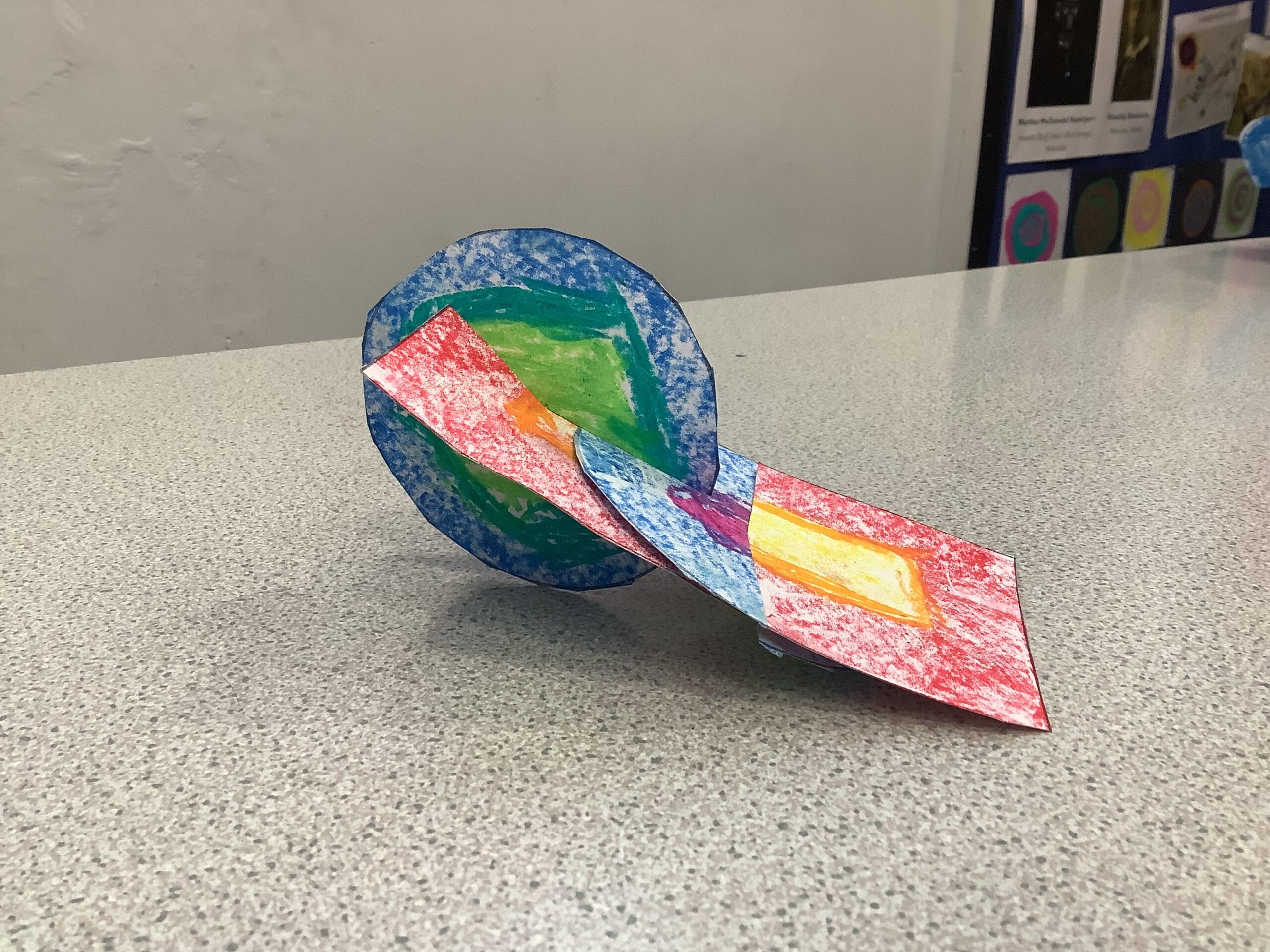
Our final sculptures

As promised, take a look at some of our final sculptures from this half term’s art learning!

We had so much fun creating these and exhibiting our knowledge of colour and shape.

On behalf of all the Year 4 staff, we hope you have a lovely holiday and a very happy New Year.

See you on the other side!

This week’s message (Friday 22 December 2023)

Following an earlier message this week, this last message of 2023 is a short one…

Our library here at Moortown Primary has been restocked with some brilliant, funny and awe-inspiring books! It’s been great to see enthusiasm pouring out of the children as they’ve flicked through the new spines and marvelled at the interesting covers. Hopefully, your child will bring home a library book (or two) this week for you to enjoy together over the break. They might even be able to tell you all about our new featured shelf which contains fiction books purely dedicated to animals. We want children to follow their interests when reading and we encourage them to read anything, whatever it is: TV subtitles, newspapers with a grandparent or even just the back of a cereal box! Every word or sentence read helps your child to put in the reading miles. Happy reading!

In case you missed it, over three events this week (older children carol singing and younger children performing in Lights, Camera, Action!) we’ve raised £278.15 for our chosen charity Children’s Heart Surgery Fund. Thank you and we hope you enjoyed the singing or the show!

Finally, all of us here at Moortown Primary wish you a very Happy Christmas and New Year.

We look forward to seeing you all again on Monday 08 January.

An early weekly message (Wednesday 20 December)

This week’s message comes early, and it’s an unusual one because the majority of it is written by Miss Hague, the Head of School at Scholes (Elmet) Primary, one of our sister schools in Sphere Federation:

I’ve visited Moortown Primary School many times to work with Mrs Weekes but a couple of weeks ago I came to talk to the children about safeguarding – making sure we keep our children as safe as they can reasonably be, both in school and beyond school.

From the moment I arrived, I was really impressed by the welcome I received. Simply walking around school, I was met with lots of smiles
and friendly greetings – those first impressions are really important.

During my visit, I met with three different groups of children from three different phases: Years 1 and 2, Years 3 and 4, and children from Years 5 and 6. Our conversation covered many topics such as feeling safe (both in school and online); what you should do if you’re worried about something; behaviour in school; and the school rules. We also talked about what we understand by equality.

The children had a vast amount of knowledge and could talk to me confidently about all these areas.

It was really clear that the Living and Learning curriculum is embedded and woven into many aspects of school life. A real strength for me was to hear the children talk about equality. The younger children were able to talk about everyone being treated the same and the older children were able to talk in more detail about protected characteristics. There was a genuine message (and feeling) that the children were able to convey to me and that was that everyone would be welcome at Moortown Primary no matter what.

When speaking about online safety, our conversation was mostly about keeping personal details safe, not trusting everything people claim to be online, and not getting persuaded by ‘pop-ups’. It’s really helpful if children think in terms of the4Cs for online safety: content (what we see), contact (who we communicate with), conduct (how we behave online), and commerce (buying, selling, gambling, phishing). The NSPCC have useful information that might help you think of the online
risks.

Thanks to the children at Moortown – I had a really lovely afternoon.

And some feedback from someone else, too: we recently had a visit from our Local Authority School Improvement Advisor. Amongst other great feedback were the following comments:

Pupils know the expectations for learning and routines across school are clearly embedded. Teachers were observed demonstrating strong subject knowledge. Behaviour across school continues to be exemplary including during transitional times.

We are artists!

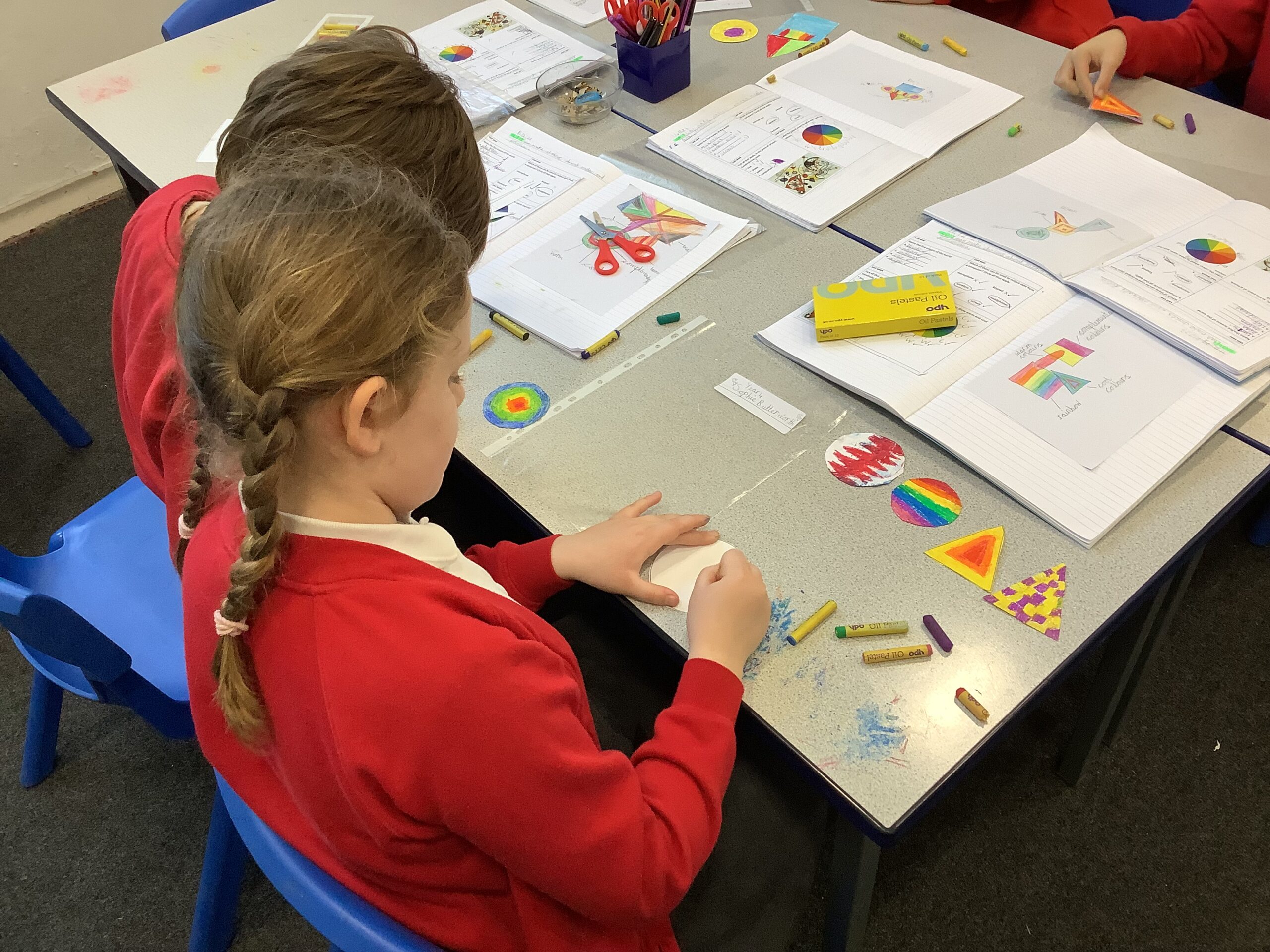
After many weeks of learning about Kandinsky and Napaltjarri, Year 4 have begun creating their sculptures inspired by them!

First, we cut out the shapes that we had chosen in our designs.

The next step was then to start decorating these shapes using oil pastels and chalk.  Some children have chosen warm colours, complementary, cool colours or a mix!

This week will involve using Brusho dye to complete our colour choices and fixing the individual shapes together.

Watch this space for the grand reveal of our final pieces!

Living and learning: mental health

Over the last couple of weeks, Year 4 have been learning about mental health.

During our first session, we talked about feelings. Being able to identify and talk about feelings and emotions is an important part of our mental health. We spent time discussing different feelings and how to manage them. We also talked about how to spot how others are feeling by looking at their body language.

This week, we started to look at self-care. There are lots of different ways that we can practise self care. Some ideas are:

  • talking to someone
  • reading a book
  • having some quiet time
  • taking some deep breaths
  • hugging our teddies
  • doing some exercise
  • writing our feelings down

Help at home by talking to your child about what self-care techniques they can do whenever they are feeling ‘big feelings’.