Check out Y5’s costumes for World Book Day! Can you recognise any of the characters?
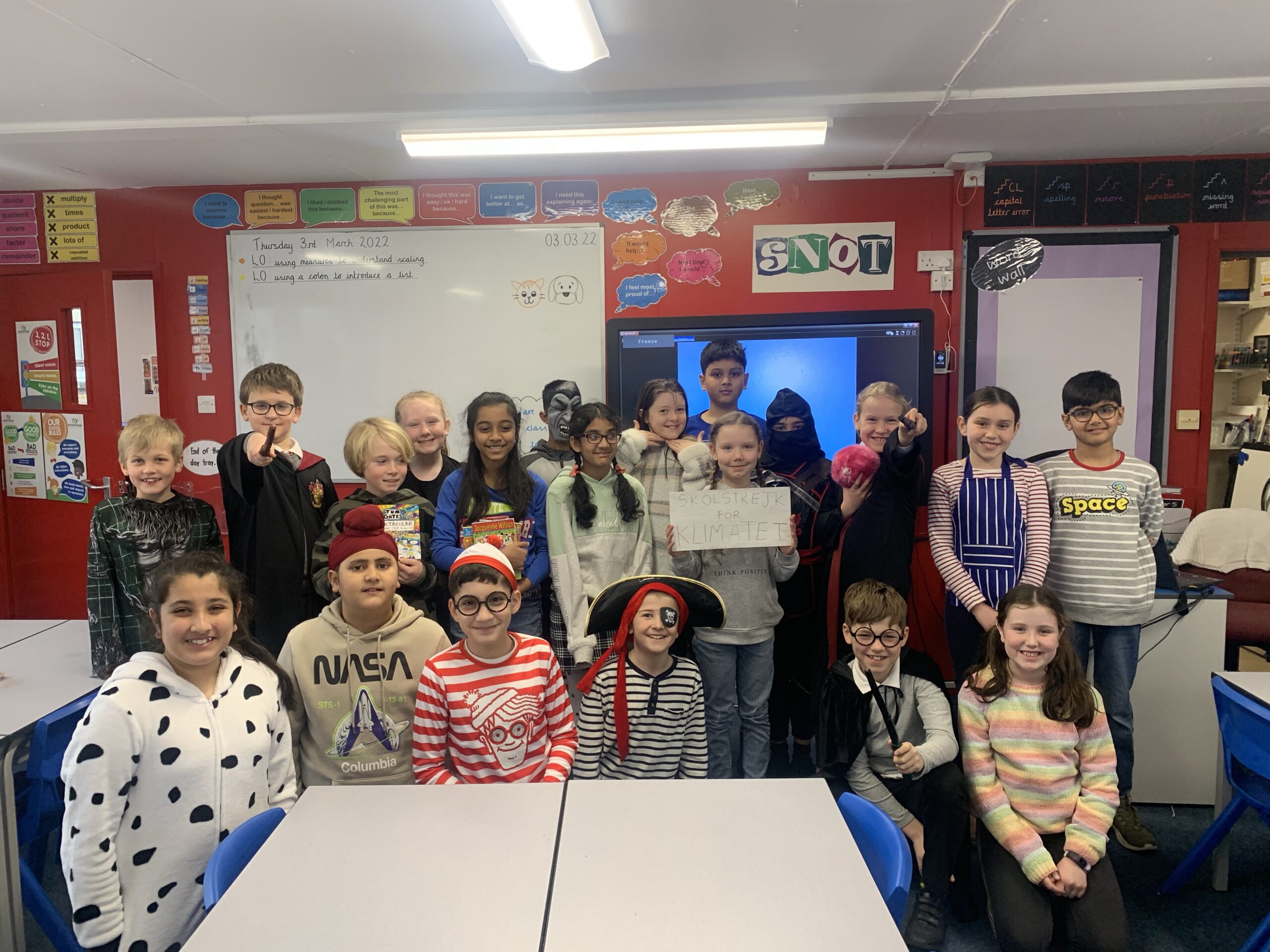

Check out Y5’s costumes for World Book Day! Can you recognise any of the characters?
This week, Moortown Primary School has been taking part in Safety Week.
Year 5 have been learning lots about different ways that they can stay safe both inside and outside of school.
Some highlights include…
A visit from Dogs Trust informing us how we stay safe around dogs – be that our own dog or a dog we might not know.
Road Safety learning:


Safer Internet Day: a whole day dedicated to learning about how we can stay safe online. The children really impressed me with their knowledge about how they stay safe online.


A visit from Moortown Fire Service where the children were able to ask questions about how to prevent a fire and stay safe in the event of one. Something that really resonated with the class was the importance of sleeping with your door closed. Ask your child if they can remember why this is important.
And a quiet half an hour where we read this book about consent.

If you or your child have any questions about anything we have discussed this week please don’t hesitate to ask.
This week’s message is about Reading – find out more about supporting your child learn to read so they can read to learn. The first part comes from Mrs Latham, Sphere Federation’s Early Reading Leader. The second part is from Miss Wilson, our other Reading Leader.
We’ve made some improvements to our phonics and early reading approach over the last few months. We’re using the government validated phonics scheme Little Wandle Letters and Sounds Revised. We’ve always believed that phonics and reading is a priority. The changes we’ve made in school ensure that this continues to be the case.
Our phonics lessons happen every day – they’re now just a bit longer (half an hour). In these lessons, children are taught how a letter or letters (graphemes) match to sounds (phonemes).
Alongside phonics lessons, we’ve introduced Reading Practice sessions. These happen 3 or 4 times each week with children in Reception, Year 1 and some children in Year 2. These are small group sessions, led by an adult, where children read a book that is matched to the phonics phase for the children in that group. The time to do this has been made available by moving to allocating ebooks for children to share their phonics reading success at home. Year 1 or 2 children who are secure at Phase 5 will read a fluency text each day and take home a wider variety of books.
Children also take a sharing book home to develop a love of reading. These books are to enjoy together and read for pleasure. Enjoy stories, predict what might happen and use different voices for the characters. Information books (non-fiction) can also be so much fun to share – finding out facts and discussing new information. Above all – make it fun!
A recent workshop explained the changes and accompanying materials were emailed out.
If your child is in Key Stage 2, thank you for completing their Reading Record every week – it’s been great to see how children (and you!) have been engaging with their reading at home.
Have a discussion with them about the things we get up to in Book Club or what their library book choice is this week. Another great conversation to have is about different authors. Use this website and have a watch of some of the videos that are age-appropriate for your child. Keep an eye out for World Book Day we’ll let you know how we’re celebrating all things reading at school!
Remember that your child should be reading daily. This could be in a cosy, quiet spot by themselves, alongside an audio book or with an adult. When reading together, some simple questions can have a big impact on memory and understanding. Ask a variety of questions:
We want children to progress from learning to read to be able to read to learn which includes understanding the world around them. Check this website out for more useful questions.
In Science, Year 5 have been learning about evolution and how things adapt over time.
We learnt about Darwin’s finches – a study conducted by Charles Darwin where he explained why different birds had different beaks. Darwin hypothesised that birds with long, pointy beaks had adapted in order to eat insects. On the other hand, birds with shorter, sharp beaks had adapted to eat hard fruits.
We conducted an experiment to see which beaks would be better suited to eat sunflower eats. We used chopsticks to represent the long, pointy beaks with chopsticks and tweezers to represent the shorter, sharp beaks.


Ask your child which instrument was better for picking up the sunflower seeds and therefore what we concluded from this experiment!
Last week’s message began with some news about the continuing challenges Covid is presenting. Since then, we’ve had some information about the situation across Leeds. This week’s message begins with this, and continues with some information about next week’s Staying Safe themed week, and a few reminders and requests, useful for everyone to read. At the end, just for parents of younger children, is an update about phonics.
Absence rates are higher in Leeds than they are nationally: attendance at Leeds schools (20.01.22) was 85.2% (87% primary and 83.7% secondary) compared to a national average figure of 87.4% (89.1% primary and 85.9% secondary). Some of the difference is down to a greater proportion of pupils being absent with Covid in Leeds (6.2%) than nationally (5.1%).
Staff absence rates are also higher in Leeds: 5.5% of teachers are absent for Covid-related reasons compared to 4.5% nationally. For teaching assistants and other staff, the disparity is even greater: 6.4% in Leeds compared to 4.7% nationally.
Thankfully, this week has been a bit more settled. We’re really hoping the curve is about to turn as it has in other areas of the country, but in the meantime, please do stay vigilant to symptoms.
Next week, we’ve another themed week: Staying Safe. Themed weeks are one of the ways we enrich our Living and Learning curriculum. Your child will be learning all about staying safe in lots of different situations, such as online safety and road safety. A variety of visitors will support this learning.
Online safety will be a particular focus on Safer Internet Day, Tuesday 08 February. Do take a look at these top tips for parents and children and more online safety advice. You may also want to look at these screen time guides.
Throughout the week, discuss this learning at home to encourage your child to stay safe.
We’re also running our Staying Safe active travel to school photo competition throughout the week. Send us photos of how your child stays safe on their way to school for a chance to win one of five £10 vouchers. Send entries to [email protected] by Thursday 10 February.
We’re all so busy at the moment and we know it’s easy to let some things slip. The next few points are reminders and requests to help us keep our school a happy and healthy place to learn…
It’s natural that you’ll have some questions, comments and concerns from time to time. Our teachers will be happy to speak with you, but it’s worth remembering that after 8.50am, they need to crack on with teaching the class. Instead, try to catch your child’s teacher at the very end of the school day.
Alternatively, you could contact the office who’ll pass on the message – your child’s teacher or someone else in school will be happy to call you back. This also means you don’t need to have the conversation in front of your child – sometimes it’s better to have the conversation separately.
Older children might bring a mobile phone into school. If your child does, please make sure they’re careful as they walk to school. It’s sometimes easy to be distracted – your child needs to still concentrate on staying safe when crossing the road, for example.
Finally, please do take a moment to remind yourself and your child of uniform expectations. This includes wearing only small, plain stud earrings; keeping long hair tied back; and wearing hair accessories (like hair bands) which don’t distract – keep them small and not too bright.
For parents of younger children only…
Thanks to everyone who attended Monday’s Zoom session about the changes to how we teach early reading. Parents who attended commented favourably:
If you missed the session, you can watch it here (with apologies for the weird animal noise I seem to be making at the very start!). As requested during the Zoom, look out for some resources which we’ll email to you next week, too.
As always, we hope you have a happy and healthy weekend.
Over the past two weeks, Year 5 have been learning about identity. Identity is what makes you, you!
Year 5 were great at explaining the similarities and difference between themselves in a respectful way.
Last Friday, we also took part in Identity Day. This was an amazing opportunity to show who we are as people by coming into school wearing clothes that show a community we are a part of.
All the children were extremely proud of their identity – as they should be! And I was proud of them, too, for expressing themselves so confidently but respectfully with their classmates.
Great job, Year 5!
It’s been a tough week! In ten of the twelve classes at Scholes (Elmet) Primary, there have been positive cases of Covid. At Moortown Primary, one third of staff have been absent (though not all with Covid). St James’ CE Primary has similar problems, though thankfully not 25% Covid amongst pupils as is the case with another Wetherby school. With Covid cases still so high in our schools, please do stay vigilant to symptoms and get them tested if they’re not feeling quite right.
This week’s message comes from Mrs Allaway, who leads on Maths across Sphere Federation…
This year, Sphere schools are taking part in a new national programme for Reception, Year 1 and Year 2: ‘Mastering Number’. The programme aims to secure firm foundations in the development of good number sense for all children. The aim over time is that everyone leaves Key Stage 1 with fluency in calculation and a confidence and flexibility with number.
Why is fluency with number facts so important?
We want all children to develop fluency with number facts because we know this makes a huge difference to their progress in maths. For children who find maths difficult, it’s often the case that their only strategy is to count. They don’t see the relationships or make the connections that make maths easier. For example, if five and two is seven, seven minus two must be five – that’s the relationship within the maths.
An over-reliance on counting not only makes maths more difficult, it also inhibits flexibility, thinking and the development of problem-solving strategies. It doesn’t just affect calculating, it affects maths much more widely. We need children to have stopped counting by the time they move into Key Stage 2.
What is number sense?
Alongside fluency in number facts, we want our children to develop ‘number sense’: a flexibility with number where they reason; they see relationships; they see mathematical structures; and they see such things as if six and three is nine, then nine minus three is equal to six. These relationships won’t change in Key Stage 2 and beyond, the numbers just become bigger and more complex.
We want to support all children to think mathematically, make connections and see relationships because we know these are the characteristics that make maths learning successful.
Mastering Number sessions
In our short focused sessions for children in Reception, Year 1 and Year 2, we give children opportunities to think deeply about mathematical relationships and time to practise and really embed fluency with number facts. These 10 minute sessions are in addition to our main daily maths lesson.
In some sessions, we focus on deepening children’s understand of the composition of number: inside numbers there are other numbers. For example, inside eight there’s five and three, there’s six and two. Knowing that inside numbers are other numbers enables children to develop fluency skills.
We’re also developing skills in subitising. This is the ability to look at a small number of objects (often a maximum of about five) and instantly recognise how many there are without needing to count them one by one. This plays a key role in helping children see how numbers are made up, avoiding an over-reliance on counting.
One of the key resources children use in Mastering Number sessions is a rekenrek – a type of abacus or number rack. It supports children to feel and visualise numbers as well as noticing how numbers relate to each other. Children begin to build up strong visual images by first doing, seeing and noticing the maths.
How can I help at home?
Regularly accessing NumBots will support children to practise and really embed and develop crucial number facts. If you need help accessing this, please contact your child’s class teacher.
Children in Key Stage 2 who struggle with Maths could use NumBots too – ask your child’s teacher. (And don’t forget the importance of knowing times tables – including division facts. You don’t need to use Times Tables Rock Stars, but it’s one way to practise at home.)
For those of you with a child in Early Years and Key Stage 1, don’t forget there’s a Zoom session about our updated provision for learning phonics and practising early reading skills: 6pm on Monday 31 January. Contact us for the Zoom details in case you missed them.
Have a good weekend.
This week’s message kicks off with a repeat of one we sent on Wednesday, in case you missed it.
With the government’s announcement about the ending of Plan B restrictions next Thursday, it might seem that things are getting back to normal, and it might seem like most people with Covid have a relatively mild illness compared to previous strains.
In our schools, we’re struggling.
We’ve far more cases across all three schools (and across Leeds, from what we hear) than ever before amongst our children and our staff.
For pupils, when the number of positive cases of Covid rises, we have to consider isolating the class (‘bubbling’), and even move to home learning.
For staff, we’re committed to keeping the classes open. This is starting to prove really difficult – the more staff we have absent, the harder it is to cover. (And it’s really difficult to find supply teachers right now.)
Either way, this means learning is disrupted.
You can help us:
If your child’s at home…
This might seem like something more useful for older children, but the advice here could really help avoid issues later on…
The Children’s Commissioner, Dame Rachel de Souza DBE, has recently published a guidance document for parents helping to support them to understand online sexual harassment. It’s a sensitive topic, and not one all parents feel comfortable discussing with their children.
The commissioner’s team brought together a group of 16 – 21 year olds and asked them to talk about what they think parents should know, and what they should say to their children when talking about sexualised bullying and the pressures of growing up online.
Key advice from the young adults in the focus groups included:
We all need a bit of help from time to time…
The Family Lives charity aims to offer all parents somewhere to turn before they reach crisis point. Crisis support, provided for over 40 years through their helpline, has always been at the heart of what they do. The parents’ helpline is available Monday to Friday, 1.30 – 9pm: 0808 800 2222
Their website also offers help parents with the ups and downs of family life.
…And now it’s the weekend! Have a happy and healthy one, whatever you get up to.
Our PE days are changing from next week. We will now be doing PE on a Monday and Friday. The children should come to school in their school uniform on Thursday.
Please ensure that your child comes to school wearing the correct PE kit on Monday and Friday. If you have any questions about this – please refer to our uniform policy or speak to me.
Thank you!
In biology, Year 5 have been learning about inheritance and how characteristics are passed down from parents to offspring.
We used Mr Men and Little Miss to demonstrate our understanding of this. Check them out below!

