
Observing Science
We enjoyed some more Science learning at the end of last week; it focused on predictions and observations. We bought some ‘soapy foam’ and predicted what we felt would happen to it if it were squirted onto a paper plate and left for the whole day. This meant we needed to observe it over a period of time and allowed us to adapt our predictions as it changed.

We also did a much quicker observation when we were challenged to place an item into an already full glass of water without any spilling over. In the picture above, you can see the children noticing the (meniscus) curve which is created when a circular container is at its fullest.
 We managed to place a cotton wool ball, a penny and a bulldog clip into the glasses without them spilling over. However, we concluded that the glasses into which we placed the penny and the bulldog clip may not have been totally full as we couldn’t explain, scientifically, why they wouldn’t overflow. With the cotton wool ball, we felt that the water could take up the space between the fibres and the fibres could take up the space in between the water particles.
Holiday planning
In our Maths lessons this week, Year 6 are busy booking me a holiday! They’ve got some specific criteria to stick to and are quickly realising that holiday planning is tricky with lots and lots to consider – particularly money.

I’ve given them a budget of £2500 to take my partner and me away during the Summer holidays. I’m hoping to go diving and experience some culture but don’t want to fly for longer than four hours. The children have really risen to the task and have started creating a persuasive PowerPoint to convince me that their holiday is the one to go on.


We’ll let you know whose holiday gets my vote in the end some time next week.
American Independence Day themed menu
Catering Leeds, our school meal provider, will be running a special American Independence themed menu on Wednesday 05 July.
Please contact the office by Friday 16 June if your child would like a school dinner on this day.

Tropical World!


Sharing reading
On Friday afternoon, Year 4 spent some time sharing reading with Reception class. It was lovely to see how well the older children interacted with the younger ones and vice versa. Getting enjoyment through reading is something that we want to promote and all the children seemed to be getting a lot of pleasure through this activity.
What a super way to spend half an hour on a sunny Friday afternoon.


Science with Liquorice Allsorts
Y6 have begun a Science topic this half term and begun by learning about classification keys. We began by very simply sorting the sweets in any way we chose.


We then used the Liquorice Allsorts to discuss what yes and no questions you could use to distinguish between two of the sweets. Then we used this to sort six different Allsorts into a classification key.
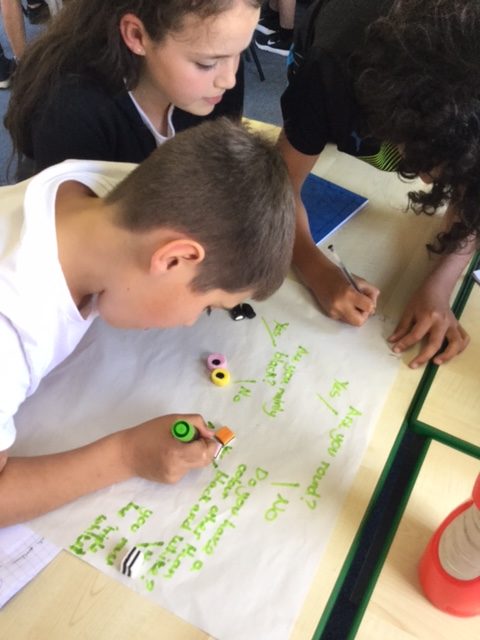


We finished off by starting a classification key to sort the children in the class. We very quickly realised it would take a very big classification key to end up with 30 individual children.
Safety Week – Friday at Yeadon Tarn
Thanks to Mrs Taylor’s organising and fantastic weather, Year 6 had a brilliant day at Yeadon Tarn on Friday of Safety Week, getting to put their safety learning into practice.
Throughout the day, we kayaked, took part in team-building problem-solving tasks and set out on some orienteering. Although they were very much looking forward to the kayaking, the children really enjoyed all three activities.
Problem Solving


Orienteering


Kayaking


Capacity finding
We’ve been making a mess this morning in our maths lesson. Children had to find the capacity of different containers in litres. First they estimated the capacity and then used a litre measuring jug to find how close their estimates were.


Measuring, comparing and observing
As part of the Year 2 learning on capacity/volume, we’ve been measuring and comparing today. Hopefully, your child has been looking at labels at home to compare volumes of everyday household things.


By the end of Year 2, this is what the children should be able to do.
Choose and use appropriate standard units to estimate and measure length/height in any direction (m/cm); mass (kg/g); temperature (°C); capacity (litres/ml) to the nearest appropriate unit, using rulers, scales, thermometers and measuring vessels.
Compare and order lengths, mass, volume/capacity and record the results using >, < and =.
Concert in Year 2
We had a short concert in the classroom this afternoon showcasing the guitar skills of one of our classmates.
The playing was almost as impressive as the understanding of how to read music.
