
PE – Dance
Yesterday, in PE, Y5 became urban freestyle dancers.
We had a great time choreographing and performing an urban-style dance -off. We started by performing a section of the routine that we were given before creating our own short dance sequences in groups.
I was particularly impressed with the fantastic attitude shown by all of Y5 throughout the lesson. Despite dance not being everyone’s favourite PE subject, they all got involved, gave it a go and, most importantly, had fun. It’s important that we challenge ourselves to do things we might not always do on a regular basis – taking a ‘safe risk’, you could say.
Here’s a collage of pictures from the lesson. You might not recognise some of us as our urban dancer alter-egos!

02 December 2016
This week, as usual, we have two homeworks. Both pieces are due on Thursday 08 December 2016.
The first is Talk Time:
I can reflect on my start to the year.
This links to our current SEAL theme: The 8 Rs for learning. It is an opportunity for children to think about their own learning and their attitude towards it. In class, we reflect a lot on our learning and Y5 are very good at this. They are honest and are not afraid to admit to making mistakes: this will undoubtedly make them better learners in the future. I’d like them to be as honest in this reflection as possible. Is their attitude consistent across the day/week? Is it consistent across subjects? And most importantly, I’d like them to make suggestions for how they could improve. No matter what is said, this conversation should be positive as it should lead to improvements.
The second is Practice Makes Perfect.
I can show I understand word classes.
We’ve spent a lot of time thinking about word classes so far this year (nouns, adjectives, verbs, adverbs, prepositions, articles) and this is a chance for children to show that they have remembered this learning.
Children have been given a sheet to help them show their understanding.
Forces – levers and pulleys
This week, we started our new mini-topic: Forces. We’re focusing on levers and pulleys.
To begin with, we used some paper and a toy car to figure out what we we already know about forces. Help at home by asking your child what forces act on a toy car or a falling piece of paper.
After that, we investigated levers and pulleys. Levers and pulleys are essentially a mechanism to exert a larger amount of force with less effort. To demonstrate this we did a little experiment:

That’s right. Despite weighing less than half what I do, Noah was able to lift me up. Ask your child how this works?
We also thought about more common examples of levers and pulleys – ones we might use in everyday life like scissors (ask your child about how were going to remember the silent ‘c’ in the word scissors) and lifts.
Tomorrow, we’ll begin working on a little project, in which we’ll apply our knowledge of forces, levers and pulleys: (attempting) making a rube goldberg machine.
Sports stars
As part of our involvement with the Leeds North East School Sport Partnership and Active Schools, we have recently entered two sporting competitions. A huge well done to all children who took part. For a few, this was their first opportunity to represent our school.
Leeds North East Primary Schools Sportshall Athletics
Fifteen pupils from Year 4, 5 and 6, took part in this action-packed competition, at Allerton Grange, comprising of many field and track events. It’s always a well-contested event and the children competed well against other local schools.
- ‘I enjoyed everything I did. Our team was very positive.’
- ‘It was a great experience that wasn’t too competitive. I loved it!’
- ‘I enjoyed the competition because there were lots of events to choose and do.’
Thank you to Mrs Bald and Mrs Russell for taking the children to this event.
Leeds North East Primary Schools Cross Country Festival
Eighteen pupils participated in the Leeds North East Primary Schools Cross Country Festival at Cardinal Heenan. There were over 650 young people taking part in the races and over 100 pupils in each race.
A particular well done to Grace and Megan who came 7th and 10th in their Year 5 girls race. Also, children commented on the resilience of Ripley who took a fall in the mud but got himself up and then continued to overtake many other runners!
- ”I thought it was good because it was different and my mum used to do cross country too.’
- ‘It was really good because even if you don’t like running too much, like me, you still had a fun time.’
As always, we thank staff and parents who helped with these events.
School Saving Club paying in session

Our next paying in date for School Saving Club account holders is Thursday 08 December 3.15-3.45pm. If you can’t make this date, the next one will be on Thursday 02 February at 3.15-3.45pm.
Children must be accompanied to the sessions.
Alternatively, you can bring money to the office in a sealed envelope marked School Saving Club for the attention of Miss Hale.
School Saving Club accounts can still be opened. Please ask at the office for an application form.
Children who are in currently in Year 3 will have their account credited by Leeds City Council with £10 once opened.
Physical activity – the facts
In August 2016, the Government released its Childhood Obesity Strategy. This document outlines actions which will address the rising rates of childhood obesity.
Yorkshire Sport Foundation have produced the following poster with statistics and key information from the strategy.

We continue to monitor and improve our physical activity provision (see our current PE Provision Plan (pe-and-sport-premium-2016-2017) and our previous PE Provision Plan (pe-and-sport-premium-2015-2016).
Packed lunches
Struggling for ideas for a healthy packed lunch?
Change4life have some great tips and easy to prepare ideas based on the Eatwell Guide.

Also make reference to our Packed Lunch Guidance.
Day 4 of STEM week
Our brilliant STEM week continued today as we were visited by a representative from Marks and Spencer’s. We learnt about one of their biggest sellers: ‘Melt in the Middle Chocolate Pudding’. After learning about the history of the organisation, we learnt all about the chocolate desserts.
For example, did you know emulsifiers are used to ensure the cake lasts longer? They help the natural oils and waters remain mixed so you don’t get an oily pudding. After a bit more theory we were lucky enough to do a taste test. We sampled the pudding and gave it scores out of 5 – full marks from me!
After that, we reflected on some learning from Monday afternoon about staying safe online. We made iMovies to inform others of the dangers around online hackers.
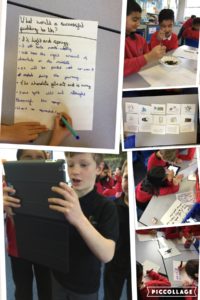 A collage of our learning.
Did you know that lemons float but limes sink?
Neither did we. But it’s true: Lemons float and limes sink!
After we discovered this we predicted which objects would float and which objects wouldn’t float. Then, we investigated.
In our investigation, we learnt that whether an object floats has nothing to do with its weight, but its density. For example, in our investigation, we found that an empty can of coke floats and a full can of diet coke floats despite being heavier. Furthermore, a tiny paper clip didn’t float.
Right at the end of our lesson, some of the children enquired further:
- “If you put something that sinks on top of something that floats what happens?” (Pippa)
- “Do boats have sides to stop the water getting in and making it heavier?” (Edward)
We hadn’t planned to but we investigated it anyway – science is fun and we should enquire and investigate as much as possible. Ask your child what we found out!
Ask your child why a lemon floats but a lime sinks. They should be able to give you a ‘text-book’ answer including the words ‘density’ and ‘particles’.


Robot coding!
This morning, as part of STEM week, we were lucky to have a visitor who taught us how to code robots. In groups we were given a car and a computer and by the end of the session each group had programmed their robot to move in a variety of ways.
It was really exciting and we learnt lots about computer coding, science, maths and working with others.
Ask your child if they can figure out what this robot would do.
 Hint: the number ‘1’ = forwards mode.
We learnt that coding can be quite frustrating – one tiny mistake in your script can mean that your robot does nothing. However, we did enjoy de-bugging (finding the errors) our scripts to ensure they worked.
Computing can be a scary topic for some adults (most of us aren’t part of the coding generation like Y5) but there are some great online resources that can help. A particular favourite of mine is Barefoot Computing. It’s free and links closely to the National Curriculum. Although it’s aimed at teachers, it will be beneficial for everyone because the website is also easy to navigate and understand.
Here’s some pics of us coding our robots…


