
The reading bug is catching on!
Check out this picture of some members of our class enjoying their library books during break time. It’s great to see children choosing to read; reading regularly (and often with an adult) definitely improves learning!
Well done, guys!
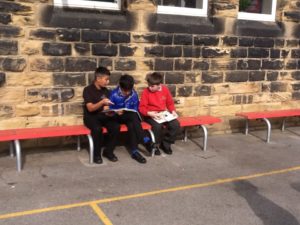
PS Thanks for the picture, Mrs Valentine!
16 September 2016
This week’s homework is Practice Makes Perfect and is due Thursday 22 September:
I understand place value.
We have been learning about place value for the past two weeks.
Here is the place value section for the Age Related Expectations for Year 3. You can find the full document here: https://50ba64cf42aa5ce33ed5ffd3ca44503c-11586.sites.k-hosting.co.uk/moortown/learn-more/expectations-core-subjects/
- count from 0 in multiples of 4, 8, 50 and 100
- find 10 or 100 more or less than a given number
- recognise the place value of each digit in a three-digit number (hundreds, tens, ones)
- compare and order numbers up to 1000
- identify, represent and estimate numbers using different representations
- read and write numbers up to 1000 in numerals
- read and write numbers up to 1000 in words
- solve number problems and practical problems involving these ideas
The above points show what your child has learnt over the past two weeks in maths lessons. Note that we haven’t covered counting in multiples of 4 and 8 yet.
This homework allows your child to continue practising the basics of what we covered in order to keep up their skills!
16 September 2016
We are looking at adding suffixes to verbs to create new words. Usually, this is fairly simple. However, there are some things we need to remember:
1. Double up for a short vowel sound – running, not runing.
2. Verbs ending in ‘e’ follow the “drop the ‘e’ for ‘ing'”, so the ‘e’ is removed before adding ‘-ed’ or ‘-ing’ – hoping not hopeing.
3. Some verbs don’t follow the rules for the past tense – built not builded.
4. You need to decide if you should add -s or -es to make a plural or a third person singular verb. Handy trick: If you add a syllable it is usually –es – foxes not foxs.
As your child will be learning the rules of adding suffixes rather than the spellings of individual words, I will test you on any word which follows these rules.
I will test you on Friday 23 September.
Here is a table which may help you begin practising your spellings:

Brilliant balancing
This half term in PE, we’re focusing on balance and gymnastics. Today, working as part of a team, the children were asked to create a balance using different parts of their bodies and also try to incorporate a piece of equipment into their work. As you can see from the pictures, the children demonstrated some amazing balancing skills, super team work and some very bendy bodies!


16 September 2016
This week’s spelling activity focuses on words ending in ‘-ible‘ and ‘-able‘ and being able to recognise which one to use.
The children need to find out words with these endings and create the word families for them.
adorable – adorably – adoration – adore – adored – adoring
There will be not test on Friday 23 September as we’ll be learning about these words throughout the week. Next week, the children will be given a list of words with these spelling patterns and they’ll be tested on them on Friday 30 September.
16 September 2016
This week’s homework is Creative and is due on Thursday 22 September.
What do I know about the world?
For the last two weeks, our learning has focused on our world. We’ve had to learn new terminology, be more familiar with the countries that make up given continents and understand what a map tells us about an area. Now it’s time to show what you know. This might involve some learning you’ve done in class but you could also teach us something new.
What could you do?
- Create a test map that the rest of us have to see if we know which is the Tropic of Cancer and which are longitude and latitude.
- Find some images of different places around the world and see whether we can say where they are.
- Plan a walk through the countryside using an OS map, pointing out where you can visit along the way and whether you’ll be tired from walking up hills.
- Draw a map of our local area and make sure your map has a key.
16 September 2016
For this week’s Mathletics task, your child has been assigned three activities related to the learning we’ve done this week. This should be completed by Thursday 22 September.
There were some problems last week with some children’s activities becoming unassigned meaning they didn’t know which ones to complete. Here are the activities so you can find them yourselves if this happens again:
Place value
- lowest common multiple
- (something harder) rounding numbers
Add and subtract
- negative or positive
As always, come and let me know before Thursday if there are any problems and, if you’re finding it tricky, I’ll be around on Wednesday lunchtime for you to complete a task then.
Best of British themed menu
Catering Agency, our school meal provider, will be running a special themed menu on Thursday 06 October: Best of British Autumn Favourites. Please contact the office if your child would like a school dinner on this day.

MAPS!
One of my great loves in life is a good map so I’ve thoroughly enjoyed our topic lessons so far this week.
We’ve thought about what different maps there are in the world and why we use them. Our learning has then focused on OS maps, looking at what we can learn about an area just by looking at a map.


We found it most interesting looking at contour lines and what they tell us about the height of the land above sea level and where the land is steep or flat.
Next, we’re moving on to human geography to explore what our country is like and how different factors contributed to our success in the Olympics over the Summer.
Where in Europe?
As part of our Where in the World? mini-topic, we’ve been learning about Europe: its countries, cities, capitals and the many things to see!
To learn this, we planned an inter-railing trip around Europe. We imagined we were going in August and planned our journey using the official inter-railing map. They were some things we had to do:
- visit eight places
- go somewhere near a mountain range
- go somewhere with a river
- go somewhere hot
- go somewhere cold
Once we’d planned our destinations, calculated our journey times and made sure we’d done all of the above, we used our research skills to find out what we could do in each place we visited.
Ask your child:
- Where they chose to visit?
- Why they chose there?
- What could they do there?
- Which country is______ in?
- Is that city a capital city?
Here’s some pictures of us in the early stages of planning our trip of a lifetime…


