Raising the bar with the eight Rs

Ok – so ‘Raising the bar with the eight Rs’ is a poor attempt at some rhyme. Here’s a much better attempt by a Y4 pupil – it’s brilliant! Well done, Daisy!

Learning things is really fun, but sometimes I get stuck,
Thinking about the 8 Rs can really change my luck!

At school when I’m doing a tricky sum, I sometimes feel like crying,
But then I remember to be resilient and it helps me keep on trying.

Taking responsibility for myself is something I must do,
If I don’t do the jobs that are meant for me, I can’t blame you!

If my Mummy asks me to tidy my room, I must not be grumpy or rude,
I must be responsive and do as I am asked with a positive attitude.

In the morning when I come to school, it’s important to have what I need,
I must be prepared and organized so I will be ready indeed!

When Mr Owen asks a question in class and I’m scared to give it a try,
I decide if it’s a safe risk to take, and it is, so I put my hand up high.

Sometimes I can be forgetful and I forget what I’ve been taught,
But if I try and put my mind to it, I can remember much more than I thought!

I love to make art out of unwanted things but I can’t always find the right bit,
But being resourceful and finding a way round I can always find something to fit.

Reflecting is very important as it helps me to think and look back,
I can reflect on what I have done in the past and that keeps me on the right track.

The 8 Rs can be useful for learning and they help me get through my day,
They guide me and lead me and remind me to think, and they always show me the way!

Living and Learning: Democracy

Thursday 25 October sees us voting for our new school councillors. We’ve been learning all about democracy in preparation for our own election and the children have had lots of questions.

At home, talk about how our country’s voting system works and what your opinions are. The children had some interesting views on what age people should be allowed to vote and when they should not be allowed to anymore. The candidates delivered their speeches today ready for us to make informed decisions in the morning.

Well done to all of those people who chose to stand for election and good luck!

All stand for the judge…

Having learnt all about the gunpowder plot during our topic lessons, we attended court to find out more with lots of us taking on the roles of the main characters.

Not only is this a fun way of extending our knowledge, but it also helps us with our writing. We thought about what questions we’d like to ask the different people involved in the story and what their answers would have been at the time.

The suspects: Guy Fawkes, Robert Catesby, Thomas Percy, John WrightThe witnesses: Mary Arkwright, Arthur Coniston, Lorn Monteagle, King James I 

The prosecution and the defence

The jury

The media

At times, the prosecution really put pressure on our suspects!

Bradford Media Museum

Yesterday, Year 6 went to the National Science and Media Museum in Bradford. We were exploring what engineers do to bring inventions to life as this is our theme for our Time Travel big topic. It was a jam-packed day; we got to see and do all sorts!

Not only did the IMAX film we saw make us squeal and reach out for the things that seemed to be coming out of the screen at us, but it also inspired many of us to want to be engineers. We realised what amazing things engineers achieve to help people and solve problems.

The Wonderlab was a great room to explore, finding out what UV light is, how sound waves can move water, how infrared cameras show which part of our bodies are hot and cold and how light can manipulated to create moving images.

The Engineering Show demonstrated how light can carry sound and taught us how our 3D glasses worked.

The Games Lounge was a step back in time to the very first arcade games which turned out to be just as fun as the games we play today.

We also explored the TV and Animation galleries, seeing how technology has advanced over recent years due to the skills of scientists, engineers and computer programmers.

Living and Learning

In our last PE session, Year One combined PE and Living and Learning. The children had to use some of the 8Rs of learning they have been taught this half term to help them complete the throwing challenge they were faced with.

The children were split into teams of six and had to throw their bean bag into the hoop in the middle of the circle. However, if one bean bag missed the hoop or was touching the hoop, the children had to start again.

Here’s how they used some of the 8Rs:

I can show I am ready to learn – The children were expected to watch demos of me throwing the bean bag as well as others to help them learn.

I remember – The children had to remember what they had been taught about throwing in previous sessions.

I reflect on my learning – If the children missed, they needed to ask themselves, ‘Why did I miss?’ ‘Do I need to throw the bean bag harder or softer?’

I respond to feedback – I was walking round the hall giving the children tips on how to throw the bean bag. The children needed to use this feedback to help them succeed.

I take responsibility for my own learning – If the children were struggling to throw the bean bag into the hoop, they needed to take responsibly and ask for help or watch their friend.

I am resilient – The challenge was frustrating for the children as all six bean bags needed to go into the hoop. The children had to be resilient as a group and not give up.

Homework matters

Some of you might have spotted an article in the Sunday Times today about a group of parents who have concerns about homework. As part of the article, the newspaper has carried out research on a sample of 80 schools and their homework policies, including that of Scholes (Elmet) Primary., one of our federation schools, whose policy is almost the same as our own.

Articles like this are not especially helpful, especially when they take only a very short extract from our policy: ‘At Scholes (Elmet) Primary School in Leeds parents are contacted “if homework is of a regular poor standard, or . . . regularly not handed in”, according to the website.’

First, it’s not quite accurate. Our policy says: ‘We will communicate to parents/carers if homework is of a regular poor standard, or which is regularly not handed in.’ It would be extremely rare for us to contact parents/carers specifically about homework. Typically, we would wait until parent-teacher consultations or the annual report and make a comment at that point.

Second, the article doesn’t really present the big picture. Our Homework Policy presents a clear rationale for homework, backed up by research evidence. A review of the research around homework indicates that ‘Effective homework is associated with greater parental involvement and support…The broader evidence base suggests that short focused tasks or activities which relate directly to what is being taught, and which are built upon in school.’ We believe our homework tasks achieve this: Talk Time is almost entirely about developing parental involvement and support in a way that is easy to achieve – ideally sitting together over a meal, but possible even in the car or walking to school; Creative homework is designed to let children demonstrate their learning in a way that suits their own ideas and preferences, and one where families can talk about and be involved in to whatever extent they choose. These two, plus the more traditional Practice Makes Perfect homework, are always based on learning that relates directly to what is being taught in school.

The policy also promotes other activities that will enrich children’s childhood: ‘Whilst homework develops children’s learning and independence, quality family time, play and free time are also important. Homework should not prevent children from taking part in wider activities such as those offered by out-of-school clubs and other organisations. Children develop their interests and skills to the full only when parents/carers encourage them to make maximum use of the opportunities available outside school.’

Third, this article was in today’s Sunday Times. Less than four years ago, the same newspaper published a very different article:

‘ONE of the biggest studies of homework ever carried out proves what every parent has always told their child — knuckling down after school pays dividends. An international study of the homework patterns of 15-year-olds in 65 countries has revealed a clear link between longer homework hours and higher academic performance. “These findings should finally silence sceptics who have argued that homework is bad for youngsters, causing stress and division in families,” said Alan Smithers, professor of education at the University of Buckingham. He called on more schools to take homework seriously by enforcing sanctions when pupils fail to do it.’

It’s a pity that today’s article misses an opportunity to present a more balanced report, even at the expense of referring to its own previous journalism.

Our Homework Policy was developed in consultation with parents/carers. Each year, we consider carefully views expressed in our annual survey – inevitably, some parents/carers feel there is too much but the majority support the current policy.

Remember…remember…

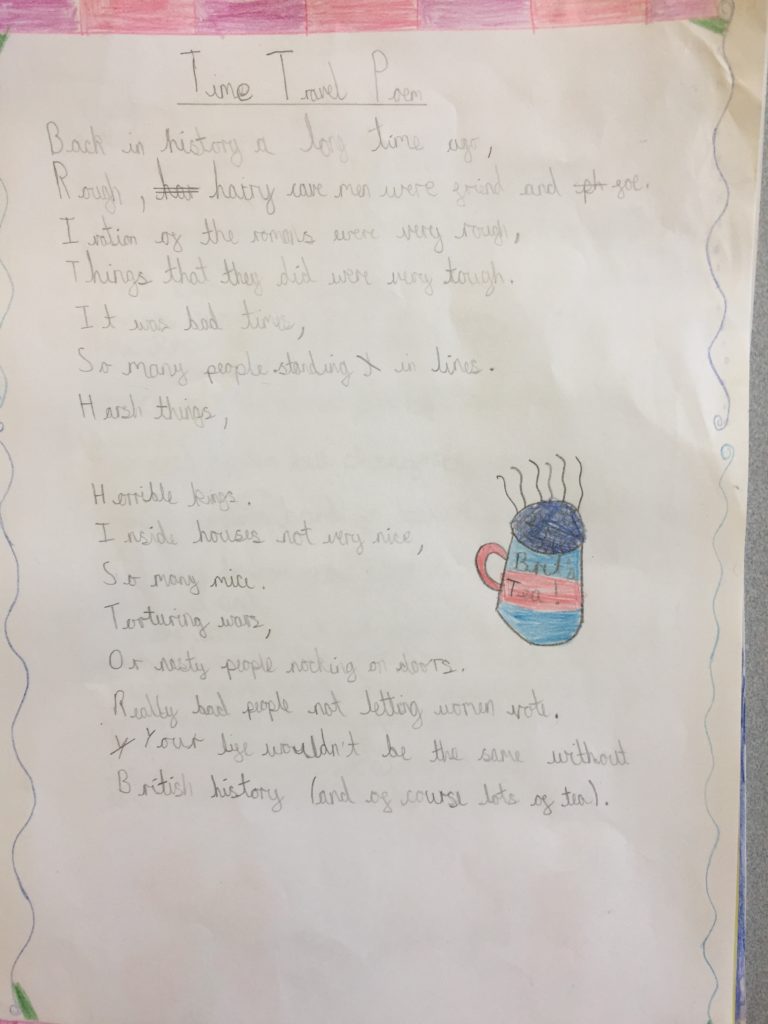
It’s a little early but, during our Time Travel topic, we’re hurtling through the history of Britain and we find ourselves in the year 800AD. In Britain, the Vikings are taking over. Meanwhile, in China, they’re creating an invention that will change the world: gunpowder.

This invention has had a huge impact on Britain and without it, the gunpowder plot in the 1600s would never have been formed. In topic, we’ve learnt all about the people involved in this devious (ask us what this means) plan and created some artwork inspired by it.