Hello, Year One!
Well done for completing another week of home learning.
Take a look at the photos of some of the learning that’s been going on:


How delicious do these Greek salads look!


Hello, Year One!
Well done for completing another week of home learning.
Take a look at the photos of some of the learning that’s been going on:
How delicious do these Greek salads look!
We’ve reached Friday – the end of the first week of the Summer Term. Well done for supporting your child with their learning for another week. Now it’s the weekend, hopefully you and your child will get out of the house to enjoy some nice weather – respecting social distancing, of course!
We’ll end the week with some links to sites with great deals on to make sure your child continues to read lots – the most important thing they should be doing in terms of home learning. There’s also a brief reference to safeguarding which Leeds City Council has asked us to publish for all our parents, and some more writing from our older children across Sphere Federation.
Reading
Oxford Owl are offering free e-books from their reading scheme. All you have to do is register and you can read them on phones, tablets and computers. It lets you filter by phonics stage or by age so easy to use! Email your child’s teacher if you’re not sure what phonics phase your child has reached.
Similarly, a lot of publishers have reduced the cost of their ebooks. For example, Usbourne are selling ebooks for 99p. (I like the look of The Girl who Speaks Bear!)
Safeguarding
There’s been a lot of information sent out over the past few weeks about online safety. At a time when your child might be online more often than they would normally, it really has to be a priority. The content of this latest guidance has come from Leeds Safeguarding Team and it contains some useful contacts; please use these contacts if you’re concerned about anything your child encounters online or if you have any other safeguarding concerns.
And some words from our older children
Here’s a good re-cap of our home-learning from Bo, writing as me. It’s very well written!
Due to Covid-19, we will not be in school for the time being. Your child should still be being educated though. Every day, we send out three pieces of home learning for your child to complete (this is on the school website). Whilst this learning is revision, we fully understand that some children may struggle with some of the tasks. We also understand that some parents may struggle to help their child so we have a solution. On the website, you can find your child’s teacher’s email address. If you need anything, we’re always here to help and will try to reply to your message as soon as possible. We hope this helps and enjoy your tasks.
And a nice summary of good advice from Ellis:
As the Covid-19 lockdown continues, I would like to offer advice and support to parents and our students. In the first few weeks, we have learned a lot and adapted quickly – thank you for the support from the staff, parents and children.
From the feedback received, I’d like to offer the following helpful hints and tips for the coming weeks:
- Make every day a fun day
- Ensure you have a good routine – include snacks and break times
- If you have older children, ask them to help
- Ask your friends from school (but not in person)
We hope this helps.
Ellis’s final point is a good idea – we’re hearing about lots of successful learning time sessions where older children meet up online to discuss the learning together. Just make sure these sessions are done in a space where you can keep an eye on things, too.
Good morning, Year One!
Before we move on to today’s task, I want to say well done for settling back into home learning so well after the Easter break. I’ve had some fantastic reports from your parents! Keep it up 🙂
Now, onto today’s tasks…
Reading
Today’s reading task is phonics.
The list of words below all contain the ‘ai’ phoneme. However, ‘ai’ is represented in many different graphemes.
Your task is to read the words and sort them into the correct grapheme.


Maths
Today’s maths task is ordering numbers within 50.
In today’s task we will be ordering numbers using the language, ‘largest’, ‘smallest’, ‘more than’, ‘less than’, ‘least’, ‘most’ and ‘equal to’.
I’m going to order the numbers below from largest to smallest using inequality symbols.
> largest to smallest
25 36 41 40
I’m going to look for which number has the most tens. That’s 41 and 40 as they both have 4 tens. Because they both have the same amount, I’m going to look at the ones column. 41 has one one and 40 has zero ones. Therefore, 41 is the larger number. Then I look at the next two numbers. 36 has more tens than 25 so that must be the next biggest. Finally, 25 is the last number I have and it has the least tens.
41 > 40 > 36 > 25
Have a go at the ones below, ordering them from greatest to smallest using the inequality sign.
49 32 23 12
28 21 36 47
26 11 31 40
20 30 45 25
Now, I’m going to order the numbers below from smallest to largest using equality symbols
< smallest to largest
19 29 31 17
I’m going to do the opposite of what I did last time. I’m going to look for which number has the least tens. That is 19 and 17. They both have the same tens so I’m going to look to see which one has less ones. 7 is less than 9 so 17 must be the smallest number. Then, I look at the next two numbers. 29 has less tens than 31 so that is the next smallest number. 31 is the number that is left. It is also the largest because it has the most tens.
17 < 19 < 29 < 31
Have a go at the ones below, ordering them from greatest to smallest using the inequality sign.
13 31 45 21
41 34 29 19
17 18 28 10
49 39 24 42
Challenge:
Fill in the missing numbers.
34 > __ > 12 > 4
__ > 31 > __ > 22
12 < 24 < __ < 45
__ < 23 < __ < 31
Music
I’m sure you’re all missing music lessons on a Wednesday afternoon!
To keep your singing voices in tune (just like mine), follow the link below and complete the music lesson.
https://www.bbc.co.uk/bitesize/articles/z4fgrj6
It would be great to see some of your singing efforts.
Good luck, Year One!
How’re you doing? Take a moment or so today to check-in on yourself to make you‘re doing ok. Just a couple of minutes of quiet down-time for you and you alone can make a big difference to how you cope in these tough times.

I know – the Ofsted judgement’s a joke. But stop for a moment and just think what you’re achieving right now: supporting your child with home learning tasks, managing to keep your household going, working from home maybe, coping with concerns about coronavirus for your loved ones… That’s no mean feat. If you can judge yourself to be ‘hanging in there’, then well done and be proud of yourself.
(And you’ve nearly got through another full week of home learning!)
We hope the change of timings for the home learning tasks going live on our website helped some of you plan to prepare a bit in advance.
Based on what you’ve told us, we’re making another change: we’re shifting the balance a bit in what we’re asking. We’ve heard that writing can be the most challenging task to engage your child and support him/her. We also wonder about the limited benefits of writing as a home learning task compared to practising reading and maths skills and learning more in foundation subjects. That’s why we’ve shifted the balance a little away from writing, based on your feedback. That’s not to say writing isn’t important – it really is – but it’s to recognise what are the best tasks for home learning.
And now, over to some Year 6 children across Sphere Federation…
Lleyton has pretended to be me here:
Hello parents. I hope you are happy. I have been planning work for the pupils – you are probably having more fun than me. I know it is hard for both of us but just keep trying your best. Here are some ideas for working at home:
- Give your children breaks in between schoolwork
- Giving them food
- Giving them drinks
- Giving them shelter
- Making a routine
- Allowing our children to communicate with friends
- Take them on daily walks
- Giving them fresh air
I know you and I are working really hard. You’re doing great. Keep it up!
Lleyton – there’s some really good advice – I do hope your own parents haven’t forgotten to give you food and drinks!
Mya’s written a poem called Ambition that might inspire us to get through lockdown:
I just want to achieve so that I believe
Just like everyone else
Doesn’t matter how hard it may seem
I have to be eager to be a believer
I will take the opportunity
To fit in with the community
I just want to achieve so that I believe
Good afternoon, Year One!
I’ve had a little go at recording a short video message for you as it has been so long since you’ve seen my face. It’s a bit odd seeing and hearing yourself on camera so I’m sorry if I come across a bit nervous!
Follow this link to view the message.
Enjoy!
Good morning, Year One!
How lovely is the weather at the moment! What daily exercise have you been doing? I’ve been finding new places to walk in the local area.
I’m also still taking part in PE with Joe Wicks. It’s so fun!
Onto today’s tasks…
Geography
Someone who studies geography is a geographer! Your task as a geographer is to remind yourself of the four countries of the UK and their capital cities.

Follow the link below to help you with today’s task:
https://www.bbc.co.uk/bitesize/articles/zdq6t39
Reading
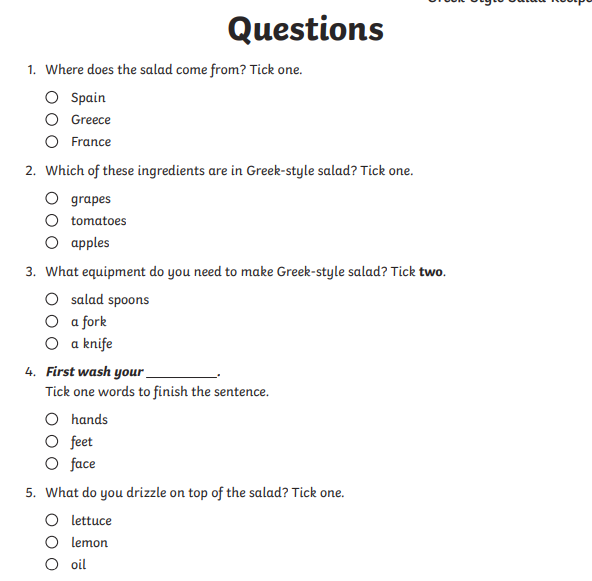
Read the instructions about how to make a healthy Greek salad. Answer the questions in your home learning book.


Challenge:
Follow the recipe to make a Greek salad.
Maths

Your first task today is to complete the sentences below using the phrases:
Use the 50 square to help
21 is _____________ 27
20 is _____________ 19
34 is _____________ 34
41 is _____________ 38
Now, use equality symbols to compare the numbers below.

23 ___ 29
37 ___ 21
40 ___ 4
31 ___ thirty one
forty nine ___ 39
30 ___ forty
Challenge:

It’s the mid-week point – hopefully, you and your child have settled back into a routine that’s working for you. It’s working for this parent: ‘I just wanted to pass on our thanks and gratitude for all the home learning that is being prepared… We thank you all for your continued help and support – it is invaluable!’
We’re keen to hear suggestions about how we can improve what we’re providing at the moment, and I’ve mentioned some things in the last couple of days. Something important to remember: tomorrow’s home learning tasks will be published this evening at 7pm and teachers will continue to publish the home learning the night before. This follows some suggestions from you so that you have time to prepare.
For the rest of today’s message, it’s over to the government and – far more importantly – to two of our Year 6 children!
Guidance for parents and carers on supporting their children’s education
The Department for Education has published information, guidance and support for parents and carers of children who are learning at home during the coronavirus (COVID-19) outbreak. It’s similar to the advice we’ve offered over the last four weeks or so, but you might want to read it:
The government has also updated its guidance for parents and carers on the closure of educational settings with additional information on the support available for parents, online educational resources and support for vulnerable children.
We know how to wash our hands… don’t we?
I found this update (over the Easter holiday period) more interesting – it explains a bit some advice we’ve made in the past, which is to wash hands with soak and water rather than rely on sanitiser:
It is essential that everyone washes their hands more often, using soap and water for at least 20 seconds. Hand washing with soap employs mechanical action that loosens bacteria and viruses from the skin, rinsing them into the drain. Drying hands afterwards makes the skin less hospitable to the virus. Hand sanitiser can be effective if soap is not available or the situation makes using soap less feasible (i.e. when outside) but using hand sanitiser provides none of the virus-destroying friction that rubbing your hands together and rinsing with water provides.
Read more about the latest guidance and video on hand washing.
The e-Bug project is led by Public Health England and has a dedicated webpage for learning resources on hand washing and respiratory hygiene. Resources are currently available for KS1, KS2 and KS3.
Finally, updates from some Year 6 children…
Nothing has really been normal recently so why don’t you take advantage of that. Try baking or cooking with your child. You could even get them to do meal planning, which can teach them to be prepared when the are older. Also, email your child’s class teacher- they would love to know what your child is doing!
To make your child feel more like they are at school, try to keep a timetable but make sure you and your child are having breaks between the work.
Thanks for that, Amelie – lots of good advice for parents there.
Lily, meanwhile, has two top tips for children:
Don’t forget to get out in the sun (but don’t forget your sun protection). I know it can be tough getting yourself into the routine of doing it when it feels just like the summer holidays!
Don’t forget to send us some pictures of you doing the work and having fun at home!
There’ll be more updates from our Year 6 children (and quite probably from the government, too) in future messages from us!
Guten Morgen, Jahr Ein!
Anyone know what language that is?
I’ve taught myself a few words from a different language. Have you learnt anything new whilst being in isolation?
If so, please email me and i’ll share it on our Class News page!
Onto today’s tasks…
Writing
In yesterday’s reading task, I asked you to choose a character from a story and write words about them.
For today’s writing task, I want you to put those words into sentences. When writing your sentences, use ‘and’ to join words together.
E.g.
George is kind and caring.
He is friendly and helpful.
George is thoughtful and selfless.
He is big and tall.
Remember to use:
Maths
Today’s task is about partitioning a number into tens and ones.
It is important to understand how a number is made up of tens and ones, e.g. 34 = 3 tens and 4 ones.
Look at the examples below:

Complete the part-part whole models below by drawing how many tens and ones each number has.

Now, complete the sentences below.
12 has _____ ten and ___ ones.
29 has _____ tens and ___ ones.
30 has _____ tens and ___ ones.
49 has _____ tens and ___ ones.
Reading
Today’s reading task is a RIC.
R – Retrieval
I – Interpret
C – Choice

Read the text below and answer the questions
My name is Sienna and I am six years old. My favourite thing at school is PE because I love running around outside.
My favourite food is anything sweet. I love cakes , chocolate and fruit. When it is hot and sunny, I love eating ice cream.
I saw some chocolate breakfast cereal in the supermarket and my mum let me get some. Now, I can even eat chocolate for breakfast!
What don’t I like? Anything with bits in!
Questions:
Retrieve: What is Sienna’s favourite thing at school?
Retrieve: Name two things Sienna likes to eat?
Retrieve: What doesn’t Sienna like?
Interpret: Do you think Sienna has a healthy diet and why?
Choice: Why does Sienna use an exclamation mark after the sentence, ‘Now I can even eat chocolate for breakfast!’?
Keep up the great learning, Year One!
Good afternoon, Year One!
I hope you’ve all managed to settle back into the home learning tasks after a little break!
Here are some photos of children in our class having fun during the Easter break.


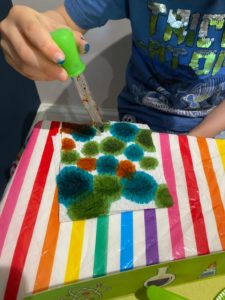


Please continue to send photos of the different things you are up to – it’s really great to see.
Remember to stay safe, stay positive and keep smiling!
Mr Parker 🙂
(In case you weren’t aware, these messages appear on both on our website and by email a little later.)
Yesterday, we talked about two main things:
This BBC article links these two points. The article flags up the importance of routine, and offers three top tips to achieve a safe structure for the day (and one that will help parents working from home, too).
…what is more important, say educationalists, is maintaining a degree of normality, rather than worrying about a child’s progress in English or maths. Home-schooling for now is “about encouraging parents to help their children create regular routines and study habits”, says Prof Becky Francis, of the UCL Institute of Education.
In an attempt to support you more with the home learning, we’re making one important change: from Wednesday, teachers will publish the home learning at 7pm the day before.
This change stems from requests that we publish the tasks the night before so that you can prepare:
So, tomorrow, home learning will go live at 9am (the usual time), but also tomorrow, there’ll be another post at 7pm – this will be Thursday’s home learning. And we’ll continue like this; for example, Monday’s home learning will be published on Sunday at 7pm (with the Monday date).
Thanks to the various parents for making this suggestion.
Finally today, a lot of families rely on friends, grandparents and organisations to help with childcare. Your child might be missing these people just now.
The Invisible String by Patrice Karst might provide comfort – it’s read here by one of our Sphere Federation teaching assistants (thanks, Gemma!).