
Squashed sentences!
The first week of the new term is over and the class have settled well into their routines again. We have been learning to add two 1-digit numbers by bridging 10 (see previous post), reading and writing words with the suffix -ing, and learning how not to ‘squash’ our sentences.
A squashed sentence is when two sentences are squashed together without any punctuation.
An example: I went camping it was fun.
This should be: I went camping. It was fun. (…or some other punctuation, but not a comma)
We can also join two sentences with conjunctions.
An example: I went camping and it was fun.
This week, we were focusing on separating two squashed sentences with a full stop. Children found it easy to identify where the full stop should go to separate the sentences when listening to a squashed sentence being read, but found it less easy to do this in their own writing.
To help at home, you could ensure that children are pausing at full stops in their reading. You could also write two sentences which are separated by a full stop in the incorrect place, such as I went. Camping it was fun. Read the sentences together and see if your child could fix it.
‘Squashed sentences’ are something which spoils some older children’s writing, and it’s hard to get out of the habit later on. Please practise this lots at home!
Science: Wow!
On Wednesday, Y5 enjoyed a morning jam-packed working scientifically. We saw some awesome reactions that made us gasp as well as taking on some observing, measuring and recording of our own mini experiments.


Here is some of our favourite ‘Wow’ science. Don’t worry… no Y5s were harmed during filming.
What happens when you heat custard powder?
What happens when you set hydrogen on fire?
Spectacular Science!
Today, we were fortunate enough to visit the science department of Allerton Grange High School.
We completed six experiments using their specialist equipment in the labs; we mixed acid with magnesium and even made our own sparklers!
We also saw some awe-inspiring demonstrations of different chemical reactions. In one of them, Zach had his hands set on fire!
Most importantly, all the children returned to school enthused about science and hungry to learn more. This is great because our current topic ‘What’s The Matter?‘ and our next topic ‘Life‘ are driven by this subject.


This week, by Arran and Bailey
Arran and Bailey spent some time reflecting on some of our learning this week.
Topic
In Year 6, we have started a new mini topic called ‘What’s The Matter’. This topic involves Chemistry. In our first lesson, we learnt about ‘filtration’ and how to separate mixtures and solutions.
Here is some technical vocabulary that we have learnt:
- ‘Mixture’: A mixture is a combination of a solid and a liquid which won’t dissolve.
- ‘Solute’: A solute is solid that dissolves in a solvent.
- ‘Solvent’: A solvent is the liquid used to dissolve a solute.
- ‘Solution’: A solution is the combination of a solid and a liquid that have dissolved.
English
In English we have received a mystery letter from Alexander Wolf. The first few lines of the letter read: ‘Everybody knows the story of The Three Little Pigs. Or at least they think they do. But I’ll let you in on a little secret. Nobody knows the real story because nobody has heard my side of the story.’
Based on this letter we are writing a news report.
What’s the matter?
Our mini topic for the first two weeks is What’s the matter? In this Science-driven mini topic we will be looking at rocks, soil and fossils. Today, we’ve been investigating the properties of rocks. We conducted an experiment to see which rocks were permeable and which rocks were impermeable.


We used pipettes to add three drops of water onto a flat surface of a rock. We then observed what happened to the water. We were looking to see if it would soak into the rocks or just sit there. Why don’t you ask your child about the difference between permeable and impermeable rocks and how this experiment helped us to discover if rocks were permeable or not?
You could also explore whether other materials are permeable or impermeable – materials like raincoats, for example!
Welcome back!
2016 has hit the ground running in Y5. We welcomed each other back on Monday with a great circle time…

We’re working really hard on new English targets and are tackling measuring capacity in Maths.
Our new mini topic ‘What’s the Matter?’ started with lots of questions and hands on discovery as we explored which materials would conduct electricity.
Maths
Happy new year! It’s nice to see all the children happy to be back at school!
This week, we have begun adding numbers up to 20. We have looked at the method of ‘bridging 10’. The following is taken from a parent guide to addition from Oxford Owl. It is available online here: https://primarysite-prod-sorted.s3.amazonaws.com/abbots-hall/UploadedDocument/06bb6ca9993b4b29bf6b805cbb2b9ea4/OxfordPressParentSupportAdditionlines.pdf

Instant recall of number bonds to 10 is essential to make the group of 10 with ease. Please practise these number bonds with your child to secure this understanding. It can be as simple as saying ‘7’ and your child quickly replying with ‘3’. A good time to do this could be during car journeys or when walking to school together. Frequent practice will embed these number facts.
Thank you for your ongoing support.
Fruit kebabs
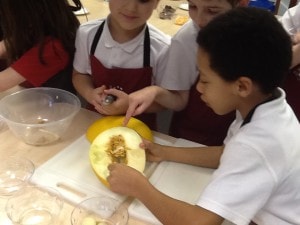
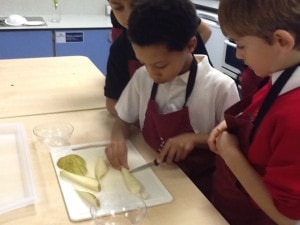
Year 3 have been practising their peeling and chopping skills today when preparing a variety of fruits to make their own fruit kebabs. We considered other aspects of selecting fruits such as seasonal availability, allergies and individual preference. Children were keen to try new fruits, both fresh and dried.
At a time of year when many people make healthy eating goals, we all agreed this was a great way to get one of your 5-a-day.




Mystery letter causes outrage in Year 6 English lesson
Happy New Year!
Yesterday, we read the classic fairy tale: ‘The Three Little Pigs’. Then, in the middle of our lesson, we received a letter from Mr A.Wolf. The letter explained how the wolf has been made out to be a villain when really the whole story was a misunderstanding involving a bad sneeze and a cup of sugar; some of us were more understanding of the wolf’s plight than others. We combined all of this to create our own version of the plot in which the wolf is not the villain.
There were some interesting ideas. Rav’s alternative plot included misheard song lyrics, heavy whistling and a tranquilizer dart, while Jaskirat’s alternative plot centres around the wolf having a bad couch and asking his neighbours for medicine.
Despite being aimed at younger children, we have used ‘The Three Little Pigs’ as a stimulus for some very creative and mature learning. The focus of our learning will be on news reports so we’ll be producing our own news reports based on our alternative plots.
You can help at home by encouraging your child to read the news (online or in the paper) and pick out how the writing might differ to what you would find in a narrative. Also, ask them about the plot they have devised in class and how it differs to the original story line. 
Let’s get sugar smart
Today has seen a new campaign launch by Change 4 Life, the government’s public health initiative, aimed at reducing the amount of sugar that children consume.
The free Sugar Smart App can tell you the amount of sugar in items by scanning the barcode, and then displaying the result as a number of cubes or in grams. The app can be used as a way of revealing the hidden sugar content in foods and to make us more aware of what children are consuming.
Public Health England, which runs the Change 4 Life campaign, hopes the Sugar Smart app and campaign will help combat tooth decay, obesity and type two diabetes and encourage families to choose healthier alternatives.
