
26 March
***Yoga Space are running a free kids yoga this morning at 10.30am. You need to register 1 hour before the class starts to take part. ***
Thank you for all the photos of your home learning work so far. It’s been great to hear and see how you have been getting on and we are proud of all your enthusiasm. We are particularly impressed with how neat and well presented your learning is. Keep this up! It is important to take pride in your work. Have a look at the class news page to see some examples.
Physical activity: As well as your daily exercise outside your house, why not try one of the many activity videos on imovement. There are different ones each day.
Mindfulness activity: Today, take some time to lie down in a quiet place and listen to some relaxing music with your eyes closed. A chance to refocus before restarting your learning.
We’ve had another Lexia achievement with Penelope getting her next Lexia level yesterday. Well done! Where possible, the aim is to reach Level 9 by the end of Year 2.
Here are your home learning tasks for today.
Task 1 reading
Firstly, try to keep reading a variety of texts while you are learning at home. We recommend 20 minutes of reading every day.
1.Reread the fluency text all about polar bears. You should be able to read it a bit more fluently today now it is more familiar.
2.Use the text to answer the questions below.
Polar bears
Polar bears are the planet’s biggest land-based carnivores – although they actually spend most of their lives around water and ice (their Latin name means ‘sea bear’). So they’re at particular risk from global warming, which is melting the Arctic sea ice they depend on.
Polar bears generally live and hunt alone, though they can be quite social too. They mainly eat seals – using their remarkable sense of smell they can detect a seal in the water beneath a metre of compacted snow, and from almost a kilometre away.
Adults are strong swimmers – they can swim for several hours to get from one piece of ice to another. Their thick white coat and a layer of fat keep them warm and camouflaged in their harsh Arctic environment.
1. Are the following statements true or false?
Polar bears eat plants. TRUE or FALSE
Polar bears are good at swimming. TRUE or FALSE
Polar bears often eat seals. TRUE or FALSE
Polar bears can’t smell very well. TRUE or FALSE
2.Find and copy a word from the text that means
usually ___________
amazing __________
can’t be seen ________
firmly pressed together ___________
3.How do the polar bears keep warm in the cold Arctic environment?
Challenge: Can you think of your own question about the text?
Task 2 maths
Here are your answers from yesterday’s learning. How did you do?
1 curved side – circle
3 vertices – triangle
4 straight sides – rectangle
4 straight sides of equal length – square
5 sides – pentagon
6 vertices – hexagon
8 sides – octagon
For the challenge question, we would encourage the children to check the number of sides on a shape by marking each side with a line as they count.
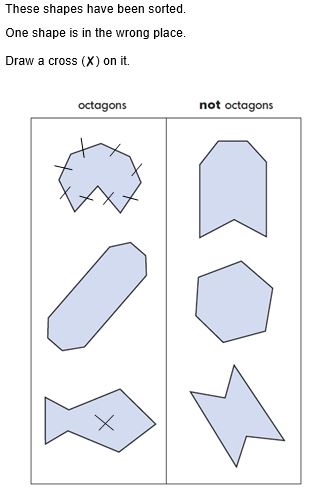
Before you start today’s activity, count in 2s, 5s and 10s (upto 24, 60 and 120). You could even teach someone how we use the cross crawl action when we count.
Today, we will be focusing on times tables. Remember in Year 2 we want you to try and learn your ten, five and two times tables (in that order).
1. Spend 10 minutes on Times Tables Rock Stars. Based on our checks in class, you have been set the times table that you need to practise. Please email (carolinetaylor@spherefederation.org) if you need help with logging in.
2.Complete the following number sentences. Remember to skip count on your fingers to help you.
3. Put the number sentences in order from from the lowest total to the highest total.
2 x 10 = __
6 x 5 = __
__ = 5 x 2
10 x 10 = __
0 x 5 = __
__ = 12 x 2
9 x 5 = __
1 x 2 = __
Challenge: Choose three of the above times table facts and write down the other facts you know using this information. For example, if you know that 4 x 10 = 40, you also know that 10 x 4 = 40, 40 ÷ 10 = 4 and 40 ÷ 4 = 10.
Task 3 Living and Learning
Our statement for this week is:
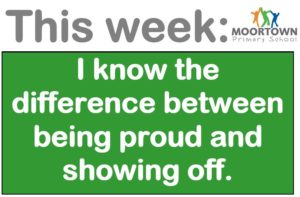
1. Tell someone what proud means.
2.Tell someone what showing off means.
2. Imagine someone has got first prize in a talent competition. Draw a picture of them (with two speech bubbles) telling a friend what has happened.
3. Use one speech bubble to show what they might say to their friend if they were feeling proud and in the other what they would say if they were showing off.
Challenge: What might you do if someone was showing off about something?
Finally, we’ve spotted lots of rainbows in windows as we’ve been out for our daily walk. Have you spotted any? Have you got one in your window? We’d love to see it!
25 March
Hope you are all set for today’s activities. You maybe starting to have some kind of routine or timetable now and as with the normal school day, remember to include plenty of brain breaks.
Physical activity: Joe Wicks’ live PE lesson is proving popular in our house – hope you are managing to join in too. It’s a great start to the day! Today, why not also try one of the many videos on GoNoodle. I know a particular class favourite is Banana, Banana, Meatball.
Mindfulness activity: Cosmic Kids Yoga have a variety of yoga, mindfulness and relaxation videos to follow online. Let us know which ones you’d recommend to a friend.
Well done to Leon who achieved his next Lexia level yesterday. Just 10/15 minutes a day can help your child to progress in their Lexia learning.
Here are your home learning tasks for today.
Task 1 reading
Reread the fluency text about polar bears from Monday. Today, read it aloud and take account of the punctuation in the text – a short pause for a comma and a longer pause where there is a full stop.
Hopefully you enjoyed the Pobble365 image from yesterday. There are no wrong answers for the questions that were set but it is always good if you can explain your answers by giving reasons based on the text/image. For example, maybe they had got the plane from a museum because it looks old.
Today, we have a poetry text including some of our spelling words this week.
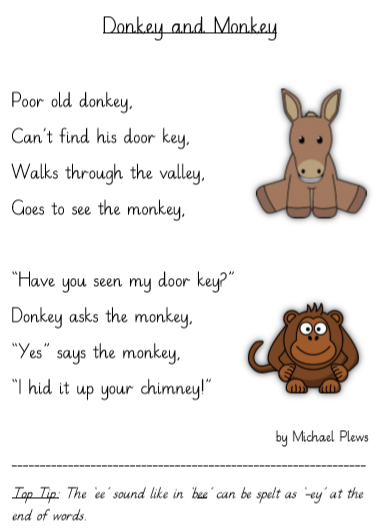
1.Read the poem aloud.
2.Read it again in a different voice. For example, an excited voice or a tired voice.
3.Copy out the words in the poem that follow the ey pattern like your spellings.
4.Think of other words that follow the ey pattern (Spellzone can provide some more if you get a bit stuck).
Challenge: Try and add a third verse following the pattern of the poem and including some ‘ey’ words.
Task 2 maths
Here are your answers from yesterday’s learning. How did you do?
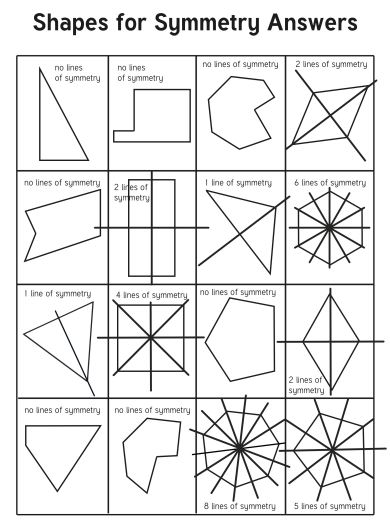
Before you start today’s activity, write out, in digits and words, the numbers from 0 to 20.
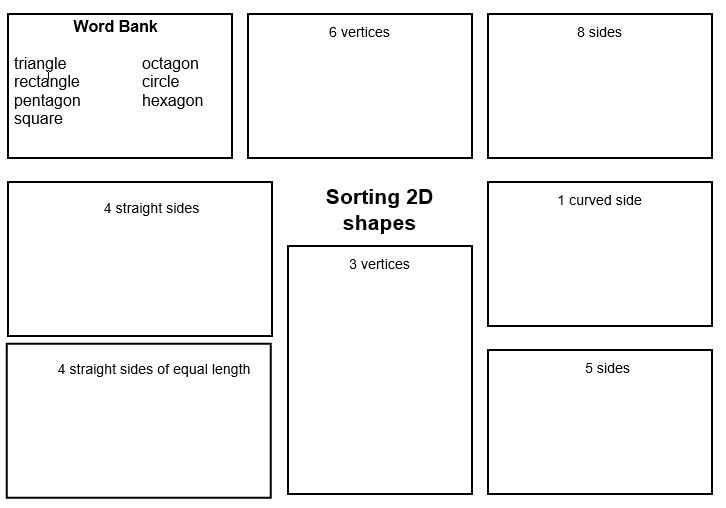
Today, we will finish our learning on 2D shapes with a sorting exercise.
1. Using the shapes listed in the word bank, sort them into the correct box.
2.Attempt to draw the shapes too.
Challenge: Complete the question below.
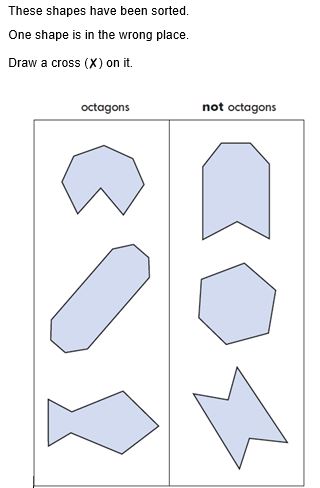
Task 3 Toys now and then
Imagine you have lost one of your toys (go and get it so you have it in front of you).
1.Write a description in sentences to help people find your toy.
2.Think about what adjectives you could include to give more description.
3. Include a picture of your toy too.
Challenge: Look at the adjectives you have used. Can you think of what is the opposite of these adjectives?
Finally, it would be great to see some of your home learning if you want to type it in an email (carolinetaylor@spherefederation.org and jackiefreeman@spherefederation.org) or send it as a photo. Keep working hard, everyone. You’re doing great!
24 March 2020: answers
Maths – LO: arithmetic
- 145 and 646
- 27 limousines are needed.
- 196 bundles with 4 left over.
- 4,263
- 691,247
- 16,539
- £1,140,697.25
- 650 divided by 12. She needs 54 boxes and there are 2 eggs left over.
- false, false, false
- 145,078
- 222,358
- 6 x 35 = 42 x 5
- difference = 4,950
Reading – LO: retrieval
- What did Odin want Freya to do? Command the weather and seasons.
- Why was it considered an important job? She had to get just the right amount of sun, snow, wind and rain.
- What was the name of Freya’s spouse? Odur
- What adjective was used to describe the cave/tunnel? dark
- True or false:
The sapphires in the cave were dazzling. false
The goblins’ skin was bumpy. true
The goblins gestured to the object on the floor. false - Find and copy a word which shows the goblins were stood together. huddled
- List two tools mentioned in the script. picks and shovels
- Match the adjective to the noun:
wet damp strange
noise air walls
damp – air
walls – wet
strange – noise - What garment is mentioned in the script? dress
- What event were Freya and her husband going to attend? a magnificent feast at Odin’s palace
- What was Freya’s intended destination when she left Asgard? Midgard
- List two ways from Loki’s speech that shows Freya did not want to kiss the goblins.
Freya was well shocked!
The thought of kissing those revolting faces!
Yuck!
she ran
24 March 2020: Home learning
Phonics
words to read:

words to write:
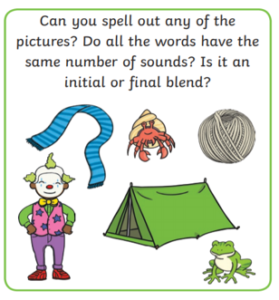
Phonics activity:
Write a sentence using one of the words you have written. For example:
The clown has a pink waistcoat
How did your child find the writing activity? Remember it’s OK for some words to be spelt phonetically. Encourage your child to write independently, rather than copy you.
Literacy
Choose a new book to read. Stop reading in the middle of the story. Can you guess what will happen at the end? Were you right?
What book did you read? What did your child predict? Let us know.
Maths: order numbers 0-10
Put the number cards from your pack in order. Can you find small objects to count to match. Count carefully!
What objects did your child use for the activity?
Extra activity
Did you make playdough? What did your child make?
Tuesday 24 March: Home learning
Good morning Year 2! Hope you all had a productive first day of learning at home. Here are your home learning tasks for today.
Physical activity: Who joined in with Joe Wicks’ live PE lesson yesterday? The 30 minute session can be accessed at any time if you miss it in the morning. The sessions will be running Monday to Friday at 9am. Today, why not also try one of the Super Movers videos if you need a brain break. Here’s a video about division.
Mindfulness activity: Starfish meditation – this is a great way to refocus the mind. Spread your fingers on one hand like a star fish. Slowly, trace your finger, from the other hand, around your fingers and hand. Continue until you feel calm.
Here are some of the words you may have selected from the fluency text yesterday as words that you are not sure of. We use the word synonym to show words that mean the same.
carnivore – meat eating
particular – special
depend on – need
generally – usually
social – to be with others
remarkable – amazing
detect – find
compacted -firmly pressed together
camouflaged – can’t be seen
harsh – severe
Task 1 reading
This image is taken from the Pobble365 . This website shows a different picture every day as a stimulus for learning. The children have seen these images before in class. Answer the following questions about the photo.

1. What do you think it is that Poppy and Jasper have seen?
2.Where do you think Poppy got the aircraft from?
3.What will happen next?
4.Where do you think they had planned on going?
5.Will they reach their destination?
Challenge: What could be a title for the image?
Task 2 maths
Before you start today’s activity, here is a game to play (test your number bond knowledge – up to 20 or up to 100).
We have recently been learning about symmetry especially relating to shapes. Watch this video to remind yourself of what it means.
1.Look at the 2D shapes below. Which shapes are symmetrical?
2. Which shapes have more than one line of symmetry?

3.Play this game to check your understanding of symmetry.
Challenge: Which capital letters have lines of symmetry?
Task 3 writing
Look back at the Pobble365 image. Here’s a story starter.
Flying is supposed to be fun, right?
Poppy often dreamed about what her first flight would be like. She’d imagined it was like being a bird; free and weightlessly drifting through the clouds.
The first part of the journey had been exactly as she’d hoped it would be. Jasper agreed, signalling his enjoyment by barking enthusiastically from the co-pilot’s seat.
Things were about to take a drastic turn for the worse…
1.Continue the story. What could happen next?
Challenge: Use two different conjunctions in your learning (such as because, but, and, so, when or if).
Ordering numbers to 50
The children ordered numbers from largest to smallest using tens and ones. Using the ten sticks, the children were able to see which number is largest. If the numbers had the same about of tens, they looked to see which number had more ones.


Phonics
Thank you for attending our Phonics Mornings this week- we hope you found it useful.
Below are sentences taken from ‘Letters and sounds’ which your child can write independently using their phonic knowledge.
Mark and Carl got wet in the rain.
The farmer gets up at six in the morning.
Jill has fair hair but Jack has dark hair.
Jim has seven silver coins.
I can hear an owl hoot at night.
Nan is sitting in the rocking-chair.
Bow down to the king and queen.
Gurdeep had a chat with his dad.
I can see a pair of boots on the mat.
It has been hot this year.
Don’t forget to let us know about the writing and reading your child is doing at home.
moortowneyfs@spherefederation.org
We Love Reading
As part of our homework review, Year 4 were invited to bring in their favourite book to share with the class. There was a really good range of books and we saw lots of books from other children that we’d like to read ourselves.
In tables, we shared our book and showed really great listening skills by looking at the speaker and asking questions to find out more.
There was some lovely homework to share too with Amrit M’s, Tanvi’s and Edris’ standing out. Well done.


Living and Learning: Be kind
Today, in Living and Learning, we had a powerful circle time with an important message.
In order to illustrate the effects of saying unkind words, we used two apples (one of which had been bruised).
We gave the first apple a variety of compliments and positive, kind comments as we passed it around the circle.
With the bruised apple, we passed it round and said unkind words and negative comments.
We looked again at both apples, and there was no change; both apples still looked the same. We then cut the apples open. The apple we’d said unkind words to was bruised and all mushy inside.

We talked about what we saw inside the apples. The bruised and mushy apple showed what would be happening inside every one of us if someone uses unkind words.

Living and Learning: Being Me
- I cover my mouth (when I yawn, cough, sneeze). Get your child to demonstrate the ‘vampire’ method to family members at home.
- I can say something good about myself. It’s important that your child can confidently talk about themselves in a positive way.
- I pay and receive compliments in a sensible way. Try paying compliments each day to each other! Some children struggle to hear positive words about themselves, but this is important for self-esteem. Try paying (and listening) to praise and compliments.
- I recognise my talents. Talk to your child about talents, whether academic, physical, social or emotional. Some of us may have a natural talent, but most have talents that derive from lots of practice.
- I know the difference between being proud and showing off. We encourage compliments to be paid – but encourage your children to know the balance between being having self-esteem and showing off.
- I use good table manners. This is another manners-related Living and Learning statement. Think about good table manners at home – not pointing our cutlery at someone or speaking with food in our mouths, for example.