This week, our spellings are Year 1 high frequency words. These are common words and appear very often in written texts.
| were |
| there |
| what |
| when |
| out |
| oh |

This week, our spellings are Year 1 high frequency words. These are common words and appear very often in written texts.
| were |
| there |
| what |
| when |
| out |
| oh |
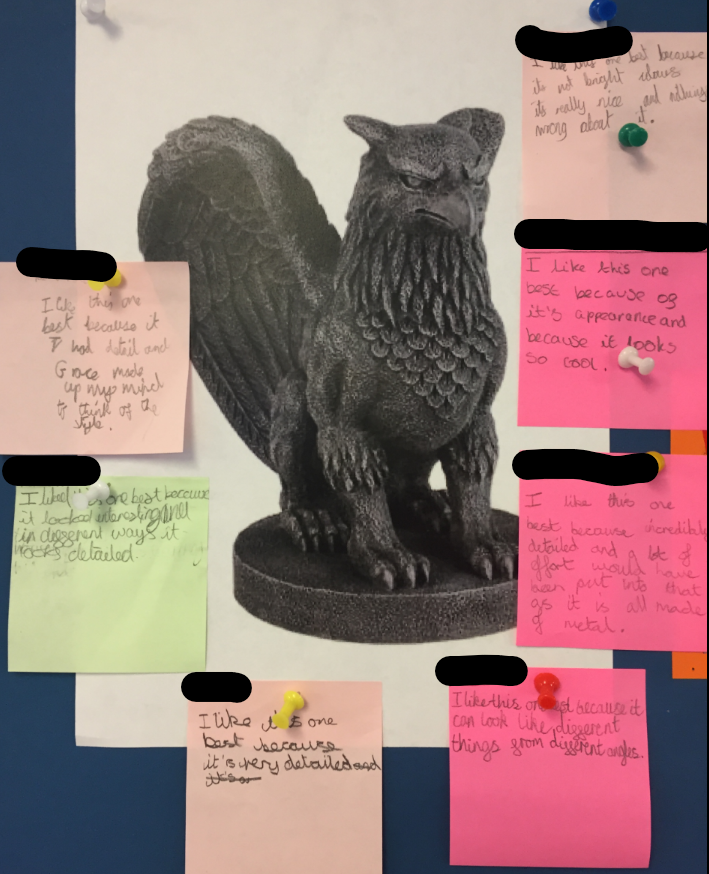
As part of our topic learning around Fighting Fantasy, we’re working towards creating a modroc sculpture of the sort of creature you might come across in Firetop Mountain.
Today, we thought about what sculpture is, looking at some examples and discussing which we like best and why. At home, share any sculptures you know about and see whether your child likes it and why/why not.
We continue to work our way through the Year 5/6 spelling list. Create ways for you to remember how to spell these words and generally practise using the strategies in the back of your homework book. Don’t forget to try adding prefixes and suffixes to the words. Spelling practice is best done little and often so make sure you come back to the spellings at least three times in the week. Date your practice and ask an adult to sign it to show that you’re practising regularly. There will be a test on Friday 2 March.
We hear so many scare stories and myths about health and safety that it’s easy to pour scorn on anything remotely related to the topic. However, as a school, we need to know that our buildings and our practices are safe and secure for your child and his/her teachers.
Just like we’re happy to invite a fresh pair of eyes into school to evaluate the quality of teaching and learning, we do the same – invite an expert from Leeds City Council – to check on health and safety aspects of our school.
We’re delighted that our school was judged to be outstanding in terms of health and safety, following a recent inspection (o4 February 2019).
The inspection was really thorough, covering 166 checks and giving ratings of high, medium; low/no priority. The school was rated 99% (a rating of over 90% ranks as ‘outstanding’.)
Moortown Primary is a happy, healthy and safe place to learn!
On Saturday 09 March at 10:00am, a litter-picking session at Moortown Park will take place, organised by the Friends of Moortown Park Committee.
The Chair, Pat Ingle, writes:
Your help is needed please. We are running a Litter Picking event on Moortown Park starting 10.00am on Saturday 9th March and it would be great to see a small army of helpers to make light work of it. Volunteers should please meet at the entrance to the Park from the Parklands Estate (end of Lime Tree Avenue), at the opposite end of the main path from the Shadwell Lane entrance. Children accompanied by parents will be a welcome addition to the team on the day. We will be joined by our Ward Councillors.
Please wear footwear, gloves and clothing suitable to the conditions, bearing in mind that quite a bit of rubbish is caught in undergrowth. I have some rubbish bags and we will be arranging with the Council for the collected rubbish to be removed promptly the next week. I have just a few pairs of gardening gloves for those without, as well as a small number of litter picker arms.
Please note there are no refreshment or toilet facilities onsite.
Moortown Park has now been open for approaching 2 months and I think we can all agree on how wonderful this new green space is for the community, clearly evidenced by the substantial number of people using the park. I would like to thank the Council and some wonderful individual litter pickers who have already done some of the cleaning up of past rubbish from before and during the development of the park, but it would be fantastic to see the initial clean up completed and the park looking ready apart from the final seeding in the Spring.
I look forward to seeing you at this first community event.
After conversations had at parents’ evening, here is a list of some areas of maths that we don’t cover in a lot of detail in Year 6 as they’ve been taught lots in previous year groups. Using the revision guides sent home, the tests the children have brought home and your own ideas, see whether you and your child can practise these skills at home and become really confident with them.
Staying safe in the environment was one of our main areas of learning during ‘Staying Safe Week’. Year 1 went on a walk around the local area and to the park to see what dangers there might be. The children were very knowledgeable about road safety and stated the importance of staying well away from the road when walking on the pavement. Fortunately, we didn’t have to cross any roads but the children had remembered the Green Cross Code in case we needed it. We also discussed the importance of staying in sight of the adult you are with and not talking to strangers.
Whilst at the park, we had a good look at the equipment and decided that it was not safe to play because it was too wet and slippy. Hopefully we can visit the park again when the equipment is safe to play on.


 o


This week, our spellings are Year 1 high frequency words. These are common words and appear very often in written texts.
| could |
| down |
| from |
| have |
| here |
| him |
The Canals and Rivers Trust worked with us today to discuss how we can be safe near water. The children were really good at spotting what would be a hazard but they learnt lots of new, useful information too.
We know not to jump in after somebody if they are in trouble in the water. At home, ask us why this is important.
We know how to use a life belt properly. At home, see whether we can tell you the dos and don’ts of this.

And, we know what we can do to help somebody who is in trouble in the water (while waiting for a response from 999), keeping ourselves safe too. A home, ask us what we could use instead of a rope to help somebody…
…and, find out why one of us is lying on the ground during this rescue attempt – they’re not just being lazy!
Continuing our learning about staying safe, Y6 went to Allerton Grange today to use their climbing wall. Not only did we have a great time, but we learnt about why the harness and helmet were essential for this sort of activity and were taught how to behave when undertaking an activity with greater risk involved.
The children loved the climbing; many conquered fears; and their behaviour was exemplary.
Miss Rushbrooke learnt how to keep others safe too by being the belayer for the climbers.
Lots of us made it to the top and those that didn’t pushed themselves out of their comfort zone.


