This week’s message (Friday 07 July 2023)

This week’s message is a short one, starting with a reminder of the our annual Summer competition…

Big brains

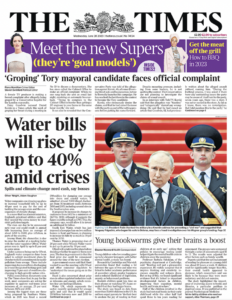
A recent news article caught our eye – front page of The Times (28.06.23):

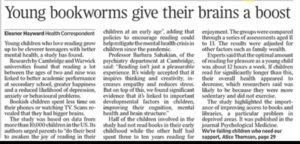
Here’s an extract from the article:

Young children who love reading grow up to be cleverer teenagers with better mental health, a study has found.

Research by Cambridge and Warwick universities found that reading a lot between the ages of two and nine was linked to better academic performance at secondary school, greater happiness and a reduced likelihood of depression, anxiety or behavioural problems.

Bookish children spent less time on their phones or watching TV. Scans revealed that they had bigger brains.

The research authors stressed the value of parents and carers ‘doing their best to awaken the joy of reading in their children at an early age’. The reaserch suggests that the ideal would be for children to read about 12 hours each week.

Talking of reading…

Extreme reading

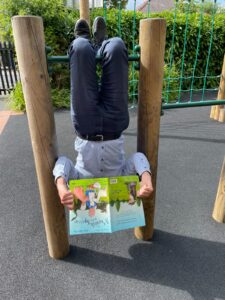
Here at Moortown Primary, we love reading. Over the Summer holidays, we’ve a challenge for your child… Show us how reading-obsessed they are by sending us a pic of them reading in an extreme place or position.

Here’s someone who’s already getting stuck into some extreme reading. (can’t think who it could be!)…

To enter, email your pics to [email protected] by Friday 08 September. Enter ‘Summer competition’ as the subject.

All entries will be displayed in school, and there are prizes for our favourites.

Governance

Each year, the Sphere Federation governors produce a document that outlines their work over the year. Read the 2022-23 Annual Governance Statement.

Finally, in case you missed it, check out Mrs Weekes’ post from a few days ago which describes the themed week coming up next week. 

07 July 2023

This Talk Time relates to your end-of-year report.

I can talk with adults at home about my report, recognising successes and strengths.

It’s important to remember that your achievements come in many forms. Your key strengths could relate to your learning behaviour, your attainment in a particular subject, or your speed of progress.

This is also a great opportunity to apply your understanding of the 8Rs for learning:

  • responsive
  • ready
  • (safe) risks
  • responsible
  • resourceful
  • resilient
  • remember
  • reflect

Being reflective will be the most prominent of the 8Rs in your conversations as you’ll identify successes recognised by your teacher in the report but also other strengths that you’re aware of. Consider which of the other 8Rs you currently excel at the most. Perhaps you’re a very responsible individual who always demonstrates good learning behaviour. Maybe you’re extremely resilient and have a never-give-up attitude. It could be that you’re very resourceful, using what’s around you to support your learning and not always seeking help right away.

Living and learning: body image

In Living and Learning we are learning about body image.

Body image describes our idea of how our body looks and how we think it is perceived by others. This can include our thoughts and feelings about our height, weight, shape, skin, colour, and our appearance and attractiveness more broadly.

We started our session by looking at adverts and discussing whether what we saw in the adverts was real or fake. We then talked about the implications that adverts/media can have on our self esteem and body image.

We talked about the fact that we are all different and therefore all look different. Year 3 discussed how we should be confident in who we are – love ourselves and our bodies and not comment on other peoples.

Year 3 also shared how although we can sometimes be aware of what we look like – it’s what’s on the inside that counts!

Help at home by asking your child what they like about themselves. This links to last week’s Living and Learning statement – I can say something good about myself.

This week’s message (Friday 30 June 2023)

This week’s message comes from the Junior Leadership Team. Before this, just a wee reminder: the last few weeks of the school year are busy (annual reports, productions, sports day…) so it’s a good idea to check out our school calendar.

Hello

We are the Junior Leadership Team (JLT) and we’re very excited to let you know what we have been doing this year.

In the Autumn term, we were elected by our classmates to represent their views and enable their voices to be heard. We act as good role models for others by acting maturely and respectfully at all times. We are involved in making decisions on behalf of the school and its pupils eg we were responsible for choosing new playground equipment and markings and selecting the Key Stage 2 Reading Champion.

At the start of the year, we reviewed the Anti-Bullying Policy. We made sure that children would be clear on what bullying looked like and where to ask for help if needed. Another of our early tasks was to select our school charity. Each JLT member led a vote in their classes for their favourite charity. These nominations were discussed in a JLT meeting and then a democratic vote took place. As a result, St. Gemma’s Hospice became our charity this year. We are very proud to have raised over a thousand pounds for St. Gemma’s and £238.30 for Comic Relief. We have done this by organising many fundraising events eg a sponsored number challenge, carol singing outside M&S and a Year 3 /4 production. We could not do this without your generosity or support – thank you.

One of our favourite activities this year was to visit St. Gemma’s Hospice and have a tour of the grounds. We really enjoyed walking in the garden, which was a very relaxing and calming experience.

In the Autumn term, it will be time for the new JLT elections. It will be our time to step down and allow others to enjoy the experience of representing our school and making positive changes.

Thank you to everyone who has supported us this year.

30 June 2023

This week’s Talk Time relates to the knowledge we’ve gained about Science this half term.

I can show off my biological knowledge through my understanding of animals including humans.

Years 1 and 2 – Animals including humans:

  • I know that animals, including humans, have offspring, which grow into adults.
  • I can find out about and describe the basic needs of animals, including humans, for survival (water, food and air).
  • I can describe the importance for humans of exercise, eating the right amount of different types of food, and hygiene.

Years 3 and 4 – Animals including humans:

  • I can describe the simple functions of the basic parts of the digestive system in humans.
  • I can identify the different types of teeth in humans and their simple functions.
  • I can construct and interpret a variety of food chains, identifying producers, predators and prey.

Years 5 and 6 – Animals including humans:

  • I can identify and name the main parts of the human circulatory system, and describe the functions of the heart, blood vessels and blood.
  • I am aware of the impact of diet, exercise, drugs and lifestyle on the way my body functions.
  • I can describe the ways in which nutrients and water are transported within animals, including humans.

At school, we refer to 8Rs to promote good learning behaviour:

  • responsive
  • ready
  • (safe) risks
  • responsible
  • resourceful
  • resilient
  • remember
  • reflect

This week’s ‘Remember 2s’ (R2s) directly link to three of the 8Rs:

  • Remember – Think back to Science lessons, learning, tasks, games etc.
  • Reflect – Which facts are you most confident with? Which ones do you need to work on?
  • Resourceful – For facts you’re unsure of, how can you improve your understanding? Who could you ask at home or at school?

Year 5/6 only – complete your My Health My School pupil diary from Saturday 01 July for the next seven days and return it to class once completed

We are biologists!

This half term in Science, we are biologists. 

We are learning about teeth and eating.

Last week, we conducted a comparative test to see the impact of different liquids on our teeth. We used an egg as the ‘tooth’ as egg shells are similar to teeth enamel.

We placed eggs in orange juice, Coca-Cola and vinegar. A further egg we covered in toothpaste and placed in Coca-Cola to see if it protected the egg.

We left the eggs over the weekend and observed and recorded our results when we came back to school on Monday.

We found that the Coca-Cola had discoloured the first egg but the toothpaste had protected the other egg.

The orange juice had caused the shell of the egg to start cracking and decaying!

Help at home by asking your child what could happen to their teeth if they drink sugary drinks and forget to brush their teeth!

This week’s message (Friday 23 June 2023)

We kick off this week’s message with early news of our annual Summer competition…

Extreme reading

Here at Moortown Primary, we love reading. Over the coming weeks, we’ve a challenge for your child… Show us how reading-obsessed they are by sending us a pic of them reading in an extreme place or position.

For last year’s competition, we gave you a few ideas for your happy and healthy smiley faces spotted in unusual places. This year, we’re not giving you any ideas (yet!), but you’ve plenty of advance warning, so get your thinking caps on!

To enter, email your pics to [email protected] by Friday 08 September. Enter ‘Summer competition’ as the subject.

All entries will be displayed in school, and there are prizes for our favourites.

Our current topic…

…is a Design and Technology one – it’s a great topic to finish the year! The focus for all classes this year is construction (next year, it’s textiles) so children are busy designing and making products.

A key aspect of the Design and Technology curriculum is the understanding that products don’t just get made. Instead, they go through a design process that includes three key elements: evaluate, design and make. Think of this process as a cycle. For example, Sphere Motors want to create a new family car. Before the car is made, they need to evaluate existing products and talk to customers so that they’re clear about what the new car needs to have. They will then design the car and evaluate those designs. They may make a prototype of the car to help them evaluate the designs. Next, they’ll decide on a final design that will go into production and get made. This finished product will be evaluated and the whole process starts again.

Years 1 and 2

Children have been exploring what makes structures stable and strong. Next, they’ll get their design brief: to design and make a new chair for Baby Bear (clumsy Goldilocks has broken it again). Children will design and make their product, using what they’ve learned about strength and stability to help them. Finally, they’ll evaluate the product by testing it and reflect on what they would change about their design to improve it.

Years 3 and 4

Children will use a construction kit called Techcard to design and make a prototype of a go-kart which must satisfy a number of design criteria. They’ll explore how to make strong structures and mechanisms using Techcard before designing and making their prototype. Finally, children will evaluate their finished product by comparing it to their design and testing whether they have achieved the design criteria.

Years 5 and 6

Children have begun the topic by learning about pioneering female designers and engineers.

They then move on to designing and making a moving vehicle which most protect Eggy the Egg in a crash. They’ll need to research and learn about the different safety features that cars use to prevent crashes and protect passengers. They’ll then establish the design criteria and design and make their vehicles. They’ll be using a range of tools and materials to make their vehicles. Finally, children will test their vehicles against each design criteria to see how successful it is. They’ll then evaluate the vehicle based on the results of the tests to suggest improvements.

How can you help?

Talk to your child about what they’ve been learning in class. You could even talk through the three key elements of the design process: evaluate, design and make (check out Sphere Motors, above).

The class news page of the school website is a good place to go to find out more about what the children are doing.

The school library and local libraries will have some books about Design and Technology which your child will be able to borrow and develop both their reading skills and design knowledge.

Finally, there’s a lot of programmes on CBBC and CBeebies with a Design and Technology focus:

  • Bitz and Bob
  • Grace’s Amazing Machines
  • Junk Rescue
  • Maddie’s Do You Know?
  • The Dengineers

Uniform update

Each year, we review our Uniform Policy. This year, there’s only a tiny tweak about footwear to make things clearer for you: ‘choose shoes that are safe to run around for healthy, active playtimes’.

Talking of uniform, please remember a couple more points:

  • ‘Regarding jewellery, only plain stud earrings (no more than 4mm wide)…are allowed.’ We’ve started to notice more earrings that are bigger and brighter – please save those for weekends and holidays!
  • ‘Advisors recommend no earrings are worn for PE; therefore, we will ask your child to remove earrings before the lesson and put them back in after the lesson. This will be carried out by the child. If they are unable to remove or put their earrings back in by themselves, they must not wear them on the day they have PE.’ – so the start of the Summer holidays is a good time for ears to be pierced.

Thanks for your cooperation.

That’s all from us this week – enjoy a happy and healthy weekend (maybe the whole family will get up to some extreme reading!).

23 June 2023

This week’s Talk Time has a social theme:

I can talk about a healthy friendship I have.

A friendship is something we can choose to have and it should make us feel happy and secure. Healthy relationships are positive and welcoming towards others, and do not make others feel lonely or excluded. When thinking about a healthy friendship there are some important characteristics to consider such as mutual respect, truthfulness, loyalty, kindness, generosity, trust, sharing interests and experiences and support with problems and difficulties.

Think of someone in your life who you feel you have a healthy friendship with. Discuss why you feel it is a healthy relationship by linking it to some of the important characteristics listed above.

Encourage your child to think about what they would do if they were having difficulties with a friendship and who could help them.

Living and learning: RSE

Last week in Living and Learning, Year 3 were learning all about pants from Pantosaurus!

While we had a lot of fun singing along, the lesson carried a very important message. We had a very mature conversation about how what is in our pants is private and what to do if someone makes us feel uncomfortable.

Help at home by reading the NSPCC guidance on how to speak to your child about pants.

https://www.nspcc.org.uk/keeping-children-safe/support-for-parents/pants-underwear-rule/


This week’s message (Friday 16 June 2023)

Hot, hot, hot! Despite the weather, there’s still loads of learning happening at Moortown Primary!

We start this week’s message with with an important change…

Our school day

Some time ago, the Government published a White Paper setting out various proposals which included the strong expectation that schools are open for 32.5 hours each week. Following the consultation, the White Paper was cancelled. We assumed the ‘strong expectation’ would also be no more.

Frustratingly, the expectation remains in DfE and Ofsted publications – this wasn’t clear earlier in the year.

This means we need to add five minutes to the school day. We’re going with the overall preference from the parent/carer consultation earlier in the year, which is to add the five minutes to the start of the day. This means our school day from September will be 08.45 – 3.15, every day.

I’m sorry for the confusion and change.

As always, if you’ve questions, comments or concerns, please do let me know.

Testing times

The end of the school year brings with it many assessments, some we have to do and others are to help us keep track of all our pupils’ learning.

The DfE has updated its collection of information for parents. This now includes links to all National Curriculum assessment leaflets for parents, including leaflets for the:

  • KS1 and KS2 national curriculum tests (Year 2 and Year 6 pupils)
  • reception baseline assessment (RBA)
  • phonics screening check (Year 1 pupils, and some Year 2 pupils)
  • multiplication tables check (Year 4 pupils)

In school, we really try to make sure all the assessments are as positive as possible.

Our annual survey

Thank you to everyone who completed the annual survey this year. The survey closed at noon today. We’ve had over 50 responses, almost all extremely positive (for example: ‘This school is a gem… We feel honoured and proud that our child has this wonderful opportunity to be among talented students and looked after well qualified teachers and staff.’).

We’ll spend some time reviewing the responses. Just like in previous years, we’ll get in touch with any individual parent / carer in advance if they’ve raised any specific issue (as long as they’ve provided their name), and we’ll look at some of your suggestions for improvements.

Staying safe in the water

Next week is Drowning Prevention Week. Here’s a few facts to think about:

  • around 44% of accidental drownings happen between May and August
  • 62.4% of accidental drownings happen in inland water
  • accidental drownings takes an average of 402 UK & Irish Citizens every year          
  • lack of confidence and competence in water affects survival rates 
  • more than 46% never intended to be in the water

Spend some time with your child talking about staying safe in and near water.

Have a happy and healthy – and safe – weekend.