This week’s message (Friday 20 January 2023)

Today’s message is a long one. Hopefully, the sub-headings later on will help you to read the parts that matter most to you. We do encourage you all to read this next bit…

Did your child get an electronic device for their Christmas?

Recently, Ofsted’s chief inspector, Amanda Spielman has said she is ‘not comfortable’ with primary school aged children having unlimited internet access. She said there was a ‘great deal’ that could be done to really limit the content to which young children are exposed: ‘The first thing you can do is not give a child a smartphone when they’re too young,’ she said. ‘I’m very surprised when primary aged children have smartphones, for example, and even in early secondary school. It’s really hard to manage that.’

Whether you agree with her or not, the reality is that we’re having to increasingly address problems that children encounter online at home, especially bullying comments on WhatsApp (despite a minimum age of 16).

I had a chat with a parent this week about this. It was great to hear that she had rules in place at home for her children and online devices:

  • sitting alongside the children, Mum or Dad check the devices regularly – knowing this means that children moderate their own behaviour and have set opportunities to talk about things that might be concerning them
  • the devices are kept downstairs – the more ‘public’ space means that children make the same good choices they would do in the playground and other spaces and have plenty of opportunity to talk about what they’re doing and seeing

These two simple rules mean that online behaviour is open – nothing is secret.

If you’ve not already done so, please draw up a few ground rules to stay safe online.

Watch us while we work

Next Thursday (26 January), we’ve another session where we invite you into school to check out the teaching and learning. Come and join us in the classroom to watch us. It’s an opportunity to see some Maths and Reading being taught – it might help to support your child at home.

Safer Internet Day

On Tuesday 07 February, we’ll join schools across the UK in marking Safer Internet Day 2023. Safer Internet Day is a global campaign to promote the safe and responsible use of technology, which calls on children and young people, parents, carers, teachers, social workers, law enforcement, companies, policymakers and more, to help to create a better internet.

Using the internet safely and positively is a key message that we promote in school. Safer Internet Day is an opportunity for us to re-emphasise the online safety messages we deliver throughout the year.

Please continue the conversation at home – use these activities and information to help you. Whether you have five minutes to start a conversation or hours to spare, there are top tips, quizzes and films which you can use at home with your child.

If you have any concerns or questions about keeping your child safe online, please do get in touch with your child’s class teacher or Mrs Weekes.

Speak out, Stay safe

Teaching children how to talk about their worries to stay safe is so important. Next week, as part of our Living and Learning lessons, all classes will be completing the NSPCC Speak out Stay Safe assemblies to ensure our pupils know what to do and who they can speak to.

The NSPCC has also developed an adapted version of their assembly for parents/carers to use at home with their children.

To complement the assembly, there are some resources that can be used to enable further discussion whilst doing activities with your children.

You’ll also find online safety information for families of children with additional needs and disabilities.

Childline also have a website with age-appropriate advice for primary school children on topics such as bullying. It also has games and other interactive tools.

Governor elections

Well done to Scholes (Elmet) parent, Liam Ffrench, who has been elected as Sphere Federation’s new parent governor. Thank you to all three candidates, and thank you to you if you voted.

Industrial action

Earlier this week, we sent a message about the forthcoming strikes:

Yesterday, the National Education Union (NEU), one of the trade unions representing the teaching profession, announced its intention to strike.

For schools in our region, the dates of the planned strikes are:

  • Wednesday, 01 February
  • Tuesday, 28 February
  • Wednesday, 15 March
  • Thursday, 16 March

In some schools there may be little or no impact from strike action but in others it may mean that changes are made to the way they operate – this includes partial or full closure.

At the moment, we are not in a position to indicate whether Moortown Primary will be affected.

We will keep you informed. In the meantime, it would be advisable to prepare for some disruption on the days listed here.

We understand this is frustrating and that it might seem like there are mixed messages: if teachers strike, how can we refuse term-time holidays, for example. To be clear, it is one teachers’ union that is currently striking and this union argue that there are strong reasons to strike for the long-term benefit of pupils. There are other teachers’ unions who are not currently striking. Mrs Weekes and I are currently assessing the possible impact of the strike days. We’ll let you know as soon as we can.

With our very best wishes for a happy and healthy – and warmer – weekend.

20 January 2023

This week’s Talk Time is linked to our current topic Geography and has a social theme.

What could we do in our local environment to make a positive impact on the world?

Within our Geography lessons, we’re learning about the term ‘interdependence’. This is the dependence of two or more things on each other. Interdependence is closely linked to our Talk Time this week as there are things that we do on a local scale that have consequences on a national and international scale. For example, if you live within walking distance from school you could choose to walk rather than drive. This would impact the world in a positive way as there would be one fewer cars on the road, helping to reduce the CO2 emissions.

Use this time to have a discussion at home with family and friends. You could think about the following:

  • What have you seen around your local area that has been designed to support the local environment? (i.e. recycling areas, litter picking)
  • How does this have a positive impact on the world?
  • Is there a change you could make in your life to help the local environment?

Living and Learning: drugs, alcohol and tobacco

The last couple of weeks have been focused on talking about drugs, alcohol and tobacco. Year 3 took part in some great learning about these substances so that once they are old enough, they can make safe and informed decisions on what they choose to do.

Our circle time was focused on this, too! We spoke about how we can stay healthy and included time to discuss how these substances can impact our health, either positively or negatively.

Help at home by asking your child how they can keep themselves safe regarding alcohol, drugs and tobacco.

This week’s message (Friday 13 January 2023)

Thanks for all the compliments about the after-school clubs we’re offering this term – everything from art to yoga!

This week’s message is from Mr Wilks, our leader for Science and Foundation Subjects…

We’ve just started a Geography topic in school.Before we dive right in, here’s a reminder about topics and what they look like.

What do we mean by topics?

Topics are the vehicle for delivering much of the learning in the foundation subjects (eg History, Art, Geography). Each half-termly topic has a driving subject – the main focus for teaching pupils the knowledge and skills they need to succeed in life. The driver changes with each topic to ensure a broad and balanced curriculum.

Although the learning in each topic is provided by the driving subject, there are opportunities for enrichment through other subjects. For example, learning in a history-driven subject may be enriched by observational drawing of an artefact. In this example, the enricher is art.

For more information about the intent, implementation and impact of our topics, click here.

What is this half-term’s topic?

This half-term, your child is a geographer. The topic focusses on either environmental issues or natural disasters. Children in Years 1 and 2 will investigate their locality; Years 3 and 4 children will learn about volcanoes; and Y5,6 children are investigating climate change.

Across the year groups, children will develop their understanding of some key geographical concepts:

  • location is a position (eg a country, a city), often described in a clear, precise way (ie using a latitude and longitude).
  • place = location + meaning. It is constantly changing. A sense of place is also defined by how an individual perceives it (eg one person’s perception of Leeds or Wetherby as a place will be very different to another’s).
  • scale is the relative sizes of different places. This could be differences in area, population, distance or the amount of natural resources. Scale is also defined by our view of the world. We may consider an aspect of geography on a local, national or international scale eg climate change.
  • interdependence is the idea that the world is connected. No country or individual acts in isolation. Our actions here affect people in different countries around the world. This can be related to where we get our food and energy, where we go on holiday, or the effects of climate change across the world.

Check out our Curriculum Statement for more information about key concepts (page 17) and age-related expectations and vocabulary (page 22 and 23).

Years 1 and 2

Children begin the topic by learning about the four countries and capital cities that make up the United Kingdom. They then go on to learn about the difference between human and physical geography features. They’ll then investigate human and physical features in their locality. The key part of this topic is to investigate their locality and identify what they like about it and why. They will also investigate something that could be improved and how it could be improved. For example, they may notice that litter is an issue and raise awareness of this issue with their peers in school, local residents and even a local councillor.

Years 3 and 4

Children will be learning about volcanoes. They’ll begin by learning about what lies beneath the Earth’s surface. They’ll investigate plate tectonics and how these move and the different types of volcanoes formed by this movement. They’ll learn about how mountains are formed and name and locate the tallest peaks in the UK – did you know that these peaks are the remains of ancient volcanoes? Next, they’ll move onto some specific case studies: Eyjafjallajökull in Iceland and Mount Vesuvius in Italy. They’ll investigate how volcanoes can be dangerous but also bring benefits to the people who live in their shadows.

Years 5 and 6

Children are learning about climate change. They’ll begin by learning about latitude and the link to world climate. They’ll then learn about what climate change is and what is causing it. They’ll then look at three case studies to learn more about the consequences of climate change across the world: melting sea ice in Greenland, rising sea levels in the Solomon Islands and coastal erosion in East Yorkshire. Finally, they’ll consider how climate change can be slowed and whose responsibility it is.

How can you help?

Regardless of the year group your child is in, Google Earth is a brilliant tool to help develop children’s understanding of space, place, scale and interdependence. Zoom right in on your home and then zoom out to reveal the area of Leeds that you live in. Zoom further out to see what city you live. Zoom further for the county. A little further and you might start to spot some national parks. Further still and you can see the country that we live in. Keep zooming and you’ll see the continent we live in (though this isn’t labelled). Before you know it, you’re floating in space and circling the Earth!

Google Maps is another great tool for comparing places.

  • Year 1,2: Can you find your school? Your classroom? Your house? Your local park?
  • Year 3,4: Can you locate the two volcanoes you’ll be studying? Can you zoom into the craters? What similarities and differences can you see?
  • Year 5,6: Use this mapping tool to investigate how a place has changed over time. We’ll be focusing on coastal erosion but you could find where you live and compare today’s map with one from fifty or a hundred years ago. What has changed and what has stayed the same?

Quizzing your children about some locational knowledge will help them to remember important information. I’ve listed some examples below. Use the age-related expectations to find the right pitch for your child.

  • Which continent do we live in?
  • Which country do we live in?
  • In which hemisphere is our country located?
  • Which county do we live in?
  • Which city do we live in?
  • Which part of Leeds do we live in?
  • Which four countries make up the United Kingdom?

Go to the library and get some geography-related books, especially an atlas. You could compare maps of the same place to see what type of information they show. For example, you find lots of maps of the United Kingdom. One might show the countries and capital cities. Another might show the mountains, rivers and National Parks. Another might give information about the climate.

For KS2 children, there are lots of different games and activities on the Ordnance Survey Mapzone website. I especially like the jigsaws in the Map Puzzles section of the Games. Click here for the website.

Also for KS2 children, there is lots of information and some tasks and quizzes on the BBC Bitesize website.

13 January 2023

Vocabulary is the focus of this week’s homework. This is because we’ve just begun a new Geography topic and with it comes new Geography vocabulary.

Here’s a list of key words that are being learnt and applied as part of our learning. Over the half-term, practise using these words with your child.

Years 1 and 2 Geography vocabulary:
• locality: an area or neighbourhood
• environment: the surroundings of a human, animal or plant
• recycling: turning waste into new materials
• pollution: something harmful or poisonous in an environment
• to survey: to find the opinions of a group of people by asking them questions
• physical geography: physical geography looks at the natural things in our environment
• human geography: human geography looks at changes in the environment by humans
• issue: an important topic or problem that needs discussion
• solution: a way of solving an issue or problem

Years 3 and 4 Geography vocabulary:
• tectonic plates: different pieces of the Earth’s crust which fit together like a jigsaw and move in different directions and at different speeds
• volcano: an opening in the Earth’s crust that allows magma, ash and gases to escape
• magma: molten rock (rock so hot that it has turned into liquid) which is underneath the Earth’s crust
• lava: when magma reaches the surface of the Earth it is called lava
• active volcano: these have a recent history of eruptions and are likely to erupt again
• dormant volcano: these have not erupted for a very long time but may erupt at a future time
• extinct volcano: these are not expected to erupt in the future
• land-use: the specific purpose that an area of land is used for
• geothermal: heat produced from within the Earth (geo means earth and thermal means heat)

Years 5 and 6 Geography vocabulary:
• climate zones: different parts of the world grouped by temperature and rainfall (eg the Met Office give six: arid, equatorial, Mediterranean, polar, snow and temperate)
• climate change: a change in climate (temperature and rainfall) over a period of time (also known as ‘climate crisis’ and ‘climate emergency’)
• global warming: an outcome of climate change: a gradual increase in the overall temperature of the Earth (also known as ‘global heating’)
• latitude: imaginary lines which show how north or south a place is (the equator is the best-known line of latitude)
• fossil fuel: a non-renewable energy source, formed from the remains of plants and animals that died millions of years ago (eg coal, oil, gas)
• renewable energy: a source of energy that is sustainable so it will never run out (eg wind energy, solar energy, tidal energy)
• emission: an emission is something that been released into the world (eg carbon dioxide is an emission created when fossil fuels are burned)
• erosion: a process where materials are worn away and transported by natural forces such as wind or water
• groyne: a low wall or barrier built out into the sea from a beach to slow erosion

Some of these words have been introduced already but there may be others that are going to be covered in the coming weeks.

Class Assembly

It is Year 3’s second Class Assembly tomorrow. The assembly will start at 2:45.

Year 3 have requested that I post the link to the song we will be singing – so here it is!

Help at home by having a little sing-along!

See you tomorrow!

Welcome back!

Happy New Year!

Year 3 have had a busy but brilliant first week back at school!

We started our new science topic about rocks, soils and fossils. Year 3 carefully observed a variety of different rocks in order to group them by their properties (appearance, weight, texture etc).

We practised our skipping skills during PE…

And started planning our new piece of writing where we write a recount about escaping from a volcanic eruption!

We are all looking forward to a jam-packed half term!

This week’s message (Friday 06 January 2023)

Happy new year to you all – I hope the Christmas break was a happy and healthy one for you. Now that we’ve had one full term in school, this week’s message is a look at attendance for the full Autumn term and information about a parent governor vacancy…

Attendance matters

Up to 09 December across England, the attendance rate was 92.7% for all schools and 94.0% for primary schools (this is based on data for schools reporting their attendance figures to the Department for Education).

Up to 16 December, our whole school attendance figure is 95.6% – it’s fantastic that the Moortown Primary data is above national – thank you for helping to ensure your child attends school.

The attendance figure for each year group is similar:

  • Reception class: 95.1%
  • Year 1: 95.4%
  • Year 2: 96.1%
  • Year 3: 94.9%
  • Year 4: 96.2%
  • Year 5: 96.1%
  • Year 6: 95.5%

Check out this NHS advice about when your child should and should not attend school.

Governor election

We recently wrote to all parents and carers regarding a parent governor vacancy, and to seek nominations. As the number of nominations received exceeded the number of parent governor vacancies, it’s now necessary to hold a ballot.

​We sent an email out this morning giving details about the voting process. Every parent of a registered pupil at school is eligible to vote.​

To vote, use the following link: ​https://forms.gle/KnUTi8DXRFjxitX66

​The ballot closes at 12 noon on 13 January 2023. The result of the election will be confirmed on the school websites.

Have a good weekend.

06 January 2023

Our first Talk Time of 2023 has a reading and oracy theme.

I know a poem.

This week, you’re going to be learning a famous poem. It takes great resilience and remembering skills to be able to learn a poem – two of our 8Rs for learning.

Y1,2: Ning Nang Nong by Spike Milligan

On the Ning Nang Nong

Where the Cows go Bong!

and the monkeys all say BOO!

There’s a Nong Nang Ning

Where the trees go Ping!

And the tea pots jibber jabber joo.

On the Nong Ning Nang

All the mice go Clang

And you just can’t catch ’em when they do!

So its Ning Nang Nong

Cows go Bong!

Nong Nang Ning

Trees go ping

Nong Ning Nang

The mice go Clang

 What a noisy place to belong

is the Ning Nang Ning Nang Nong!!


Y3,4: Catch a Little Rhyme by Eve Mirriam (CC)

Once upon a time
I caught a little rhyme

I set it on the floor
but it ran right out the door

I chased it on my bicycle
but it melted to an icicle

I scooped it up in my hat
but it turned into a cat

I caught it by the tail
but it stretched into a whale

I followed it in a boat
but it changed into a goat

When I fed it tin and paper
it became a tall skyscraper

Then it grew into a kite
and flew far out of sight …

Y5,6: Daffodils by William Wordsworth

I wandered lonely as a cloud
That floats on high o’er vales and hills,
When all at once I saw a crowd,
A host, of golden daffodils;
Beside the lake, beneath the trees,
Fluttering and dancing in the breeze.

Continuous as the stars that shine
And twinkle on the milky way,
They stretched in never-ending line
Along the margin of a bay:
Ten thousand saw I at a glance,
Tossing their heads in sprightly dance.

The waves beside them danced; but they
Out-did the sparkling waves in glee:
A poet could not but be gay,
In such a jocund company:
I gazed—and gazed—but little thought
What wealth the show to me had brought:

For oft, when on my couch I lie
In vacant or in pensive mood,
They flash upon that inward eye
Which is the bliss of solitude;
And then my heart with pleasure fills,
And dances with the daffodils.

These talking points could be used to support your initial reading and understanding of the poem:

  • What’s the poem about?
  • Can you work out the meaning of tricky words and phrases by using the clues in the poem?
  • What’s the rhythm of the poem? Where do you pause for breaths?
  • Are there any rhymes (words ending with the same sounds (eg cat and hat)?
  • What other patterns do you notice (repeated words/lines, line lengths, themes/key messages)?

When you have a sound understanding of your chosen poem, turn your attentions to reading it aloud with confidence and clarity. This week’s Remember 2s (R2s) will help with that:

  • Speak clearly in a loud voice without shouting.
  • Pause for breath at the right places to make sure you read at an appropriate pace.
  • Face the reader as often as you can.

Here are some creative strategies that you might use to help you remember the poem – do what works best for you:

  • Create actions to go with certain words or phrases.
  • Draw a series of pictures to help you remember what comes next.
  • Say or sing the poem in a unique or funny voice.
  • Echo phrases/lines with someone at home.

The ‘Big Brain’ Art Gallery!

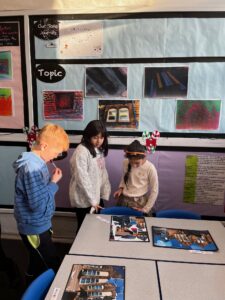
This morning, Year 3 and 4 hosted their first art gallery where they were able to showcase all the amazing art they have produced this half term.

We displayed all the pieces across the two classrooms and gave the children the opportunity to look around and comment on their classmates artwork.

A fantastic end to a fantastic half term!

All of the Year 3/4 team wish you a Merry Christmas and happy and healthy holiday.

See you in the New Year!