A-maze-ing computing

As part of our Fighting Fantasy topic, we’re working towards creating our own maze-based games on a computer programme called Kodu. Last week we learnt about algorithms, decomposition and debugging.

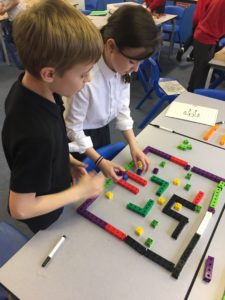
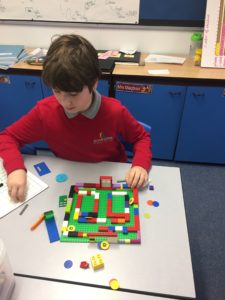
Today, we’ve continued our learning about debugging by creating our mazes offline.

When we realised our maze didn’t work or wasn’t complicated enough or was too complicated, we had to debug in order to improve it.

Using blocks, Lego or Kapla helped us to make sure we kept the lines of our mazes straight and allowed to be symmetrical with our designs.

Once we were happy with the shape of the maze, we started to think about what the aim  of the game would be, adding points or obstacles in our way.

Next week, we’ll move our learning onto the computers and create our maze in Kodu.

At home, ask us how our learning is developing and see whether we can tell you how the game we’re creating will work. Here’s an explanation for how to play this maze.

Training days 2019-20

For those already planning their trips away and days out, we’ve now agreed our 2019-2020 training days:

  • Monday 02 September 2019
  • Tuesday 03 September 2019 (this means children are back on Wednesday 04 September, although there’s a transition period for those starting in Reception)
  • Friday 25 October 2019 (this is the day before the October holidays)
  • Thursday 07 May 2020 (this is provisional – it depends on whether we must close for polling day)
  • Monday 20 July 2020 (the last day of the school term, meaning children break up on Friday 17 July 2020)

The dates are all published on our school calendar.

(We tell you our training days well in advance, and we’ve tried to schedule many close to existing school holidays. This means you’ve got more chance to plan and book any holidays abroad. We don’t authorise term-time absences for holidays.)

Living and Learning: I can make things better

Year 6’s Creative homework was really impressive this week. They were asked to show how we can make things better and there were all sorts of creative responses with all sorts of different contexts: friendship, the environment, school, home life – the list goes on.

We always enjoy looking at each other’s homework and we write comments in homework books to tell each what we think.

Lots of children liked Sachpreet’s homework – and not just for the great photo of the class back in Reception. They liked how she’d gone through the whole class saying what she felt each person had changed for the better.

Let’s let the dice decide

Year 6 turned their day into a Fighting Fantasy quest on Friday. They let the dice decide.

The dice decided which line came into the classroom first.

The dice decided when we did what lessons.

The dice decided what we ate for lunch.

The dice decided who we played with at breaktime.

It was an interesting day and, although they could choose not to, most children allowed the dice to make all of their decisions.

Offline Computing

In topic, we’re working towards creating a maze game using Kodu. Today, we learnt about decomposition and debugging through using an algorithm to travel through a Pacman maze.

We had to figure out the code, follow the code, debug the code and, finally, try writing our own code. When we played each other’s we found some errors and helped each other to debug what we’d created and, if we hadn’t made any mistake, we tinkered with a friend’s code to see whether they could then spot the mistake.

At home, as us what the words in bold mean and what ideas we’ve got for our final maze game.

Fighting Fantasy

We’ve started our new topic learning this week which is driven by our class novel: Fighting Fantasy – The Warlock of Firetop Mountain.

(Ask your children why I can use a colon in this sentence.)

Today, we made the very important decision of which character we were going to be along our adventure. We read about the characters and then picked out key features that would make us want to pick them.

Having taken in all of the information given to us and each characters’ (Ask you child why the apostrophe is after the ‘s’) scores for stamina, skill and luck, we shared our opinions before putting it to the vote.

Not everybody agreed!

Ophelia Lapwing will be our alter ego for the next eight weeks – wish us luck.

Gymnastics

This half term, our focus in PE is gymnastics. So far, the children have enjoyed learning a variety of gymnastics shapes including; star, pike, dish, arch, tuck and straddle. The children have also learnt how to travel and perform basic movement skills in gymnastics. They have combined movement skills and shapes to create a sequence. We will be moving on to learn jumps and rolls and adding them to a sequence.

More marvellous comments about Moortown

On Tuesday, a Local Authority advisor (who happens to also be an Ofsted inspector) visited Moortown. We invited him in because we’re always keen to get a second opinion on our practice and to be offered any suggestions to keep getting more and more effective. The visit involved visiting four classes in school (Y1, Y2, Y3 and Y5) and looking at Writing and Maths books in Y2, Y4 and Y6. The advisor’s report is really positive. Here are some comments from it.

The lesson observations evidence that without exception, teachers have high expectations of the children in their care. They each demonstrated good subject knowledge and an age appropriate awareness. Subsequently, children across the four observed year groups behave well and were attentive and responsive to the teacher.


Teacher pupil relationships in this classroom are secure. Children responded to the ‘3,2,1 stop’ command with immediacy and it is clear that the children are happy and comfortable in the teacher’s care.


…the… teacher’s enthusiasm was infectious… The [reading] lesson, led from the hall… was managed well… All pupils engaged with the activity well and competent questioning from the teacher enabled pupils to demonstrate their understanding. At a later visit to the classroom where children were completing a summary paragraph about a web page, the same teacher zest was evident. The children were entirely focused on the learning and when challenged could explain the purpose of the exercise and the learning. The use of an ‘erm’ game engendered a great deal of controlled exuberance from the children who are clearly enjoying this style of teaching.


Outcomes had been clearly modelled and when asked, the children were able to explain their learning. The use of mood photographs had been neatly aligned with the school’s current Living and Learning statement and was effective in providing the children with a purpose to write.


Looking at books from alternate years clearly evidenced the impact of teaching on progress with work becoming more sophisticated as they advance through the school. Without exception and in both English and maths books, the work is aligned to the age related requirements of the national curriculum.


In each year group, high demands in productivity and neatness are evident in English books. Opportunities to write at length are particularly impressive in Y4 and Y6. In Y4 for example, pupils are given the freedom to change characters or settings based on their reading, researching and planning from high quality texts. These opportunities allow the most able to demonstrate their flair for language whilst even the lowest ability perform well in advance of what would have been expected… Such challenge is ensuring this group in particular are making excellent progress. The same can be echoed in Y6 where exercises are planned to add value to learning. The complexity of sentence structure and use of evocative vocabulary for the middle and higher ability Y6 pupils is extremely impressive. Meanwhile, through the demand and expectation to keep up with their peers, the progress of the lower ability pupil was equally impressive.


Without being overly demanding of teacher’s time, marking and feedback is of the highest quality. The use of symbols to indicate where pupils should edit or improve their work is met with purple pen action that clearly has an impact on learning over time.


In Maths, the pace of teaching is effective in embedding learning. Positively, the demand for even the least able to access the same body of learning as their more able peers is having a definite impact on their progress over time.


…there is evidence to show that even the most able are challenged to their limits. And without exception, the requirement for pupils to correct errors or respond via same day intervention is another positive driver for accelerating the progress of the many rather than the few.

The report also contains three useful, but quite specific, recommendations which we’ll work on.

Friday 18 January 2019

Create ways for you to remember how to spell these words and generally practise using the strategies in the back of your homework book. Spelling practice is best done little and often so make sure you come back to the spellings at least three times in the week. Date your practice and ask an adult to sign it to show that you’re practising regularly. There will be no test from this list but instead there’ll be a word search to complete on Friday which will include these words.

  • category
  • cemetery
  • committee
  • communicate
  • community
  • competition
  • conscience
  • conscious
  • controversy
  • convenience
  • correspond
  • criticise
  • curiosity