Week Beginning 19 October 2020

We’re really missing you in school and we can’t wait to have you back. We hope you’re managing to stay happy, healthy and safe while you’re not with us here in school. You are still very much a part of our school community so please get in touch with us. You can email me at [email protected].

Here’s a short video message from me introducing the week.

Maths

This week’s maths learning is linked to addition and subtraction

These five video lessons will roughly match the teaching and learning happening in class:

Lesson 1: video, worksheets, answers

Lesson 2: video, worksheets, answers 

Lesson 3: video, worksheets, answers 

Lesson 4: video, worksheets, answers

You don’t have to print the worksheet. Your child can write or draw their answers on paper. Your child’s learning will be most effective if you sit with them to pause the clip and check / praise / support your child as the clip moves on.

Spelling

Look on the homework page to find this week’s spellings. Your child should complete one task each day.

  • Day 1: Write the words and draw shapes round them to show the ascenders and descenders. (Set yourself and others at home a challenge of using some of the words when you’re speaking, too!)
  • Day 2: Write the words using rainbow writing. (Try some of the other activities in our Super Spelling Strategies guide.)
  • Day 3: Write separate sentences, each containing one of the spellings. (Don’t forget to show off really neat handwriting and make sure you sentence starts with a capital letter and ends with a full stop, exclamation mark (!) or question mark (?).
  • Day 4: Repeat Task 2 or 3.
  • Day 5: Get an adult at home to test you on your spellings. Practise any you spell incorrectly – you could write them out carefully until you’re sure.

(Suggested time: 15-20 minutes daily)

Reading fluency

This is the text we’ll read in class to to build up fluency skills this week.

In school, we generally follow this sequence:

  • Day 1: Read the text aloud with your child listening. Read it clearly and slowly, pointing to each word as you read. Have a chat about any unfamiliar words.
  • Day 2: Read aloud each sentence (a full short sentence or part of a longer sentence), and have your child read it back to you. Do this ‘echo reading’ for the whole text.
  • Day 3: Read the text and talk about the effect of the punctuation on how you read it – pauses for full stops and expression for exclamations (!) or questions (?). Your child reads the text aloud.
  • Day 4: Read together with expression (just like you practised on Day 3).
  • Day 5: Your child reads independently and fluently.

(Suggested time: 15 minutes daily)

Reading comprehension

Day 1: We will be using this RIC lesson in class. RIC stands for:

  • Retrieve: finding information in a text
  • Interpret: using clues in the text to unlock information
  • Choice: thinking about the author’s choice of words, techniques or organisation that make the text interesting and enjoyable to read

Day 2:  Watch this video and learn about the ‘au’ digraph.

Day 3: Watch this video and learn about the ‘ey’ digraph.

The two videos above were made by one of our teacher friends from another school in the federation.

Day 4: Book Club. Once a week, we have a relaxing lesson where we sit and read quietly, often with an adult. At home, we’d like you to read your favourite book or text, too. If possible, discuss the book with an adult, talking about some or all of the sections of this grid.

(Suggested time: 30 minutes daily)

Writing

Activity  1

This week in class, we are learning about tense. Watch this video and have a go at this sheet.

Activity  2

Talk to your child about a picture or photograph you choose. Write three words or phrases to label different things in the picture (eg ‘a car’ or ‘a red car’). Your child should aim to spell in a sensible way and use finger spaces between the words, joining up letters if they can (use our handwriting guide to help).

Topic

This week, we’re starting our new topic learning about The Great Fire of London. Find out what London was like in the past using this this Oak National Academy Lesson. 

(Suggested time: 30-45 minutes)

Science   

We’re continuing our  learning about habitats and living things. This Oak National Academy lesson will really help to support learning at home. Once your child has watched the video, try the quiz that follows.

(Suggested time: 30-45 minutes)

16 October 2020

This week’s home is Practice Makes Perfect.

I can use commas in sentences.

Write out the sentences below using commas in the correct places.

On Sunday I had a busy day.

First I went to the shops.

I bought fish fingers chips and tomato sauce.

After that I watched television.

Then I drew a picture read a story and did my homework.

Finally I had my tea and went to bed.

If you need any help, feel free to email me before the homework is due.

Our weekly message (16 October 2020)

This week’s message includes reference to the Health and Safety Executive and to coronavirus contacts. (There’s no connection whatsoever between these articles and the last feature, which is about ghastly ghouls and beastly bugs!) Most  importantly, though, we start the message with a reminder about an important Sphere Federation survey…

Relationships and Sex Education

A chance to tell us your views about an important policy update…

From September 2020, Relationships Education and Health Education are now statutory and form part of the National Curriculum. As a result of the changes, we’ve updated our Relationships and Sex Education (RSE) policy and we’re now consulting with parents, staff and governors. Your views are important to us. We welcome your feedback on the policy via this short survey. The survey will be open until Friday 23 October.

To help you understand the requirements further, we’ve emailed you with additional information, including the draft policy itself. Contact us if you haven’t received this. In addition, you might like to look at the following websites:

  • DfE statutory guidance on Relationships Education, RSE and Health Education
  • Guide for parents on Relationships Education, RSE and Health Education
  • List of FAQs for parents on the new RSE/Relationships Education requirements

Looking after our children, looking after our staff

We’re confident in our Sphere schools that we’ve done everything we reasonably can to make sure they’re happy, healthy and safe places to learn…

Since schools opened in September for the new school year, representatives from the Health and Safety Executive (HSE) have been contacting schools to check on procedures in place to make sure schools have taken enough precautions to safeguard children and staff in the context of coronavirus. None of the Sphere Federation schools were contacted. However, from a wider perspective, it’s reassuring to note that it’s been reported that the HSE has been highly impressed with the work schools have done.

People have told us that Track and Trace staff have sometimes been sending out mixed messages, and sometimes the messages don’t match the advice schools have been given. When in doubt, we’ve been able to contact a Department for Education helpline. The advice we’ve been given on the helpline has been helpful. They advise we follow closely our own risk assessments.

Employers must protect people from harm. This includes taking reasonable steps to protect staff, pupils and others from coronavirus (COVID-19) within the education setting.

Department for Education, 01.10.20

We want our schools to be happy, healthy and safe places to work, too…

We’re doing our best to look after our staff, too. All staff had the opportunity to have flu jab recently, and they’ve all got access to the Employee Assistance Programme, a service that provides a variety of support for education staff. These aren’t new things we’re doing because of the pandemic – we’ve provided them for a few years now.

What’s counts as a contact?

Someone from Public Health England has communicated with us recently, and we thought some of the information about contacts which they sent to us might be useful for you to know about…

A ‘contact’ is a person who has been close to someone who has tested positive for COVID-19 any time from two days before the person was symptomatic up to ten days from the onset of symptoms. This period is when they are infectious to others. For example, a contact can be:

  • people who spend significant time in the same household as a person who has tested positive for COVID-19
  • sexual partners
  • a person who has had face-to-face contact (within one metre), with someone who has tested positive for COVID-19, including being coughed on; having a face-to-face conversation within one metre; having skin-to-skin physical contact; or contact within one metre for one minute or longer without face-to-face contact
  • a person who has been within 2 metres of someone who has tested positive for COVID-19 for more than 15 minutes
  • a person who has travelled in a small vehicle with someone who has tested positive for COVID-19 or in a large vehicle or plane near someone who has tested positive for COVID-19

Beastly bugs and ghastly ghouls

Any plans for half-term? Perhaps a trip to Temple Newsam House is in order…

  cid:image001.jpg@01D6A212.16359650

Beastly bugs have discovered 5 star accommodation at Temple Newsam House. They’ve booked their staycation for Halloween week when the ghastly ghouls from years gone by pay their annual visit. Meet past residents and hear ghostly tales as you explore this 500 year old building. Follow the bug trail around the house, spot the miniature bug rooms and pick up your own Beastly Bug Craft pack to take home.

Visit between 11am to 4pm from Saturday 24 October to Friday 30 October (and be aware the house is closed on Monday 26 October). Pre-book your tickets to avoid disappointment. 

Following lockdown, Temple Newsam House has been open to the public for a few weeks now. They’ve had great feedback on the Covid precautions that they’ve put in place.

Fab feedback from a former pupil…

It was lovely to read this email that arrived recently…

My name is …, and I was a pupil in Moortown Primary School between 2006-2012. I just wanted to drop a quick, albeit overdue, letter of appreciation for the phenomenal years this school and its staff has given me. I think it goes without saying that having the responsibility of educating the younger generation has an immense impact on their development and well-being. It still surprises me today when I get reminded of my days being taught under such great characters. Each and every single one of my former teachers in this school has, in one way or another, taught me a skill in which I use to my advantage today. I arrived in the UK in the summer of 2006 from my home country Kuwait, not knowing a single word in English. Suffice to say, I felt very much at home and welcomed by a such a loving school.

I owe my love for numbers and Mathematics to Mrs. Taylor, and her magnificent style of teaching while I was in Year 2. I also owe my critical thinking to Mr. Roundtree, whenever he’d have his … long conversations about thinking outside the box.

I’m happy to say that I am now entering my second year of study in the University of Sheffield, majoring in Software Engineering.

I genuinely believe this school shaped me into the man I am today; so thank you.

Week beginning 12 October 2020

We’re really missing you in school and we can’t wait to have you back. We hope you’re managing to stay happy, healthy and safe while you’re not with us here in school. You are still very much a part of our school community so please get in touch with us. You can email me at [email protected].

Here’s a short video message from me introducing the week.

Maths

This week’s maths learning is linked to number and place value.

These five video lessons will roughly match the teaching and learning happening in class:

Lesson 1: video, worksheets, answers

Lesson 2: video, worksheets, answers 

Lesson 3: video, worksheets, answers 

Lesson 4: worksheet

Lesson 5: video, worksheet, answers 

You don’t have to print the worksheet. Your child can write or draw their answers on paper. Your child’s learning will be most effective if you sit with them to pause the clip and check / praise / support your child as the clip moves on.

Spelling

Look on the homework page to find this week’s spellings. Your child should complete one task each day.

  • Day 1: Write the words and draw shapes round them to show the ascenders and descenders. (Set yourself and others at home a challenge of using some of the words when you’re speaking, too!)
  • Day 2: Write the words using rainbow writing. (Try some of the other activities in our Super Spelling Strategies guide.)
  • Day 3: Write separate sentences, each containing one of the spellings. (Don’t forget to show off really neat handwriting and make sure you sentence starts with a capital letter and ends with a full stop, exclamation mark (!) or question mark (?).
  • Day 4: Repeat Task 2 or 3.
  • Day 5: Get an adult at home to test you on your spellings. Practise any you spell incorrectly – you could write them out carefully until you’re sure.

(Suggested time: 15-20 minutes daily)

Reading fluency

This is the text we’ll read in class to to build up fluency skills this week.

In school, we generally follow this sequence:

  • Day 1: Read the text aloud with your child listening. Read it clearly and slowly, pointing to each word as you read. Have a chat about any unfamiliar words.
  • Day 2: Read aloud each sentence (a full short sentence or part of a longer sentence), and have your child read it back to you. Do this ‘echo reading’ for the whole text.
  • Day 3: Read the text and talk about the effect of the punctuation on how you read it – pauses for full stops and expression for exclamations (!) or questions (?). Your child reads the text aloud.
  • Day 4: Read together with expression (just like you practised on Day 3).
  • Day 5: Your child reads independently and fluently.

(Suggested time: 15 minutes daily)

Reading comprehension

Day 1: We will be using this RIC lesson in class. RIC stands for:

  • Retrieve: finding information in a text
  • Interpret: using clues in the text to unlock information
  • Choice: thinking about the author’s choice of words, techniques or organisation that make the text interesting and enjoyable to read

Day 2:  Watch this video and learn about the ‘oy’ digraph

Day 3: Watch this video and learn about the ‘ue’ digraph.

Day 4: Watch this video and learn about the ‘ir’ diagraph

The three videos above were made by one of our teacher friends from another school in the federation.

Day 5: Book Club. Once a week, we have a relaxing lesson where we sit and read quietly, often with an adult. At home, we’d like you to read your favourite book or text, too. If possible, discuss the book with an adult, talking about some or all of the sections of this grid.

(Suggested time: 30 minutes daily)

Writing

Activity  1

We are continuing to learn about commas in class. Have a go at this sheet. Write the sentences using commas in the correct places.

Activity 2

Talk to your child about a picture or photograph you choose. Write three words or phrases to label different things in the picture (eg ‘a car’ or ‘a red car’). Your child should aim to spell in a sensible way and use finger spaces between the words, joining up letters if they can (use our handwriting guide to help).

Topic

Get arty with topic learning at home.  Look at the piece art below:

Mona Lisa by Leonardo Da Vinci

Think about these questions:

What do you like about it?

What don’t you like about it?

Do you think it is modern or old?

How do you think Mona Lisa is feeling in the painting?

(Suggested time: 30-45 minutes)

Science   

We’re continuing our  learning about habitats and living things. This Oak National Academy lesson will really help to support learning at home. Once your child has watched the video, try the quiz that follows.

(Suggested time: 30-45 minutes)

Week beginning 12 October 2020

We’re really missing you in school and we can’t wait to have you back. We hope you’re managing to stay happy, healthy and safe while you’re not with us here in school. You are still very much a part of our school community so please get in touch with us. You can email me at [email protected].

Here’s a short video message from me introducing the week.

Maths

This week’s maths learning is linked to number and place value.

These five video lessons will roughly match the teaching and learning happening in class:

Lesson 1: video

Lesson 2: video, worksheets, answers

Lesson 3: video, worksheets, answers 

Lesson 4: video, worksheets, answers

Lesson 5: video, worksheets, answers

You don’t have to print the worksheet. Your child can write or draw their answers on paper. Your child’s learning will be most effective if you sit with them to pause the clip and check / praise / support your child as the clip moves on.

Spelling

Look on the homework page to find this week’s spellings. Your child should complete one task each day.

  • Day 1: Write the words and draw shapes round them to show the ascenders and descenders. (Set yourself and others at home a challenge of using some of the words when you’re speaking, too!)
  • Day 2: Write the words using rainbow writing. (Try some of the other activities in our Super Spelling Strategies guide.)
  • Day 3: Write separate sentences, each containing one of the spellings. (Don’t forget to show off really neat handwriting and make sure you sentence starts with a capital letter and ends with a full stop, exclamation mark (!) or question mark (?).
  • Day 4: Repeat Task 2 or 3.
  • Day 5: Get an adult at home to test you on your spellings. Practise any you spell incorrectly – you could write them out carefully until you’re sure.

(Suggested time: 15-20 minutes daily)

Reading fluency

This is the text we’ll read in class to to build up fluency skills this week.

In school, we generally follow this sequence:

  • Day 1: Read the text aloud with your child listening. Read it clearly and slowly, pointing to each word as you read. Have a chat about any unfamiliar words.
  • Day 2: Read aloud each sentence (a full short sentence or part of a longer sentence), and have your child read it back to you. Do this ‘echo reading’ for the whole text.
  • Day 3: Read the text and talk about the effect of the punctuation on how you read it – pauses for full stops and expression for exclamations (!) or questions (?). Your child reads the text aloud.
  • Day 4: Read together with expression (just like you practised on Day 3).
  • Day 5: Your child reads independently and fluently.

(Suggested time: 15 minutes daily)

Reading comprehension

Day 1: We will be using this RIC lesson in class. RIC stands for:

  • Retrieve: finding information in a text
  • Interpret: using clues in the text to unlock information
  • Choice: thinking about the author’s choice of words, techniques or organisation that make the text interesting and enjoyable to read

Day 2:  Watch this video and learn about the ‘oo’ digraph

Day 3: Watch this video and learn about the ‘ar’ digraph.

Day 4: Watch this video and learn about the ‘or’ diagraph

The three videos above were made by one of our teacher friends from another school in the federation.

Day 5: Book Club. Once a week, we have a relaxing lesson where we sit and read quietly, often with an adult. At home, we’d like you to read your favourite book or text, too. If possible, discuss the book with an adult, talking about some or all of the sections of this grid.

(Suggested time: 30 minutes daily)

Writing

Activity 1:

Year 1 children: Talk to your child about a picture or photograph you choose. Write three words or phrases to label different things in the picture (eg ‘a car’ or ‘a red car’). Your child should aim to spell in a sensible way and use finger spaces between the words, joining up letters if they can (use our handwriting guide to help).

Activity 2:

Finger strengthening activities support the development of fine motor skills needed for writing.

Challenge your child to have a go at 3 or more of these activities: practise tying shoe laces, fasten and unfasten buttons, attach nuts and bolts, separate dried pasta and dried peas (or similar) into two separate piles, do some mindfulness colouring in, do a jigsaw, cut up drinking straws and thread them on to a shoe lace, attach clothes pegs (the squeezable type) to a shoe box or similar, use a paint brush and water to make pictures or words on a wall, chalk words or pictures on the ground, make a Lego model.

(Suggested time: 30 minutes daily)

Topic

Get arty with topic learning at home.  Look at the piece art below:

Mona Lisa by Leonardo Da Vinci

Think about these questions:

What do you like about it?

What don’t you like about it?

Do you think it is modern or old?

How do you think Mona Lisa is feeling in the painting?

(Suggested time: 30-45 minutes)

Science   

We’re continuing our  learning about habitats and living things. This Oak National Academy lesson will really help to support learning at home. Once your child has watched the video, try the quiz that follows.

(Suggested time: 30-45 minutes)

Living and Learning: 8Rs for learning

In this half term, there has been a focus on the 8Rs for learning.

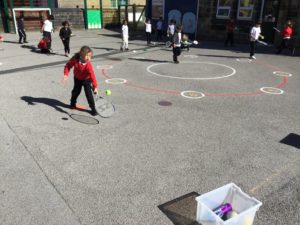
During one PE session, we focused on showing resilience.  The children were set an extremely tricky task of trying to hit a tennis ball into a box from a distance. What made it unexpectedly harder was the wind blowing the boxes around! The children struggled to get the ball into the boxes but never gave up and some eventually managed it.

They all showed great resilience!