Watch Us While We Work

Thank you to all the adults who came to Watch Us While We Work this morning; it was lovely to see you all in our classroom. If you were unable to make it, continue to read to find out what we got up to.

To start, we looked at different strategies to help us learn our spellings. As you know, we have 40 spellings to learn by the end of the half term and therefore, finding fun ways to learn them is essential.

Here are a few we completed in class today:

We then moved on to practise our times tables, using our counting stick and dry wipe times table worksheets. To end the session, we read this week’s reading fluency text (I wandered lonely as a cloud by William Wordsworth) with a focus on our oracy targets.

We hope to see you next time!
Science: An air-resistance experiment

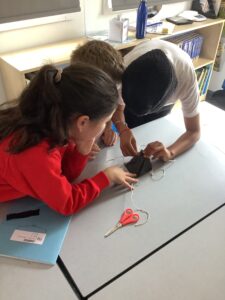
For the past three science lessons, Year 5 have been planning, undertaking and evaluating a science experiment all about air resistance. Our enquiry type was ‘Comparative and Fair Tests’. The question we were answering was: ‘Will the surface area of a parachute affect the time it takes to fall to the ground?’ The children decided on their variables, made a prediction and then were able to create the parachutes they needed.

Once they were created, the children then went out to test their parachutes and conduct the experiment.

Once we had the results, we were able to look for any anomalous results (a result that does not fit the pattern; in Maths, this is called an outlier). We also looked at the mathematical element of this science lesson as Year 5 could then calculate the average times for the tests.

To present their findings, they created bar charts using the calculated average times. These charts helped to show how the surface area clearly impacted the fall time.

Finally, the children were able to conclude their results. They found out that the bigger parachute had a larger surface area and therefore, there was more air resistance so it was the slowest.

Reading Records

At Moortown, reading records help us to celebrate our love for reading. As a reminder, here is the key information you and your child need to know:

  • Each time one of the children signs out a new book to read from the library, they can make note of these in their reading record and rate them out of 5 stars.
  • Every Friday, I chose an activity for the whole class to complete in their reading record. More information on these activities is found inside the record.
  • The children bring in these reading records every Friday for our Book Club lesson where we’ll discuss their books and develop their love of reading.
  • Please accompany your child’s weekly activity with a short comment sharing with us the reading your child has been doing at home.

Take a look at some fabulous activities Year 5 have completed last week:

Times Tables Rockstars

Each week, the TTRS leader board is updated in class. First place receives a prize, second place receives 5 golden tickets, third place 4 golden tickets and so on.  Well done to this week’s Times Tables Rockstars!

Just a quick reminder, that each day, your children should be practising their times tables for 10 minutes. The deadline for this homework is Friday. If your child does not have access to TTRS, please bring in paper copies of their times table practice – with their completed reading record – to school on Friday.

Please see the homework guide for more information.

Geography: Green Space is Vital!

This week, the children have been learning about green spaces and why they are vital. In the lesson, Year 5 were asked to find posters around the room which had facts on them; they had to summarise the key points and write the information on their whiteboards. They then created their own posters with the facts and statistics.

Help at home: Discuss why green space is vital to humans, animals and the environment.

Geography: What is city expansion?

In Geography, the children explored what city expansion is. First, we defined it: ‘It is also known as urban sprawl, this is the increase in a built-up area of a city’.

We then took to ‘Digimaps’ to compare the size of Leeds City Centre in the 1890s, 1950s and current day. Have a look at our work:

Help at home: Discuss why the city has expanded and how can we tell.

Living & Learning: Eight Rs for Learning

This week our L&L statement was ‘I use the eight Rs to help me learn.’ We started off by recapping the 8Rs and then looked at each one in detail and discussed different statements that match the 8Rs.

  • reflecting – I look for feedback from my teachers and peers and think about how I can use this to improve.
  • remembering – I find links between what I am learning and what I already know.
  • resilient – I stick at things even when they are difficult and do not give up; I stay positive.
  • resourceful – I know where to find information and use it in my work (word walls, support sheet etc.).
  • responsible – I am respectful with everything (presentation, resources etc.).
  • risk-taking – I can ask questions and give my opinion in a group/class situation.
  • responsive – I can respond appropriately to peers and adults.
  • ready – I always want to learn new things.

Help at Home: Discuss with your child which 8R for learning they feel confident in and which they feel like they need to improve.

Science: Friction and Air Resistance

In Science, we have been exploring the impacts of friction and air resistance.

Here are the definitions:

We first tested which object would have the least amount of friction on a surface: an ice cube or wooden cube? Our prediction was that the ice would be the quickest therefore it has the least amount of friction. Our scientific enquiry type was ‘fair and comparative’ tests.

The children then went on to test air resistance (or drag). We tested that if our surface area increased would it slow us down or speed us up? Bin bags were our equipment of choice, have a look at our experiment:

We found out that an increased surface area means more air resistance therefore, we ran slower with the bin bag than without.

Help at home: Discuss different scenarios that are impacted by friction and air resistance.

Welcome Back!

Welcome back after the summer holiday. We hope you had a happy and healthy summer. It  has been great to see so many happy faces back in school.  The children have settled really well in their first week and are adapting to new routines, classrooms, teachers and an earlier start time of 8:45am.

This week, we have sent the children home with a reading book and a new reading record book. It is really beneficial that your child reads at home daily – it improves fluency and increases the enjoyment of reading. The children can record what they’ve read at home in the reading records. We will also set a task for them to complete at home. Please ask your child what their task is for their homework and actively encourage them to think about the presentation of their work in the journals and the importance of neat handwriting and accurate use of punctuation.

Thank you to all the children who have come to school in the correct uniform and PE kits  this week. If you are unsure of the uniform, please click the link to see what is required.

Important Dates

PE – Monday and Wednesday

Spelling test – Friday

Library – Wednesday

Class assembly – Wednesday 22nd November 2023 & Wednesday 21st February 2024

We are looking forward to a successful year!