
Year 2 book club

Next Tuesday, 11 December, it’s book club time in Year 2. This is an opportunity for the children to bring a favourite book to share with their classmates. It could be a story or an information book, a comic or a poem. It could be an old favourite or a book they’ve recently read.
Mrs Taylor and Mr Wilks will also share their favourite book!
We look forward to seeing and hearing about your choices!
When will be your next Park Run?
Thank you to Richard Spencer (parent, chair of the PTA and Park Run race director at Roundhay Park) who came to speak to the whole school this afternoon about the great, free, weekly Park Run events held locally.
We were impressed by the number of children who have already completed a Park Run event with one pupil achieving over 100 runs!
All you need to take part is to register for your personal bar code that is used at the event to record your position and time for the run. ThePark Run event is not a race. You are only trying to beat yourself by achieving a faster time each time you do it.
There is no commitment to attend every weekend: just turn up with your bar code when you can.
The course is fully marshalled and so children are able to run round with others as long as an adult accompanies them to the event.
- Junior Park Run (age 4-14 years – 2km course) 9am every Sunday
- Park Run (5km course) 9am every Saturday
- Local courses include Roundhay Park, Temple Newsam and Bodington (Brownlee Centre)
We’d love to hear your Park Run achievements – let your teacher know!

What is water resistance?
Our Science learning continues with water resistance this week. We’ve applied our previous learning about air resistance to investigate how the shape of an object affects the amount of water resistance acting upon it.
First, we planned the sort of shapes we thought would sink fastest and slowest through water.
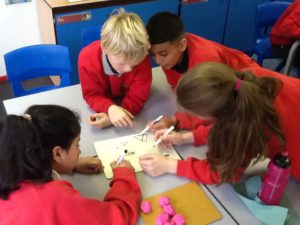
Then, we worked together to create these shapes out plasticine in order to test them.

Finally, we tested the shapes against each other to see which would sink faster and discuss what forces were working on them to give the outcomes we saw.


Why not try the same at home? Albert wondered whether the size of the container we were testing them in would affect the results greatly. Could you investigate this at home?
What charity should our school support?
And the winner is…

Year 5’s chosen charity (the World Wildlife Fund) eventually went on to be chosen by our school council as Moortown’s new charity.
Here’s an extract from their website:
The world’s leading conservation organization, WWF works in 100 countries and is supported by more than one million members in the United States and close to five million globally. WWF’s unique way of working combines global reach with a foundation in science, involves action at every level from local to global, and ensures the delivery of innovative solutions that meet the needs of both people and nature.
Air resistance is amazing! Part 2
To test the science behind the parachute slowing us down when running, we set up an experiment involving parachutes, eggs and a window.
Year 5 worked in groups to make three different parachute sizes. We wanted to investigate which parachute had the most air resistance and therefore slow the egg’s fall the most to prevent it from breaking. It was important to keep everything else the same so that we could tell that it was definitely the parachute size affecting the results.


Next, it was the moment of truth. We waited patiently below to observe the speed of the parachute’s fall and whether or not our eggs cracked. A slower fall would mean more air resistance and, ultimately, an egg in less danger!

We found that the larger parachutes fell slower and had more success protecting their eggs. Smaller parachutes fell very quickly to the ground. This means larger parachutes have a greater air resistance and smaller parachutes have less air resistance.

Science mini topic
We’ve now started a science mini topic based on forces. To begin this topic, the children were shown a series of forces-related photos and asked to come up with questions based on what they would want to know.


There were some great scientific questions and these will lead into some investigations we will be doing based on forces.
BBC website has a number of videos on forces if you want to find out more.
Air resistance is amazing!
This week, Year 5 have been learning about air resistance! Here’s our post to get you up to speed on our sprinting experiment. Hope it’s not a drag!
We had three participants who first ran from the gate to the gazebo and back without the parachute on (shown here by our fantastic photographers) and these were timed.

The same people ran again but this time with a parachute attached to their back and timed again.

All three participants were much slower on their second run. Challenge your child to explain the science behind it!
Our participants said:
- “It felt like someone was pulling you back when you were running!”
- “It felt like someone lightly tugging you as you were running.”
- “The parachute run was harder. The faster you go, the more the wind pulls you back.”
- “It was quite exciting to see how fast they went.”
- “The parachute run had more air resistance because the air was getting trapped in the parachute and slowing it down.”
- “It was nice seeing how quick they were and seeing how much difference the parachute made.”
- “I was kind of surprised and kind of not surprised. I was surprised that it made it that much slower but I did know that it would make them slower.”
Owl Babies
After reading the book ‘Owl Babies’ by Martin Waddell, the children took part in lots of owl themed activities.
They compared the different sized owls and were given the challenge of proving that the mother owl was the tallest.
They drew story maps and added labels and captions to help with their retelling of the story.
Why not ask your child to retell the story to you?


What is our new school charity?
We support our school charity for a year and it is now time to change our current school charity, Make-A-Wish.
This week, each class, discussed a range of charities, researched by the children for their homework, and voted on one charity they wanted to put forward for the school councillors to decide on.
Here were the class choices:
The final democratic decision was made by a vote by the School Council and the winning charity for 2018-2019 is WWF. We will support this charity for one year.
What makes a parachute successful?
Continuing our learning about air resistance, we decided to investigate what improved the success of a parachute. Because we had already learnt about what air resistance is and seen it in action with our running parachute, we already knew what we expected to see from our investigation.
We worked in groups, each changing one aspect of our parachute to see whether this affected how safely it brought an egg down to the ground. Each group chose what they wanted to investigate.
- material it’s made out of
- its size
- the number of parachutes
- the number of holes in the parachute
Changing the number of holes


Changing the material its made out of


We tested them by holding the bottom of the cup 1m above the floor (carefully covered by plastic bags) and dropping them. We could then see how damaged – if at all – the egg was and evaluate the success of the parachute.


We were surprised by some of our results and others were what we expected. We’re now going to discuss what we observed in class and consider why we didn’t always see what we expected – a crucial part of the scientific enquiry process.