
Write like a poet – British Library
Today, Year 3 had a visitor from the British Library. We learnt a lot about the British Library like what they do, how they are different to a “normal” library and where they are based. Luckily for us, they have a base in Boston Spa!
The British Library have a copy of every single book, newspaper, magazine or even leaflet that has been published in Britain. They want to keep a record of all of these so that in years to come, people can look back and see what things were like over the years.
We read a poem – I Don’t Like Poetry by Joshua Siegel – and picked apart the vocabulary. We discussed what we liked and disliked about it. Then it was our turn to write our own poems. It can be quite tricky just to sit down and write a poem so we played lots of games to help us generate some ideas.


Some of us wrote about our day, our emotions, a hobby we like or just something random! The children really enjoyed it and were desperate to share their writing at the end.
Help at home by playing the word association game. Start with ‘apple’ and see what word the other person can think of that links to it and continue for as long as you can.
Basketball Christmas camps
City of Leeds Basketball Club, who run one of our after-school clubs, are holding Christmas camps locally over the holidays.

Writing: The Dream Giver
Over the last couple of weeks, we’ve been planning and writing a narrative based on the beginning of this short film – The Dream Giver.
We learnt how to write using prepositional phrases to help set the scene.
…above me…
…on the windowsill…
…inside the golden eggs…
We learnt to write similes to help build the narrative in the reader’s minds.
The stars twinkled like diamonds.
The ballerina danced as elegantly as a swan.
I flew as quietly as a mouse.
The children did an amazing job at writing their narratives! We were so impressed with their ideas. They shared them with Year 5 and Year 5 were too.
Here are a few of the narratives for you to have a read:
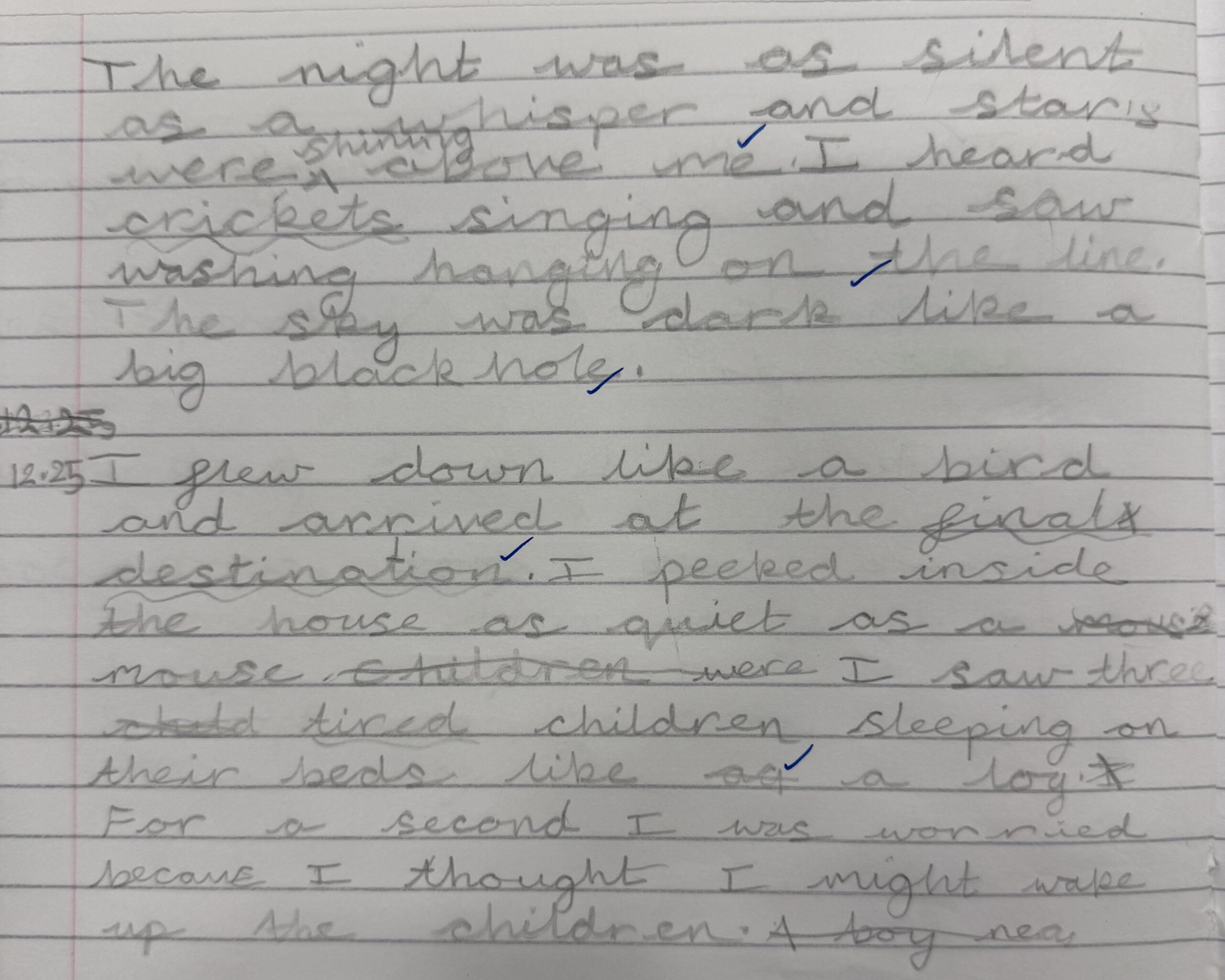


Help at home by discussing your child’s narrative and what similes they used.
Living and learning: being me
Yesterday in L&L, we discussed our strengths and weaknesses and set ourselves some targets.
We began by writing down something we’re really good at and proud of ourselves for. We realised that it could be linked to a hobby or it could be a quality that we have.
I think I’m good at climbing.
I’m a good listener.
I’m a great defender in football.
My biggest strength is being kind.
We used these strengths to help us set a target for ourselves.
For example… I’m a good listener so I’d like to challenge myself to listen to my siblings too or I’m a great defender in football but I’d like to get better at attacking too. I’m a strong reader so I’d like to set a target to read one chapter book a month in 2026.
We discussed that our targets should be…
- Specific
- Measurable
- Attainable/achievable
- Realistic and relevant
- Time-Limited
Finally, we thought about each other’s strengths and gave each other compliments. This can sometimes feel a bit awkward so we practised accepting the compliments with a simple ‘thank you’!
Help at home: ask your child what target they set for themselves. Can you work together to help them achieve this?
Leeds Rhinos festive match

The annual Wetherby Whaler Boxing Day Challenge against Wakefield Trinity is back again this year; and alongside the match children and families can experience family friendly festive fun as Father Christmas will once again take over game day proceedings before returning to the North Pole.
The match day will also feature Santa’s elves and a sing along with Frozen Princesses Anna and Elsa. Plus children can also take part in our half time snowball fight lead by a certain Christmas loathing Grinch!
Use the link to find out more and purchase tickets.
Maths – mastering number
At the beginning of our maths learning, the children spend time mastering number. These are short and sharp sessions that teach the class simple addition and subtraction facts that they can then apply to all their maths.
These have been our focus facts during this block.

We spend sessions spotting patterns, reasoning and practising these facts until we have that automaticity that will help us. For example…

We also discuss commutativity which means that if we swap the parts when adding, we still get the same sum! If we know 4 + 1 = 5, then we also know 1 + 4 = 5. The children love using this impressive mathematical language too.
Help at home: Practise these addition facts with your child and see if they know them with automaticity.
Topic: art
Year 3 are well into their current Topic – art. We have two featured artists that we are focusing our learning around.
Wassily Kandinsky
Martha McDonald Napaltjarri
We’ve used our geography skills to locate on a map where these artists were born; Kandinsky in Moscow, Russia and Napaltjarri in Haasts Bluff, near Alice Springs, Australia.
We have since then, explored the use of complementary colours and warm and cool colours. We’ve used Kandinsky’s Squares With Concentric Circles art piece as inspiration and created these:


We put our concentric circles together to create one large piece of art.
The children explored using oil pastels and chalks.
Help at home by asking your child what complementary, warm and cool colours are.
Year 3/4 sports hall athletics taster session
As part of our involvement in the Leeds Well Schools Partnership, some of our Year 3 and 4 children took part in a sports hall athletics taster session at Roundhay High School.
The event had an emphasis on personal development with the children learning and developing new athletics skills. This included standing long jump, standing triple jump, vertical jump, javelin, chest push, speed bounce and running races.
Well done to all the children for their effort and engagement at this event and for representing school so well.
Thank you to Mrs Boyle for accompanying the children.


Food technology: leek and potato soup
Today, Year 3 made leek and potato soup. We worked in small groups to prepare the ingredients and then cook them, ready for blending.
We made sure that we washed our hands and wore our aprons for hygiene reasons. We used the bridge cutting method to cut the onion and potatoes into small chunks. We also used the claw cutting method to cut up the leeks after we’d washed them. These methods are the safest way to cut food as they keep us from hurting ourselves!
We then fried the onion and leeks together and added the potatoes and stock. We left it to boil for 20 minutes and we used a hand blender to purée the soup.
Everyone tried to soup but we had some mixed reviews…
“I loved the leek smell and taste.”
“I didn’t like the sloppy texture.”
“I liked the flavour.”
Year 3 did a fantastic job and the soup tasted great!

Help at home by having your child show you the bridge and claw cutting methods.
Science – What is a rock?
During our Science lesson on Friday, we began our new Chemistry learning. We’re chemists this half term while we study rocks, soils and fossils.
What is a rock?
A rock is a hard material made from one or more minerals.
We made some careful observations about 12 different rocks during the lesson. The children used words like texture, grain, layers and crystals to describe the rocks.

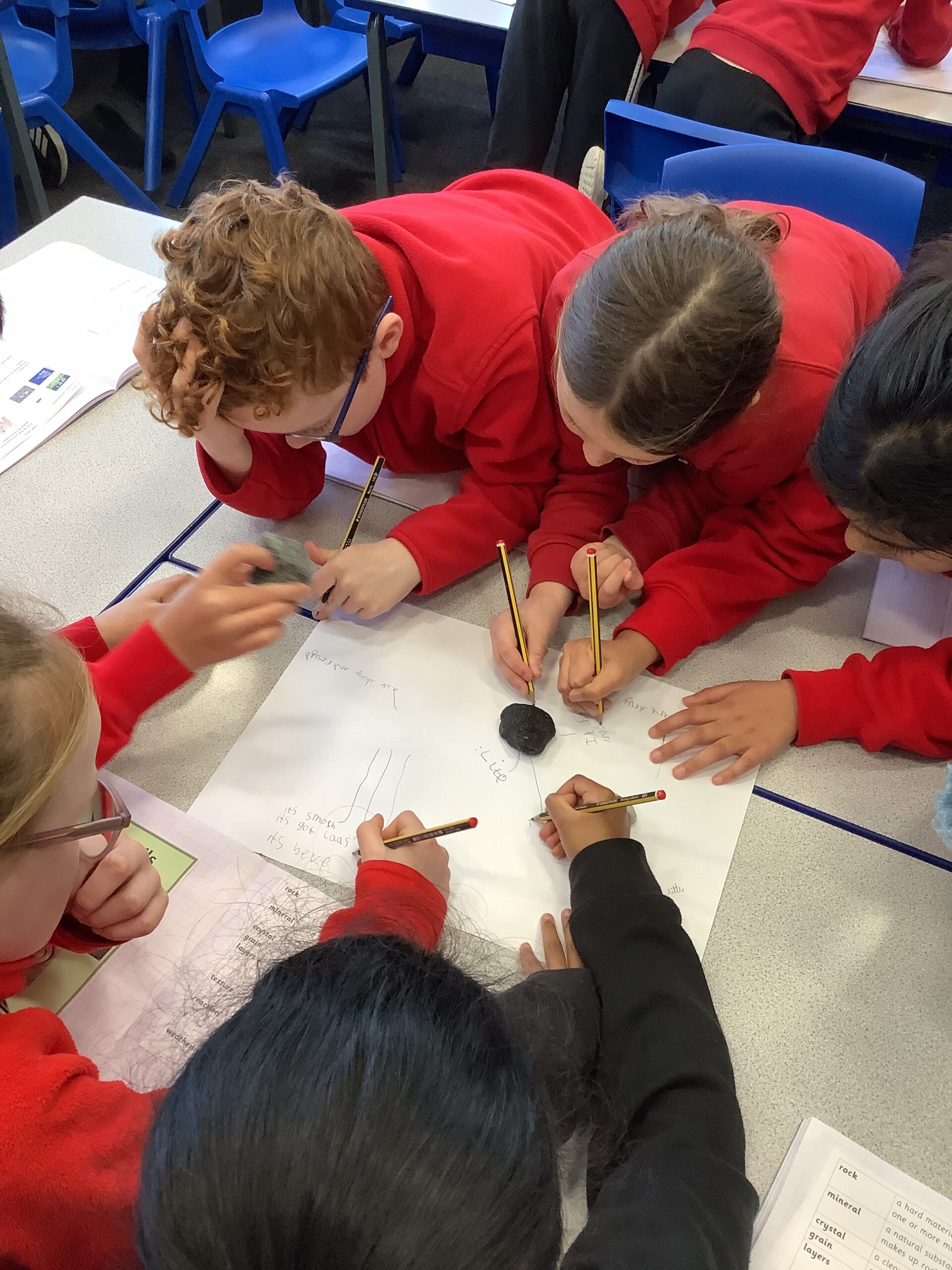
Next lesson, we’ll begin sorting the rocks into groups based on their appearance and characteristics. Help at home by describing chalk. What does it look like?