
Poetry Picnic
Each week, we will learn a new poem and will recite this poem every day. By saying the poem out loud, we can focus on the sounds and rhythm of each word or line. We talk to the children about how this can help us become better readers. This week’s poem is called Breezy Weather.
Breezy Weather
Breezy weather. Freezy weather.
When the leaves fall, we all fall together.
Breezy weather. Freezy weather.
When the wind blows, we huddle together.
Here’s a video of us performing the poem. Apologies about the shaky camerawork – I can’t record and do actions at the same time!
Science: forces
This half term in Science we have been learning all about forces. This week, we investigated air resistance using bin bags. First, we ran across the Green as fast as we could and recorded our time. Then, we did the same run but this time we held a bin bag above our heads. We found that we ran slower whilst holding the bin bag. We deduced that this must be because when we were holding the binbag it increased the air resistance and therefore slowed us down.


Help at home by discussing the vocabulary (below) that we are using in Science for our forces topic.

Living and Learning: rights and responsibilities
This week, Year 3 have been talking about rights and responsibilities.
The children discussed what rights they have and that these rights come with responsibilities. Here’s what we came up with:
I have the right to learn and go to school. I have the responsibility to help others learn while at school.
I have the right to clean water. I have the responsibility to not waste water.
I have the right to share my religion. I have the responsibility to be respectful about other religions.
I have the right to feel safe. I have the responsibility to make others feel safe.
I have the right to feel happy. I have the responsibility to make others feel happy.
Help at home: What other rights and responsibilities can you think of? See how many you can list with your child!
Questions
This week, we’ve been learning all about questions (This is a YouTube link. Top tip for watching YouTube with your child: go to the settings cog along the play bar and turn off autoplay – this avoids an inappropriate clip coming up automatically, and helps to discourage your child from passively watching clip after clip). We learnt a question is a sentence that ends with a question mark and we discovered that many questions begin with words such as what, who, when, how, why or which.
We then came up with our own questions to ask Giraffe, the main character in our class novel. After writing them down, we had fun playing a game of hot seating. In this activity, the children took turns stepping into the role of Giraffe and answering questions as if they were him.


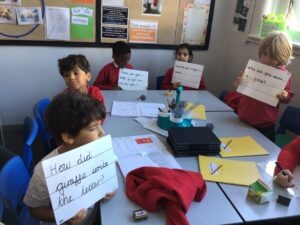


Help at home: Think of three interesting questions to ask giraffe or another character from the book.
Reading Records
At Moortown, reading records help us to celebrate our love for reading. As a reminder, here is the key information you and your child need to know:
- Each time one of the children signs out a new book to read from the library, they can make note of these in their reading record and rate them out of 5 stars.
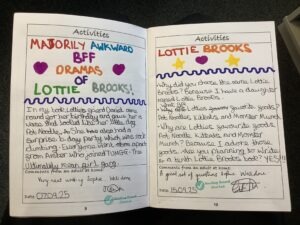
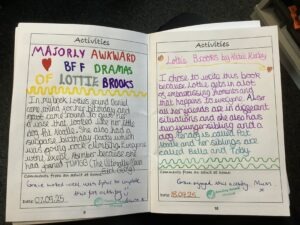
- Every Friday, I chose an activity for the whole class to complete in their reading record. More information on these activities is found inside the record.
- The children bring in these reading records every Friday for our Book Club lesson where we’ll discuss their books and develop their love of reading.
- Please accompany your child’s weekly activity with a short comment sharing with us the reading your child has been doing at home.
Take a look at some fabulous activities Year 6 have completed so far:


Reading: The Spider and the Fly
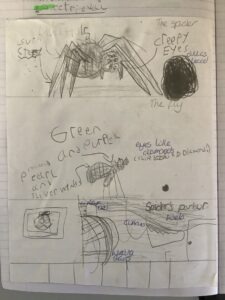
This week – in Reading – we have been looking at the poem ‘The Spider and the Fly’ by Mary Howitt. We have looked at a range of different skills but in today’s lesson the children used their retrieval skills to draw and label the characters and setting.


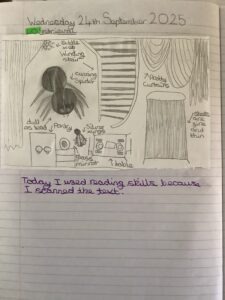
Help at home: Find out about the poet Mary Howitt. Are there any more poems you like of hers?
Living and learning: manners and courtesy
Manners are words and actions that we can do to help us be kind and respectful to others. Good manners help us to get on well with others.
We thought about examples of good manners and we did some role play to model these good manners.

We linked our daily poem to manners to reinforce this important aspect of Living and Learning.

Help at home: reinforce this message about using good manners at home as well as at school. Encourage your child to greet the adults on the gate as they arrive at school.
Also, have a go at this manners quiz to check your child’s understanding.
Leeds Rhinos play offs
PLAY OFF ACTION RETURNS TO AMT HEADINGLEY
Following the conclusion of the regular season Leeds Rhinos will take on St Helens in a mouth-watering elimination play off at AMT Headingley Stadium on Saturday 27 September 2025, kicking off at 8pm.
Tickets are on sale now at Leeds Rhinos – Online ticket sales
We hope that you will join us for what promises to be a fantastic occasion as we aim to get within 80 minutes of the Grand Final at Old Trafford.
Further info can be found here Play Off Eliminator tickets on sale now

Living and Learning: rights and responsibilities
This week, our L&L statement was: I know that rights come with responsibilities.
We had a brilliant discussion about how we all have rights, however these come with certain responsibilities. As a class we came up with some rights we have within school and the responsibilities that come with these:
- We have a right to playtime but a responsibility to play safely and respectfully.
- We have a right to learn but a responsibility to be great learners.
- We have a right to eat lunch but a responsibility to be respectful and polite to the lunchtime staff.
- We have a right to use the classroom equipment but a responsibility to look after it.
- We have a right to share our opinions in circle time but a responsibility to do so respectfully.
After, we looked into some children’s rights in the UK:

Help at home: Watch this video: https://www.bbc.co.uk/bitesize/articles/zqgm7yc#zmghp4j and ask your child what rights and responsibilities they have at home (eg. they have the right to play with their toys but a responsibility to do this safely).
Learning at home
Your child should now have their new e-book login and a reminder of their Numbots login (same login as Year 1). These can always be found inside their reading record book.
Reading
At the end of each week, your child will be set the book they have been reading in school. This can be accessed on the Collins e-book app. Please ensure this book is read at home and a comment is added to your child’s reading record book. Reading record books should be brought back to school by Wednesday of the following week.
Numbots
The children do use Numbots in school but regular short periods of time spent on this at home will help to support the children’s addition and subtraction knowledge across the year. Certificates are awarded every Thursday where children have earned their next level. We’ve had plenty so far!
Spellings
Each week, the children will be given eight spellings and these will be tested the following Friday. The spellings can always be found on the Year 2 spellings page. They will be a mixture of words from our phonics learning and also some tricky words. This spelling guide gives you some ideas for how to learn these spellings with your child. They will know their weekly score so please ask them how they have got on.
We have also been checking the children’s spelling of the Year 1 tricky words and your child has brought this learning home to show you which of these words they need to practise at home.
Handwriting
The children are practising our cursive handwriting daily following the letter sequence in our handwriting guide. This will support the children when we start to join our letters. Please use this at home to practise handwriting so the children can apply this in their writing at school.
Thank you for your support with your child’s learning at home and if you have any questions, please do come and ask!