
Maths: Translation
Today, Year 6 have been looking at translation in maths. They have been moving shapes on coordinate grids with four quadrants. Next, we’ll move on to reflection of shapes.
Help at home: Have a go at these true or false questions.


Year 4 class assembly!
Year 4 have been given their scripts to prepare for their class assembly next week! It would be brilliant if over the weekend your child can try to learn their lines off by heart for Wednesday.
We can use our oracy skills (speaking and listening) to make sure our performance is as strong as possible:
- project our voices loudly and clearly
- keep eyes on the audience
- read with expression
- good posture and open body language
We’re looking forward to seeing you there, if you can make it!
Help at home: practise your child’s lines with them.
Topic Drop Down Morning
This morning, we’ve had a lovely time revisiting some of our History, Geography and DT learning from Year 1.
In History, we recapped two heroes — Nelson Mandela and Leonora Cohen. The children really wowed me with how many facts they remembered about both significant figures.
In Geography, we recapped the seven continents and looked at the four countries that make up the UK, labelling their capital cities. Once again, the children did this confidently, demonstrating fantastic remembering skills (one of our 8Rs for learning).


Finally, in DT, we explored the design process and discussed how it’s a continuous cycle of planning, making and evaluating. We talked about how this needs to be repeated, as designers are constantly evaluating their work until they’re happy with the final design. We also tested the stability of three different structures and found that the cylinder was the most stable.


What a fab morning of learning we’ve had in Year 2! ✨
Maths
Year 3 are coming to the end of their numbers to 1,000 learning.
We’ve been using the method below to add and subtract to and from a multiple of 100 and 10.
“400 is a multiple of 100 and 10 because there is a zero in the ones and tens column.”
“240 is a multiple of 10 because there is a zero in the ones column.”

By partitioning the multiple of 10 – 240 – into 100 and 140, we can more easily subtract 60 from 140.
14 tens – 6 tens = 8 tens
140 – 60 = 80
100 + 80 = 180
To make these trickier calculations more straight forward, it helps if your child can recall these number facts. Help at home by practising these number facts at home with your child.

Year 3 class assembly
This week, Year 3 are preparing for their class assembly!
We listed how we can make our performance the best:
- project our voices
- eyes on the audience
- read with prosody
- open body language
Some children already know their lines off by heart by rehearsing them over the weekend. I’ve challenged the class to see if they can all be off scripts by Wednesday.
Help at home by practising your child’s lines with them.
We’re looking forward to seeing you there, if you can make it!
History – Invitation for grandparents
As part of our History topic, Toys and Games, we’d love to invite a grandparent into school on Tuesday 03 February at 1.20pm to share memories of the toys they played with during their childhood.
During the visit, the children will ask questions such as:
-
What was your favourite toy when you were growing up?
-
What materials were toys made from in the past?
If a grandparent or family member is able to spare some time to join us, we’d be delighted to hear from you. Please contact the school office or speak to Mrs Palmer if you’re able to help.
Living & Learning: emergency services
Today in L&L, Year 4 were learning all about the emergency services. We began by defining what an emergency is and how would we know if we’re in one.
An emergency is a serious, unexpected, and often dangerous situation requiring immediate action.
In the UK, we have four emergency services who are highly trained people whose job it is to keep us safe from danger:
- Fire Service
- Police Service
- Ambulance Service
- Coastguards
We spoke about what we should do if we’re ever in an emergency…
CALL 999
In the UK, we call 999 in an emergency. However, if you call the American number (911) you’ll still get put through to 999.
After discussing how a 999 call goes and how to make a good one, we used this to practise making the calls. One of us was the caller and the other was the handler.


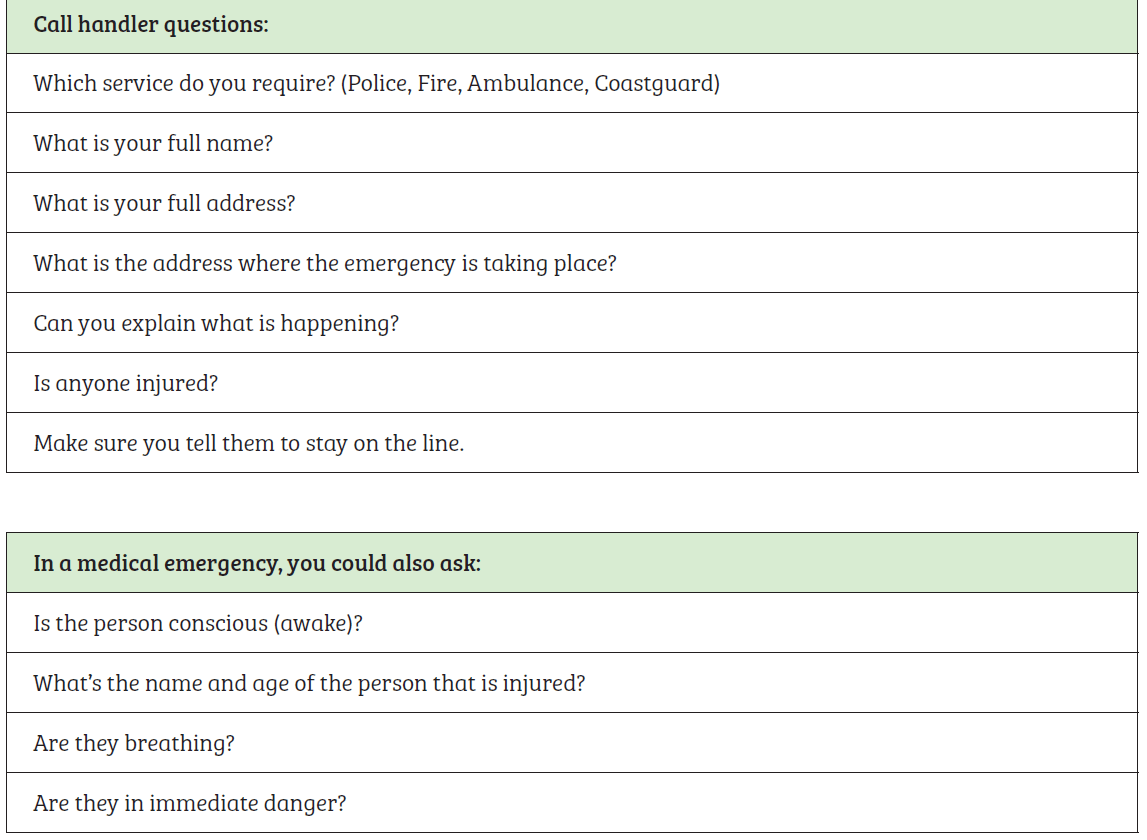
Help at home: practise a pretend 999 call with your child.
Packed lunches
Does your child have a packed lunch at school? If so, please download our Guide to Healthy Packed Lunches.
Did you know that popcorn and whole grapes are a choking hazard for children under 5? Lot’s of people don’t! The Food Standards Agency. has published the following advice on how to prepare food safely for your young child.
Living and Learning: rule of law
In our Living & Learning lessons, for the past few weeks, we have been thinking about the different British Values (Democracy, Respect & Tolerance, Individual Liberty and Rule of Law) and how they affect us.
This week, our focus has been rule of law.
First of all, we used this opportunity to recap our school rules.
We’re respectful.
We’re safe.
We’re ready.
Whether rules are at home, school or out and about, they are there to keep us safe and to make things fair. We should respect these rules.
We considered the consequences of not following rules and laws.
You might get into trouble.
You would get told off.
You might hurt someone’s feelings.
It could be dangerous.
Finally, in our Philosophy Friday session, we thought about what it would be like to live in a place with no rules and laws.
People wouldn’t respect each other.
It wouldn’t be safe.
Cars would travel too fast.
We could use matches which are dangerous for children.
People would get hurt.
Help at home: think about different rules that you might have at home. How to they relate to our school rules?
Poetry Basket: Jack and Jill
This week’s poem is a well-known nursery rhyme, Jack and Jill.
Who knew that paper and vinegar was a remedy for a banged head?!