
Maths: Shapes and Patterns.
This week our wonderful Year 1s have been learning about shapes and patterns. In this lesson the children learnt that we can put shapes together to create patterns. They explored and experimented with different shapes to see what patterns could be made. Here are a few of our favourites: 


We’re artists!
In Art this half-term, Year 4 are learning all about Wassily Kandinsky and Martha McDonald Napaltjarri.
Today, we explored using a wax resist to create our own artwork inspired by Kandinsky and Napaltjarri’s work.
Wax resist: a technique where wax is used to create a pattern which is then covered in water-based paint to create a desired effect.
We began by drawing a series of overlapping shapes with crayon to act as our wax resist. Once we were happy with our design, we used watercolour paint to wash over our crayon and watched the wax resist work it’s magic!

I was really impressed with how these came out!


Help at home: explore some of Kandinsky and Napaltjarri’s artwork online. Can your child identify any visual or tactile elements (shape, pattern, texture, space etc.) included in their work?
Food technology: leek and potato soup
Today, Year 3 made leek and potato soup. We worked in small groups to prepare the ingredients and then cook them, ready for blending.
We made sure that we washed our hands and wore our aprons for hygiene reasons. We used the bridge cutting method to cut the onion and potatoes into small chunks. We also used the claw cutting method to cut up the leeks after we’d washed them. These methods are the safest way to cut food as they keep us from hurting ourselves!
We then fried the onion and leeks together and added the potatoes and stock. We left it to boil for 20 minutes and we used a hand blender to purée the soup.
Everyone tried to soup but we had some mixed reviews…
“I loved the leek smell and taste.”
“I didn’t like the sloppy texture.”
“I liked the flavour.”
Year 3 did a fantastic job and the soup tasted great!

Help at home by having your child show you the bridge and claw cutting methods.
English: expanded noun phrases
In our English lessons, we’ve been exploring the story Not Now, Bernard by David McKee. We’ve really enjoyed retelling the events and sequencing the key parts of the story. Inspired by Bernard’s encounter with the monster, we’ve been creating our own monster-themed writing. We’ve been using expanded noun phrases to describe the creatures, such as:
the ugly, mean, sly monster
the unkind, evil, cross ogre
the horrible, scary, cross ogre
Today, we read a short paragraph describing a monster named Dink. As we read, we had to draw what we imagined he looked like. We had great fun comparing our illustrations and seeing how differently everyone pictured him!


Help at home: Use some expanded noun phrases to describe the monster.

Maths: rounding
In Maths, Year 4 are currently rounding. We’ve practised rounding to the nearest thousand, hundred and ten.
We’ve learnt a little rhyme to help us remember when to round up and when to round down….
Zero to four, DOWN to the floor.
Five to nine, climb UP the vine.
When rounding, we must identify the place value column we’re rounding to and check the decider digit to the right to see whether we need to round up or down.
When rounding to the nearest thousand, we must look in the hundreds column…

When rounding to the nearest hundred, we must look in the tens column…

When rounding to the nearest ten, we must look in the ones column.

Help at home: Can you round this 6438 to the nearest thousand, hundred and ten?
Poetry Picnic: Shoes
This week’s poem is called Shoes.
There’s a lot of vocabulary that we’ve focussed on when learning this poem: dim, lonesome, tossed and pair.
Try to use some of these words at home to help pupils to remember them.
Science – What is a rock?
During our Science lesson on Friday, we began our new Chemistry learning. We’re chemists this half term while we study rocks, soils and fossils.
What is a rock?
A rock is a hard material made from one or more minerals.
We made some careful observations about 12 different rocks during the lesson. The children used words like texture, grain, layers and crystals to describe the rocks.

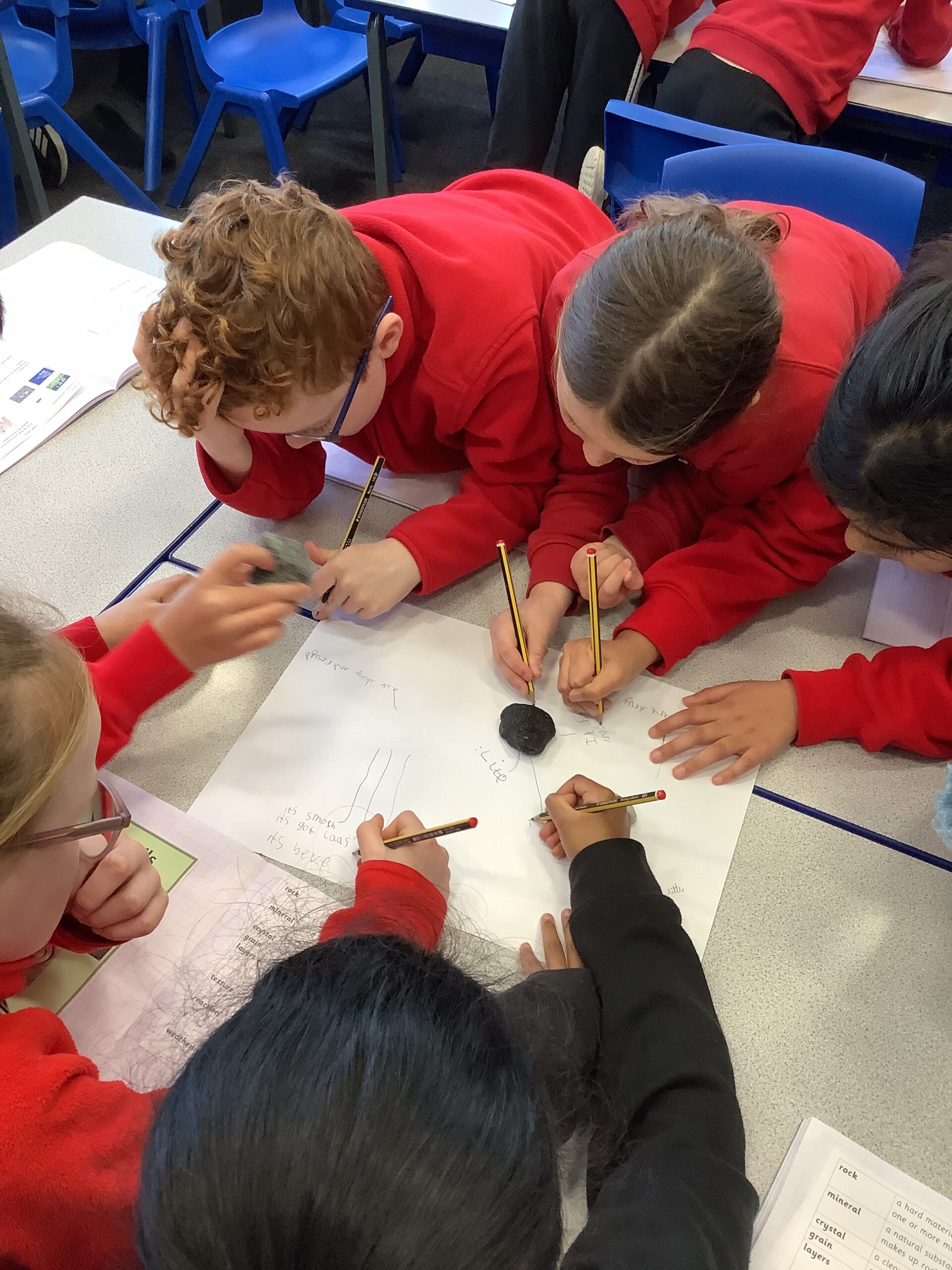
Next lesson, we’ll begin sorting the rocks into groups based on their appearance and characteristics. Help at home by describing chalk. What does it look like?
Maths: Nets of 3D shapes
In maths, Year 6 have been looking at shapes and their properties. They have focussed on angles and how to draw triangles; nets for 3D shapes; and will be going on to look at areas of different 2D shapes.
In our nets lesson, the children explored different nets to see that when folded if they would make a cube or not.


They then used this website to look at different 3D shape’s nets.
Help at home: Make a net for a 3D shape out of paper. Can you fold, cut and stick carefully so that it makes a successful 3D shape?
Science: Complete or Incomplete?
In our last science lesson, Year 6 looked at is a series circuit was complete or incomplete. The children created circuits and then had to reason if they were or not. Did you know that the current in a circuit will not flow if it is not complete?
Help at home: Are these circuits complete or incomplete? How do you know?


Hepworth Gallery
Today, Year 1 and 2 had great school trip to the Hepworth Gallery in Wakefield.
First of all, we took part in a print-making workshop which included looking at some Barbara Hepworth sculptures and finding inspiration from their shapes. There were some great outcomes and the children enjoyed seeing all their masterpieces.


We spent the afternoon looking around the garden, the different galleries and sketching some of the sculptures. There were a variety of pieces of art and sculptures to see with different textures, shapes and colours. We even got a sneak preview of the new exhibition opening tomorrow at the gallery.
The children were complimented for their excellent behaviour and engagement with all the activities. Well done, Year 2!