Science: Does the amount of seeds affect the growth of a plant?
Does the amount of seeds affect the growth of a plant?
Year 3 have set up a test to see whether the amount of seeds in one pot affects the growth of a plant and more specifically a dwarf sunflower!
What are we measuring?
We are measuring the height of the plants in centimetres every week.
What are we keeping the same?
We are keeping the size of the pots, the amount we water them and conditions (windowsill) the same.
What are we changing?
We are changing the amount seeds in each pot: 1, 2, 4, 8 and 12 seeds per pot.
We went out in the sun to plant these and to plant our own individual sunflower seeds too!
The children will measure how these grow over the weeks and take them home.
Check back here to see updates!
Help at home by predicting what you think will happen to our 1, 2, 4, 8 and 12 seeds’ growth.
Living and Learning: the importance of exercise
Our latest Living and Learning sessions have been all about the importance of exercise and how we need to keep active to keep our bodies and our minds healthy.
During the school day, here’s some ways we move our bodies:
Travelling to and from school by walking, bike or scooter
Wake Up Shake Up
Running around at playtimes
PE: basketball
The NHS guidance states that children and young people should ‘aim for an average of at least 60 minutes (30 minutes in school and 30 minutes out of school) of moderate or vigorous intensity physical activity a day across the week’. We know that the exercise we need to do to achieve this, should increase our heart rate.
We spent part of our lesson moving our bodies!

Help at home – try a new physical activity out of school – maybe a local junior park run, tennis lessons or have a look at our local physical activity guide for more ideas!
Maths: column addition
Year 3 have recently learnt how to add two numbers using column addition. Column addition is a great method for when we aren’t able to use reasoning and mental maths to help us add numbers together.
Top tips:
- Use HTO to help you line up your numbers.
- Use one digit per box to keep it neat and tidy.
- Always start adding from the smallest value column!

This is what your working out might look like if each column adds up to 9 or less.
We have then learnt what to do if a column totals 10 or more! We use these facts to help us:
10 ones = 1 ten
10 tens = 1 hundred
We must exchange the 10 ones for 1 ten and mark it underneath our answer box and do the same for 10 tens exchanged for 1 hundred.
Help at home by practising this method. Can you add two 3-digit numbers using column addition?
Herd Farm 2026!
We’ve just got back from our Year 4 residential to Herd Farm and it was brilliant! One of the reasons we like to take the children on a residential visit is to find out more about the children outside of school as well as the obvious opportunity to experience the adventurous activities. This year was no different – we see a whole different side of the children and love having a laugh with them outside the classroom!
It was an amazing visit and the children were fabulous. There were hesitations and nerves about some activities but everybody gave it a go and a lot of them surprised themselves. This is what they got up to…


We hope you had some very happy (and tired!) children tell you all about it!
Guided Reading Week 3
Here are the target pages for this week’s guided reading. These need to be read by Friday 8th May.
Ghost Hunter– up to page 160
Kensuke’s Kingdom – up to page 117
Two weeks with the Queen – up to page 95
How to train your dragon – up to page 159
Spy fox– up to page 127
Considine Curse – up to page 137
Science – reversible changes
This week in Science, we have been looking at reversible changes. We mixed sand with water to create a mixture. Then, we separated the mixture using filter paper which captures the sand and let the water pass through.
Next, we dissolved some salt in some water. This made a solution so we couldn’t just filter the salt out. We decided that we wanted to test if we could use evaporation to separate the salt and water. We poured our solution into a petri dish and left it on the window sill to see what happened.
We observed the changes over the next few days, making sure we recorded our findings in our books. We were very excited to see the salt reappear.


Help at home by talking to your child about their experiment. Is there any other time they have seen evapoartion?
Living and Learning: Being Safe
We took part in the NSPCC Speak out Stay Safe online assembly.

During the assembly, it highlighted children’s rights and gave the clear message of ‘Speak out, Stay safe’. The children were confident at identifying who their own trusted adults are and felt comfortable that they could ask for help.


We also heard about Childline – ask your child to show you the way to remember the number.

To follow up this learning, we welcomed staff from NSPCC to deliver a ‘Speak Out Stay Safe’ workshop. They were very impressed with the children’s learning and understanding.
Help at home: Discuss who your child would speak to if they needed help and/or visit the Childline website, which has age-appropriate advice for primary school children on topics such as bullying. It also has games and other interactive tools.
Summer 1: Week 3
This week, we’ve been enjoying the story The Bug Collector by Alex Griffiths.
In the book, George visits a wildlife museum and becomes fascinated by bugs. Inspired by his visit, he collects minibeasts from his garden and keeps them in jars—but soon notices they don’t seem very happy.
We had a thoughtful discussions about why:
The jars are closed, so the bugs can’t breathe.
The butterfly doesn’t have space to spread its wings.
They have no food or water.
They are not in the beautiful natural world.
They don’t have any room to move around.
This led us to explore the idea of habitats and why they are so important for living things.
Help at home: Can your child remember which habitats these minibeasts live in?

Thank you for sharing photos of your child’s home learning minibeast hunts—they’ve been a fantastic link to our story discussions!
Provision
Our construction areas have been especially popular this week, with children creating a range of fantastic models. Once they’ve finished building, we encourage them to photograph their creations using an iPad and add the pictures to the design books.
Here’s a selection of some of their amazing models—and their brilliant photography skills too!
 Caterpillar Update
Our caterpillars are growing nicely—some of us think they’re getting fatter, just like The Very Hungry Caterpillar! We’re really looking forward to seeing stage 3 of the life cycle happen next.
 Maths
Maths
This week, the children consolidated their understanding of the composition of 5, using their fingers to explore different ways of making 5 and recognising parts when some were hidden. We linked this to a familiar rhyme about monkeys/kittens jumping down from the bed, helping children visualise numbers decreasing.
We used this stem sentence to explain our thinking:
5 is made of ____ and ____; ____ and ____ make 5.

They also practised subitising (quickly recognising amounts) and explored how numbers 6 to 9 can be made as ‘5 and a bit’, using a range of practical resources and representations.
 Help at home: Re-enact the rhyme about monkeys/kittens jumping off the bed using soft toys and a simple ‘bed’ (e.g. a shoebox). Encourage your child to join in and use their fingers to show how many are on and off the bed.
PE: skipping skills
In PE, Year 2 have been practising their skipping skills ready for our festival coming up in June.
There are five individual skills: double bounce, single bounce, hop and swap, side straddle and side swing and two group skipping skills: run in jump out and keep the pot boiling.
We’ve been using our personal best records to keep track of our best scores and trying to improve them.


Help at home: skipping ropes are available to buy (£3) in class for children to continue their practising at home.
Topic – Geography explorers
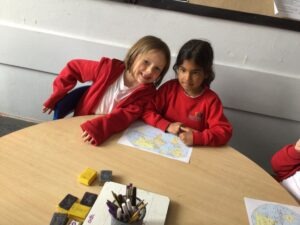
This week in our learning the wonderful Year 1s have been learning about the world we live in. Over the last two weeks, they have been learning about oceans and continents, and today they carried it on by learning all about the North and South Pole, the equator and the different hemispheres.
They did really well in this and were even able to identify countries from each hemisphere!
y